
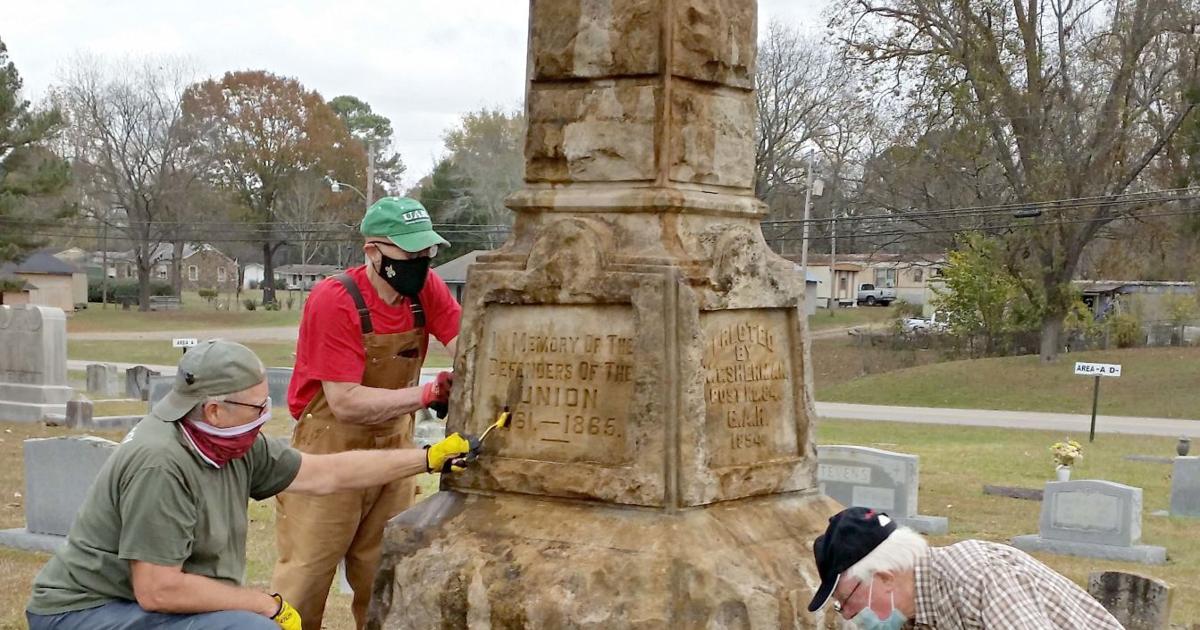
The United States haven’t always been united, and the most impactful demonstration of that over America’s 250 years has been the Civil War.
The four-year war that pitted the North against the South, neighbor against neighbor and brother against brother was the deadliest in U.S. history, reportedly costing the lives of up to 850,000 Americans less than 100 years after America had become a country.
The conflict from 1861-65 also established the trajectory of the disunited then reunited nation.
According to Civil War historian James McPherson, President Abraham Lincoln in his Gettysburg Address called the war a “testing” of whether a “government of the people, by the people, for the people” would thrive or “perish from the earth.”
“It did not perish,” McPherson, a professor emeritus of history at Princeton University, wrote in 2010 for Prologue magazine. “Northern victory preserved the nation created in 1776. Since 1865, no disaffected state or region has seriously tried to secede.”
Lincoln also mentioned a “new birth of freedom” in his address as the other fundamental problem resolved by the war, saying that “the monstrous injustice” of slavery had robbed “our republican example of its just influence in the world – enables the enemies of free institutions, with plausibility, to taunt us as hypocrites.”
“The institutions and ideology of a plantation society and slave system that had dominated half of the country before 1861 went down with a great crash in 1865 and were replaced by the institutions and ideology of free- labor entrepreneurial capitalism,” McPherson wrote. “For better or worse, the flames of the Civil War forged the framework of modern America.”
In the process, those flames reportedly consumed the lives of nearly 7,000 of the 60,000 Arkansans in the Confederate Army and close to 3,500 in federal service with the Union Army. White County Historical Society board member Scott Akridge noted that more of those died from disease than combat, but Arkansas saw its fair share of battles, including the Battle of Helena, the Battle of Arkansas Post, the Battle of Oak Grove and the Battle of Pea Ridge.
Whitney’s Lane
One of the lesser known of those battles took place in White County. Akridge and Emmett Powers wrote a book about it titled “A Severe and Bloody Fight: The Battle of Whitney’s Lane & Military Occupation of White County, Arkansas, May & June, 1862.”
There is a Civil War marker in Kensett about “The Action at Whitney Lane” that reads, “One hundred Texas Rangers and 50 local men on May 19, 1862, attacked a foraging party from the 17th Missouri Infantry (U.S.), a unit composed largely of German troops, fighting near here along Whitney’s Lane. Union losses were 22 killed and 33 wounded while four Confederates were killed.
“The attack convinced Union Gen. Samuel Curtis to abandon his advance toward Little Rock and instead march cross- country to Helena on the Mississippi. Arkansas’s capital would remain under Confederate control another year before falling to the Union.”
Ahead of the country’s semiquincentennial, Akridge shared more details about the battle with the Citizen that displayed both the resiliency and resourcefulness of the South and ultimately the futility of its effort and cause. According to Encyclopedia of Arkansas, it was “the first major contact between Federal and Confederate forces in Arkansas after the Battle of Pea Ridge on March 6-7, 1862.”
Akridge lives in Searcy but grew up in Kensett and heard stories from his family and others in the area about what they referred to as “The Battle of Whitney’s Lane, which supposedly took place just north of Kensett in the area of the Doniphan Lumber Mill.”
Akridge said his first interest in the Civil War sprouted from the stories he heard. “When I got in college, my master’s thesis was about a family from Mississippi County, during the Civil War, whose collection of letters was left to the Arkansas History Commission, the state archives,” he said.
“And then one day in the mid-’90s – my good friend, Bill Leach, was the former president of the White County Historical Society – Bill and Emmett Powers and I were sitting on the front porch of the log cabin at Pioneer Village and we were just rolling through topics of history of interest to us and one of us said, ‘You know, there’s supposedly that Battle of Whitney’s Lane but nobody’s ever written a book about it or nobody’s every written anything about it.’ And I think Emmett said, ‘If you’ll write the grant proposal and if we get a grant, I’ll help you write it.’
“… So we spent a year researching and writing that. Our original proposal was for a 50-page book and it turned out to be three times that long,” he said with a laugh.
The $3,000 grant came from the Arkansas Historic Preservation Program and paid for them to go to the Missouri state archives and to Waxahachie, Texas, where Akridge said there is a Confederate museum with some of the central characters who came up from Texas.
Akridge said he learned from his research that the Union Army had made its way around southern Missouri and down to Batesville in April and May of 1862 “after the Battle of Wilson’s Creek up around Springfield, Mo.” He said “it was the intention” of the Union forces to capture Little Rock and there weren’t many Confederate forces standing in their way.
“In April, much of the Arkansas Confederate force had made their way east to what would become the Shiloh, Tenn., battle, so they were around Corinth, Miss., just across the line, and the number of Confederates left to defend Arkansas was very little,” Akridge said. “But Texas troops were begging to arrive.”
However, he said that those troops “were a company here and a company there or a regiment here and a regiment there” amounting to a few hundred while Gen. Curtis’ Union Army of the Southwest had originally been 22,000 strong. And even though “before he gets to Batesville, the Union syphons off about half of them to send over in the direction of Shiloh, Tenn., they still had a 10,000- to 12,000-man army, still big enough to have easily have taken Little Rock.”
Curtis, though, “didn’t know exactly what was in front of him, and what the Confederates started doing was skirmishing here and there,” Akridge said. “A big part of their effort involved removing all the food and forage from the pathway between the Little Red River and Little Rock. They really couldn’t fight them in a head-on battle and so they were just going to try to starve them out, and that was kind of the strategy.”
According to Akridge, several factors came together so that it worked. He said there were small Confederate groups that would hit Curtis’ supply line of wagons between Batesville and Missouri. “The small number of Texas and Arkansas troops that were in White County were able to engage in several skirmishes that just made the Yanks keep their guard up but not advance forward because they literally thought that there was a larger amount of Confederates present than there really were.”
Curtis tried to get supplies on steamboats to come up the White River to Batesville, Akridge said, “and they could not make it due to both low water and Confederates shooting at them along the way. So a combination of factors resulted in Curtis abandoning the idea of taking Little Rock and instead went down the east side of the White River all the way to Helena.”
“So they do take Helena,” he said, “and then a year and three or four months later, they decided to try to take Little Rock and were successful in the fall of 1863 of taking Little Rock.”
In 1863 when the Union decided to move from Helena to try to capture Little Rock, Akridge said that “two Confederate transport boats were hiding out somewhere up the White River, and so three Union gunboats were sent up the White River. Two of them stop at the mouth of the Little Red and one comes up to Searcy and it finds the two transport boats and they capture the transport boats and put their own Union pilot on them and make their way back down the Little Red River.”
Akridge said he found it interesting that when Curtis’ army arrived in 1862, it used lumber from a local sawmill and logs as floats to build a type of floating pontoon bridge across the Little Red River at Searcy Landing. Then in 1863 when the gunboats came up the river and found those two Confederate transports, there is a statement made that they destroyed the pontoon bridge.
“They tore it up, and that’s a different bridge,” Akridge said, “so it had been rebuilt. It has only been in recent years that I learned about some Union troops that disembarked from a boat down around DeValls Bluff and they were sent up to Searcy in 1864 and there’s just a phrase in there where one soldier says, ‘We crossed the bridge at Searcy Landing,’ so whether it was Union or Confederate, everybody is using that crossing and they’re keeping a wooden, floating bridge across the river there, which is where the River Oaks Golf Course is now.”
By the time the gunboats had captured the transport boats and the bridge had been destroyed, “about 500 Confederates had succeeded in making it to the Little Red River on the west side and were shooting at it basically from a little below Judsonia all the way down past West Point,” Akridge said. “They’re shooting at the boats with small arms and the Union gunboat responds with basically what we call canister … firing along the west bank of the Little Red River.
“The largest of the Union gunboats that had remained at the mouth of the Little Red had begun coming up the Little Red River because they thought the other boat had been gone too long … and just below West Point, the USS Lexington unleashed, I think it was, 18 rounds of explosives, 8-inch across shells, and the quote from the captain was ‘We must have given them such a scare as they never had before’ for they, meaning the Rebels, left very suddenly.”
Akridge said while there was “that gunboat activity … it was the capture of the Confederate steamers – those were the last two boats on the White River, and that’s in 1863 – that ends Confederate boats going up and down the White River.”
“In 1864, the Union Army has Little Rock at this point – they captured Little Rock – so they’re sending out these expeditions, ranging in numbers from 500 troops up to as many as 3,000, up in the direction of White County for the purpose of really they were after some of the Confederate leaders in this area.”
He said Joe Shelby was probably “the No. 1 target,” but the Confederates were “just hiding out between Searcy and Augusta and up toward Jacksonport” and “basically they have real good knowledge of the landscape.”
“There was very little in the way that these Union forces were going to make any success in capturing all these guys who knew where all the swamp crossings were,” he said.
Measuring consequences
Overall during the war, Akridge said, it’s believed that “there were 17 companies of infantry raised in White County. That could be infantry and calvary. At full strength, there’s supposed to be 100 per company, however a lot of times they would be accepted into service even if they didn’t have that many. They might be accepted if they only raised 80 or so or whatever.
“One thousand, 500 men or so were raised from a county whose population at the time was maybe 5,000 … so it’s a significant chunk of the population [that] does enlist in the service.”
Akridge said the South’s strategy at the beginning of the war was trying to place a series of forts or large camps along the northern border of the South, around Pocahontas in Arkansas. Then there was a series of forts along northern Tennessee, the Kentucky line and continuing on east.
“That strategy is trying to build a defensive wall basically, and it didn’t work much in the same concept as say the Great Wall of China,” Akridge said. Stretching out forces across a long distance means the enemy only has to concentrate in one or two places and overwhelm them, and that was eventually what the Union Army did.
“First, Samuel Curtis here in the west and then Gen. [Ulysses] Grant and others, and, of course, when the Union captured the entire length of the Mississippi River, kind of cut off the west from the east, and then Gen. [William] Sherman marches through Georgia and cuts another third of it.”
The war in Arkansas, Akridge said, was a lot of guerilla fighting with the Union Army, based in Little Rock with a few outposts. He said one of these was in Batesville for a while. ’It just evolves into guerilla warfare, hit and runs in Arkansas as the war went on and that part had a much greater impact on the civilian population than did the larger battles.”
There are seven historical markers in White County that reflect both the war effort and its toll.
Akridge mentioned one at Searcy Landing at the River Oaks Golf Course, just before the pro shop and the parking lot on the right. There is one in front of the Gum Springs Volunteer Fire Department about the Confederate attack on Union troops at the creek just below where the fire station is, and Bald Knob City Hall has a marker about a Confederate Salt Works that was destroyed that was somewhere in the region between Bald Knob and Augusta.
“There’s some salty areas over there where they would boil the water and leave the salt,” Akridge said, “primarily for preservation of meat supplies and that sort of thing, and the Yanks found it. They use these extra large kettles and the Yanks punched holes in the kettles to render them useless.”
There also is a marker at West Point City Hall about the gunboat activity and a fiberglass panel marker was put up in the West Point Cemetery. “We were hoping to get 10 or 12 years out of it and it’s been there like 28 years now,” Akridge said with a laugh.
Akridge said that with the help of numerous others, he helped write the grants for the historical markers, and the matching funds for each of them were provided by community members and organizations that stepped up.
“I’m proud that we were able to do that because most of the counties across the state were only able to round up enough money to put up one, some two, but we got seven all together,” Akridge said, “related specifically to the Civil War, so that’s kind of a moment of pride. It carries over from the Civil War research we mainly did in the ‘90s.”
Akridge, who is a past president of the Arkansas Archeological Society, and Powers, also a member, researched and completed their book while serving as teachers at Riverview public schools. They have donated all proceeds from the book to the White County Historical Society.
The aspect of the war they covered in their book, though, is only a small part of the big picture of a nation in turmoil, going through dire growing pains, to become what it its now approaching its 250th anniversary.
In his Prologue article, McPherson quoted Samuel Clemens, aka Mark Twain, as writing in 1873 that the war “uprooted institutions that were centuries old, changed the politics of a people and wrought so profoundly upon the entire national character that the influence cannot be measured short of two or three generations.”
As McPherson wrote back in 2010, “we are still measuring the consequences of that cataclysm.”