
Barring a surprise trade in the next three weeks, when the Detroit Red Wings brass gathers for the NHL Draft on June 26, they will do so without having a first-round pick for the first time since 2012 and the first time since Steve Yzerman took over as general manager in 2019.
Detroit traded its 2026 first-round pick to the St. Louis Blues as part of the Justin Faulk trade in March, and while you can debate the trade’s merits with hindsight, all the Red Wings’ front office can do now is focus on maximizing what it can get out of its six picks in Rounds 2 through 7.
Certainly, not having a first-round pick ups the degree of difficulty for NHL teams. Round 1 remains the most reliable place for teams to find legitimate future talent. But still, year after year, at least a couple of teams manage to snag a real contributor outside the first 32 picks.
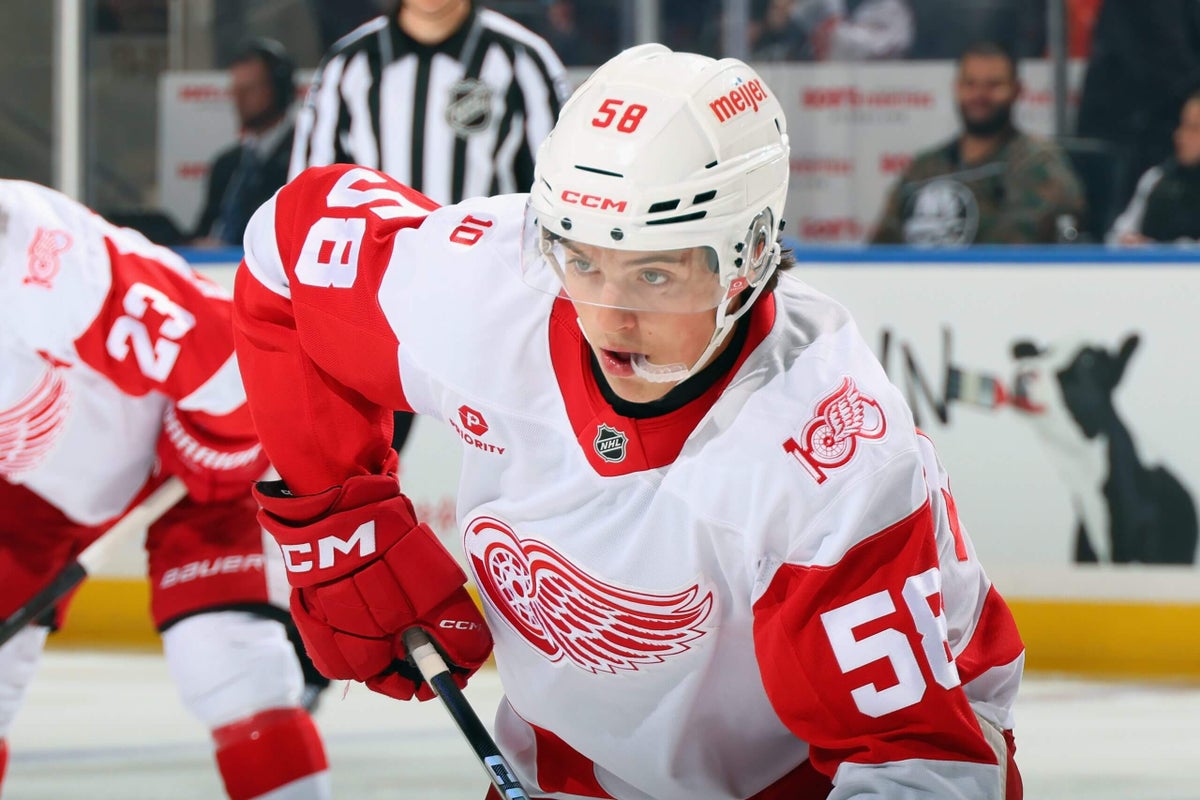
For the Red Wings, the 2025-26 season offered one such potential breakthrough, as Emmitt Finnie stepped into the NHL just two years removed from being picked in the seventh round. He managed to play 82 games and register 30 points, playing largely in Detroit’s top six. That’s already a successful pick for a seventh-rounder, let alone at age 20.
And the Red Wings needed it. Before Finnie, their drafts in Yzerman’s tenure had yet to yield much at the NHL level outside of the first round.
Notable Red Wings picks after Round 1, 2019-25
This table doesn’t represent every Red Wings pick after the first round since Yzerman arrived in 2019. They’ve made 58 of those — tied for the second most in the league in that span. However, these are the highlights: Every player who has reached the NHL, regardless of which team he played for when he did so, plus the ones who still appear to have good chances at doing so.
Immediately, there’s a theme. Only three have played a full season’s worth of games. Only six have reached the NHL. And of those six, four are now with other franchises.
Of course, trading prospects for proven NHL talent (as the Red Wings did with Donovan Sebrango, who was part of the trade for Alex DeBrincat) is a perfectly valid approach. But still, for a team with a draft-and-develop ethos, the relative lack of hits outside Round 1 so far has left the bulk of that burden on the Red Wings’ first-round picks. That’s not what you want.
However, it also hints at two realities inherent in drafting after the first round: How much harder it is to find NHL talent and how much longer it takes for those prospects to arrive.
Yzerman has been in charge for seven years now, and while that’s a long time in the NHL, it’s also not uncommon for a non-first-round pick to take four-plus years to reach the NHL.
Albert Johansson, who was picked in the second round of Yzerman’s first draft class in 2019, didn’t make his NHL debut until five years later, in October 2024. That’s stretching the limits, but players like Finnie, who was picked in 2023 and debuted in 2025, tend to be much more of the exception than the rule.
That colors the assessment here, and from the drafts in the chart above, some of the Red Wings’ most promising post-Round-1 prospects are still shy of those five years, with plenty of time to graduate.
That includes 2024 second-round pick Max Plante, who just won the NCAA’s Hobey Baker Award last season after turning 20 in late February. It also applies to 2023 second-round pick Trey Augustine, who won the NCAA’s Mike Richter Award as the nation’s best goaltender, and 2022 fourth-round pick Anton Johansson, who arrived from Sweden for the AHL’s Calder Cup playoffs and was very impressive.
Even Carter Mazur, who has debuted already but has been beset by injuries, just turned 24 and isn’t too far removed from a typical prospect timeline.
Those players will ultimately play a big role in how we look back on the past seven drafts for Yzerman and his amateur scouting staff, led by assistant general manager Kris Draper.
But right now, the results are limited. And even with those time factors (and the remaining prospects) acknowledged, it’s worth looking at what other NHL teams have gotten out of the second through seventh rounds of those same drafts in that span.
NHL drafting outside the first round, 2019-2025
Again, context is important, as the number of picks for each team is not evenly distributed across drafts. Teams that only recently pivoted into rebuilds, such as the Pittsburgh Penguins and New York Islanders, naturally haven’t had as much time for their second-rounders (and beyond) to progress.
And that matters: Only six total players picked after Round 1 in the last two drafts have reached the NHL, all of them from the 2024 draft. Stretching back a year further to 2023, that number is still just 23 across all 32 teams. So there’s plenty more time for this data to change, as more players arrive and thrive for their teams.
However, some patterns emerge from this sample nonetheless. One of them is that finding success outside the first round certainly seems to correlate with having a rising team.
Among the teams that have gotten the most games and points from their non-first-round picks in this span are Montreal, Anaheim, Utah, Ottawa and Los Angeles — all playoff teams this season, in many cases after undergoing long rebuilds.
There’s also Washington, which pulled off a stunning retool and was the top seed in the Eastern Conference a year ago, and Chicago, which should be one of the league’s next wave of ascending teams.
That all raises some concern for the Red Wings, who have made more picks in Rounds 2-7 over this span than any other team (tied with Montreal), and yet haven’t found the same level of contributors.
Detroit’s picks rank 21st in points in that span, and 18th in games played. That’s close to the middle of the pack, but it lags when you consider the number of picks they’ve made to get there, especially in the second round.
So, what are they lacking? The simple answer boils down to one true gem in the later rounds. Because when you break these numbers down further, the majority of the top teams’ results are being driven by just a couple of top players.
Since 2019, only four NHL teams have drafted more than three players outside the first round who have already reached 100 NHL games played. Only seven teams are above the Red Wings’ tally of two. So, throughout the league, it’s really the few true late-round difference-makers who provide the bulk of the counting stats measured here.
In Montreal, Lane Hutson alone accounts for 146 of the 269 points the Canadiens have drafted outside Round 1 since 2019. No other Montreal pick has, as of yet, reached 40.
In Anaheim, Jackson LaCombe is responsible for 230 of the Ducks’ 652 games — and 118 of their 225 points. The only other Ducks later-round pick from that span to reach 30 points so far is Olen Zellweger (51).
This can be done with more teams, too. Shane Pinto accounts for more than half of Ottawa’s 288 points. Matthew Knies makes up more than half of Toronto’s 305, too.
Most startlingly, Logan Stankoven alone has more regular-season points (96) than the Red Wings’ crop of Rounds 2-7 picks since 2019. But he is also the only player Dallas has drafted post-Round 1 to play even a single NHL game.
The Stars haven’t made nearly as many picks as Detroit in that span, of course, especially in the second round. However, it still speaks to how hard it is to find talent after the first round, and how important those true impact finds can be: Stankoven was the key piece Dallas traded for Mikko Rantanen.
Even for teams whose rankings aren’t so dependent on one player, such as Los Angeles (with Alex Laferriere, Brock Faber and Jordan Spence), Utah (J.J. Moser, Josh Doan and Mattias Maccelli) and Chicago (Alex Vlasic, Wyatt Kaiser and Louis Crevier), there aren’t teams nailing multiple later-round picks every single year.
Instead, it’s about finding one or two difference-makers, even if you end up simply using them in trades.
That’s true no matter how many picks teams make. Carolina, the team with the most picks after Round 1 in this time frame, is getting over 70 percent of its draft-driven point production from two players: Jackson Blake and Alexander Nikishin (though goalie Pyotr Kochetkov was also a nice find).
So, while the Red Wings grade out middling or worse in this time span, especially given their quantity of second-rounders, that could look dramatically different with just one or two big hits.
Finnie is already a hit and may become the first needle-mover, and Albert Johansson profiles as an NHL regular as well. But finding a Hutson, Stankoven, LaCombe, Moser, Knies or Doan would transform their results in a major way and is the best path to joining the upper third of the league.
Could Plante or Anton Johansson be that type of player? What about Augustine in goal? Or 2025 second-rounder Eddie Genborg, who had an excellent pro season in Sweden as a physical winger? They likely aren’t star-level, but there could be multiple real players in that group.
As for the older classes, the Red Wings’ 2020 and 2021 drafts, in particular, aren’t looking great right now, and that’s a problem given their timing at the start of the rebuild and the volume of capital expended on them. In 2020, Detroit made three picks in the second round. Of those three (William Wallinder, Theodor Niederbach and Cross Hanas), only Wallinder still has a chance to bring value to the organization.
Meanwhile, Mazur, a 2021 third-rounder, has a real path to a nightly role next season and likely would already have one if not for persistent injuries. But frankly, Detroit may need Mazur and Wallinder to hit to salvage their post-Round-1 classes from those years, especially with 2021 second-rounder Shai Buium having been scratched for the Griffins’ recent playoff run.
The 2022 class could eventually become similarly dependent on Anton Johansson, though Dylan James and Amadeus Lombardi both still have chances to play as well.
Recent history shows none of that is too surprising for a given year. It’s hard enough to pick the correct 18-year-old early in the draft, let alone one whom 32 teams have already passed on, in some cases multiple times.
What is clear, though, is that over a five- or six-year span, a successful team — assuming it hasn’t traded its picks — probably needs to find a gem or two outside the first round to rank among the league’s best.
The Red Wings didn’t do that early in their rebuild. However, when they convene for the draft in three weeks, with six picks to make, it’ll be another chance to take some swings.