
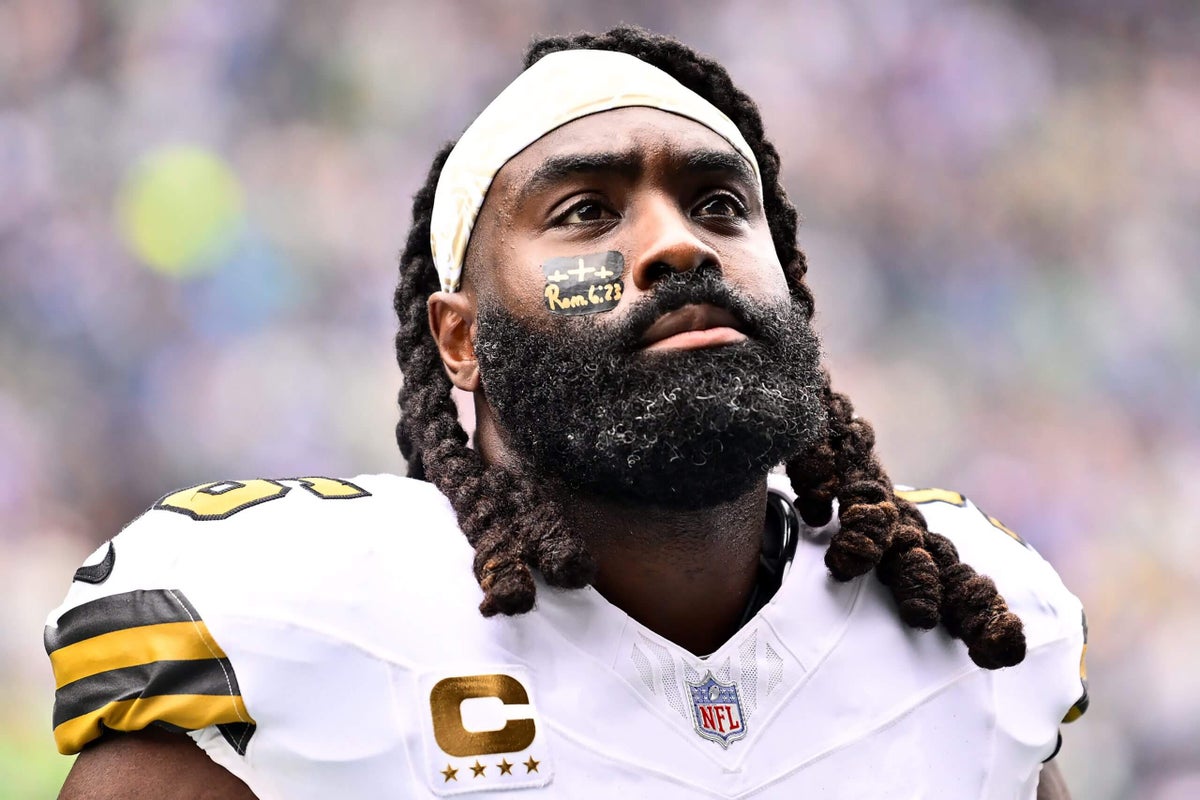
Harrison Phillips spent all of last offseason in an environment he loved in Minnesota, as part of a culture he understood, in a locker room filled with leaders and stars who he felt carried themselves the right way. He was part of a collective, not the head of one. Then, unexpectedly, he was shipped out just after training camp to a new organization, with a first-year coach and a collection of young players in desperate need of leadership.
One week after Phillips was traded to the New York Jets last year, the team announced its captains. It included a quiet quarterback (Justin Fields), an offensive lineman who was lost for the season with an injury before it even started (Alijah Vera-Tucker), a 25-year-old wide receiver who wound up only playing in seven games (Garrett Wilson), a defensive tackle who was traded at midseason (Quinnen Williams), a 25-year-old linebacker coming off a breakout year (Jamien Sherwood), and a special teamer with 14 games of NFL experience (Marcelino McCrary-Ball).
By the time Williams was traded, Phillips — by virtue of being a veteran with the comportment to speak up for his teammates — was catapulted into a role as a leader for the Jets. Maybe the leader.
“It’s a very long season and whether you’re riding high and feeling yourself on a five-game winning streak or you’re down in the dumps on a five-game losing streak, we can lean in on different leaders,” Phillips said. “When you don’t have as many, it can feel like dictatorship because he’s the loud voice in the room and we hear him all the time. It’s not his team, his defense, it’s ours. When you have enough leaders it is our team.”
That will not be the case in 2026. The Jets did their best to rectify their mistake, an aggressive youth movement at the detriment of experience and maturity. General manager Darren Mougey and head coach Aaron Glenn attacked this offseason with a plan to infuse the locker room with veterans who have been there before — and in a couple of instances, here before — and understand what it takes. Players willing and able to lead.
That includes safety Minkah Fitzpatrick, defensive tackle David Onyemata and quarterback Geno Smith. Phillips is back and Garrett Wilson is healthy.
But one addition in particular stands above them all. He is not above them, but his stature and experience stand out. So does the way he talks, the way he acts, the way he leads. He’s a coach on the field, the kind the Jets have been missing since C.J. Mosley walked away.
He’s 37 years old. They call Demario Davis “Double-D.”
Ask Davis the right question and you’ll get him talking for a while. His (re)introductory press conference in March lasted for 16 minutes, more than double the typical length. His answers are well-thought-out. His tone is rosy and warm, brimming with optimism. He sees the light, even here. He can’t believe he’s back with the Jets, the team that drafted him in 2012, and the team that let him go for the second time nine years ago. They didn’t value him then. They do now.
“Man can make all the plans they want in life but what’s going to happen to you in this world is not your say, so it’s how you respond to it,” Davis said this week. “I never would’ve thought I’d be back two times, let alone three. But for me, I always try to find a positive perspective and I guess this is just where I’m meant to be. I wouldn’t have it any other way.”
There are few players, at any position on any team, who have developed a greater reputation for leadership than Davis. It’s not only derived from his personality but also from the respect he’s garnered on the field as one of the NFL’s best linebackers since the Jets let him leave in 2018. The Saints reaped the benefit, and Glenn saw it firsthand as New Orleans’ defensive backs coach from 2016-20 (Glenn was also an assistant with the Cleveland Browns when Davis was there in 2016, and a Jets scout in 2012 when Davis was drafted).
In New Orleans, quarterback Drew Brees used to lead the pregame huddles. When he missed extended time in 2019 and 2020 due to injuries, Davis filled in.
Before an early-season game against the Seahawks in 2019, sans Brees, Davis told his teammates that it was “time to hunt” — and that a hunt has three parts.
First is the prowl, when you study your prey. Second is the kill, where the violence comes in. “When you see your opponent today,” Davis said, “look into his eyes and take his soul.”
The third: Eat. “That’s the whole reason why we hunt,” he said. “When one of us eat, all of us eat.”
And that’s how he ended it: “Let’s go eat!”
The Saints won that game, the first of a six-game winning streak in 2019. Davis led the pregame huddle in five of them.
Six years later, Davis still carries that energy.
“Double-D has this sense of — he’s just strong,” Phillips said. “He’s convicted and strong. He can lead by example, he can lead vocally, he can lead by running through someone’s face, he can lead with compassion and touching somebody because he’s such a child of God. He’s just an amazing role model for players to lean into.”
Fitzpatrick called him a “great man.”
“He just loves ball, loves people,” Fitzpatrick said. “He’s a very genuine person, genuine man and he’s a guy that has a heart for football — and a nose for the football. It’s exciting to just talk ball with him. He’s a guy that’s seen a lot of ball, has a high football IQ, and the conversations we have, you can’t have with everybody. It’s an honor and a blessing to play with a player like him.”
The Jets have had nearly perfect attendance throughout the offseason so far. The vibes are good, the energy is positive and Davis is leading the way. The Jets are hoping he can be the positive influence on Sherwood that Mosley was before him. With Mosley gone, Sherwood struggled to assume a leadership role last season; now he can go back to flying around and making plays rather than worrying about getting everyone else lined up while wearing the green dot. Davis has made it one of his missions to help Sherwood reach his potential. On Tuesday, he went out of his way to praise Sherwood for his explosiveness and sideline-to-sideline athleticism.
He loves mentoring him. And he loves doing it in a Jets uniform.
“I’m playing with a coach I believe in,” Davis said. “We’ve been together for a long time. I’m playing with a locker room full of brothers that I enjoy being around every day.
“It’s a lot of fun showing up to work every day.”
Davis is weathered, but his skills have not withered.
There isn’t tackling or full contact in drills this time of the year, and the Jets are working more on game situations than on operating as if they’re playing a full game. And yet it’s hard not to spot Davis at the end of just about every running play. Davis intercepted Smith during team drills on Tuesday — infamously, the Jets defense failed to intercept a pass all of last season. When Smith hands the ball off to Breece Hall or Braelon Allen or Isaiah Davis during 11-on-11 drills, often the running back is met at the line of scrimmage, or just beyond it, by the 37-year-old linebacker who clearly has something left in the tank. A lot, maybe.
You don’t earn a $22 million contract in Year 15 if your skills are diminishing. And Davis’ skills are still there, and just as important to the respect he garners in the locker room.
Think about this: Mosley retired last offseason at 33 after a stellar career during which his body failed him at the end of it. Here’s what Davis has accomplished in four seasons since turning 33:
• He’s fifth among all defensive players in run-play tackles, per TruMedia. He finished third in that category last year, behind Jack Campbell and Bobby Wagner.
• He’s played at least 97 percent of the defensive snaps in those four seasons and missed one game.
• In 2025, at age 36, Pro Football Focus had him graded as the fifth-best linebacker in the NFL (minimum 500 snaps) and sixth-best in run defense.
• He made the Pro Bowl at ages 33 and 34.
Davis’ ability to age gracefully is “God-given”, Glenn said. “It’s not for everybody. You have to give him a lot of credit.”
Phillips, 29, pointed out that “I’m younger than he is,” even if he felt that way as part of last year’s youthful Jets locker room. “If I’m waking up like: ahh, I got this this and this — and he’s out there, I don’t have much ground to stand on. He’s played more snaps in this league and he’s still out here doing the same things … if we got guys in year 15 doing it, what can these guys in year two really say? It’s, oh hey I have to find it too.”
Davis will slow down at some point. His age will eventually catch up to him. It just hasn’t happened yet.