
Horst and Karen Pfeifer have created their own tranquil universe off a busy highway in Ponchatoula.
From the road, there is no indication of what might lie behind the massive metal gate that opens to reveal a 30-acre spread of manicured lawns, eclectic and diverse gardens, statues and sculptures, a lagoon, an island, fountains, ponds and herds of frolicking wildlife for which they are granted an annual license by the Louisiana Department of Wildlife and Fisheries.

A waterfall flows into a lagoon surrounded by a tranquil garden.
PHOTO Jeff Strout
Horst Pfeifer, a celebrated European master chef, and Karen Pfeifer, his spouse, business partner and a textile artisan, designed their Mediterranean-style home with the assistance of the firm of architect John Williams. It was built to their specifications in 2016.
“We agreed we did not want a house larger than 3,000 square feet,” the chef said. “When I saw the plans Karen was working on, I said, ‘This looks a lot bigger than 3,000 square feet!’”
The 5,500-square-foot house is built of old brick clad in warm bisque stucco. The roof looks like Spanish terracotta tile. Deep, brick-floored galleries under exposed timber rafters surround the home, which is dominated by an open central space with ceilings rising to 25 feet. The home was designed with entertaining in mind.
Upon entering the home through a pair of 10-foot wooden doors, one first encounters a chandelier made from hundreds of yards of thin rope. Karen Pfeifer designed it on the fly as she worked to install it from a scaffolding system. The languorous flow of the textile chandelier softens the rustic effect.
“It used to flow all the way down and puddle on the floor,” she said, “but it got to be too much.” Now, the tassels that form the base of the chandelier stop about 36 inches above the heated ceramic floor of wide planks in a pale gray ash finish.
The open space is dominated by a woven chandelier made from hundreds of yards of thin rope that Karen Pfeifer, a textile artisan, designed on the fly as she worked to install it from a scaffolding system. It hangs from the 25-foot ceiling above. Below the chandelier are a pair of whimsical dogs, one yellow and the other green, crafted entirely of rubber rain galoshes by a French artist.
PHOTO Jeff Strout
On the floor below is a pair of whimsical dogs, one yellow and the other green, crafted entirely of rubber rain galoshes by a French artisan. Throughout the home and garden spaces are works by numerous artists, including Kim Zabbia, Garland Robinette, Cissie Wessel, Dolan Geiman, Dale Rogers and Tricia Robinson.
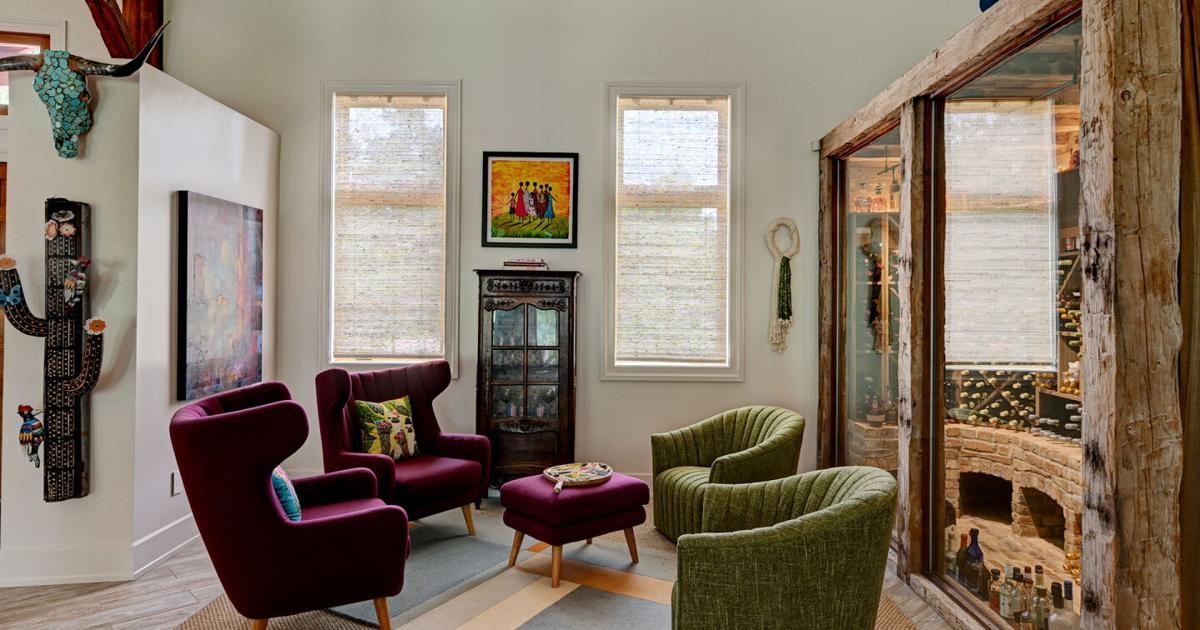
One side of the living room is dominated by a stone fireplace and large sectional sofa, as well as another seating area in front of climate-controlled wine and liquor cabinets. On the other side, the chef’s kitchen is the focal point at the rear of the space, forming a sort of culinary theater.
The must-haves for Horst Pfeifer were a Rotisol rotisserie and wood-burning indoor oven. While he works, he can visit with guests seated at the island, at the 10-person dining table or in another seating area in his direct line of vision, overlooking the live-fire outdoor cooking space.
Chef Horst Pfeifer’s open kitchen is located at the rear of the central great room, forming a sort of culinary theater. The must-haves for the chef were a Rotisol rotisserie and a wood-burning indoor oven. While he works, he can visit guests seated at the island in front of him.
PHOTO Jeff Strout
“I love to cook from a raised metal tripod over live fire,” Horst Pfeifer said of his outdoor kitchen, which amounts to a raised brick fire pit that rises above a brick-paved patio with tables and seating.
On one side of the outdoor cooking space is a verdant lawn that flows into a massive, shaded sanctuary that is home to 45 deer — mostly fallows and sikas — spiral-horned blackbuck antelopes, four peacocks, as well as a collection of hens, ducks, turkeys and chickens. On the opposite side is an extensive garden of herbs and vegetables.
“Having the beds raised makes weeding so much easier,” the chef said. “I plant every two or three weeks, so I always have a crop coming in. I grow whatever I can find.”
Karen Pfeifer was raised on a farm in Kansas in a town of 350. Horst Pfeifer was raised on a farm in a town of 150 in Baden-Württemberg, Germany, where his parents grew and raised nearly everything the family ate, including the wheat they ground at the local mill.
The couple met in the 1980s in Texas, where then-Karen Barr was a server in a casual restaurant while seeking a degree at The University of Texas at Austin, and Horst Pfeifer was running a private resort kitchen. They moved to New Orleans, where they launched Bella Luna, their acclaimed and romantic riverfront restaurant in the French Market, in 1991. Bella Luna was permanently closed due to damage from Hurricane Katrina in 2005.
After many years of living in the French Quarter, just a few blocks from Bella Luna, they bought historic Middendorf’s Seafood Restaurant, a visible fixture off Interstate 55 in Manchac that has been in business for 92 years.
They opened a second Middendorf’s location in Slidell in 2019.
When they built their dream home, having land that also served as a sanctuary was important. The home was designed so the wildlife would be visible from within.
This is Pete. The Pfeifers have one male peacock and three females.
PHOTO Jeff Strout
“We want to be able to see our animals,” said Karen Pfeifer. “We have strong connections with them.”
“We also wanted one big room, so everyone is together,” said Horst Pfeifer.
Their French Quarter home was filled with antiques, while their home in Ponchatoula is contemporary and open. Most of the furnishings were purchased at the erstwhile Monochrome in Baton Rouge.
“When we are in the restaurants, we are doing whatever is needed at both of them,” said Horst Pfeifer. “I am often the guy cleaning the fryer.
“When we are not doing that, this is all I want to do,” he said. “I just want to stay in the kitchen and see my friends and guests gathered around the table eating and drinking, and I can also see all our animals in the yard. This is what makes me happy.”