

Benzinga and Yahoo Finance LLC may earn commission or revenue on some items through the links below.
The U.S. economy is increasingly dividing into two distinct realities, with affluent Americans fueling a luxury boom while lower- and middle-income households face mounting financial pressure.
Fractured Landscape: ‘E’ Shaped Economy
The Federal Reserve’s latest Beige Book report highlights a stark bifurcation across income brackets amid persistent affordability pressures. While higher-income households have remained resilient and relatively insensitive to price increases, the rest of the country is pulling back.
According to the report, middle-income households were widely described as “squeezing more life out of every dollar before deciding to spend it,” while low-income consumers showed signs of much greater financial strain.
Don’t Miss:
Heather Long, Chief Economist at Navy Federal Credit Union, characterized the current dynamic as a classic “E-shaped” economy, noting that the top 20% are doing fine while the middle class is stretching every dollar and the bottom is in serious trouble.
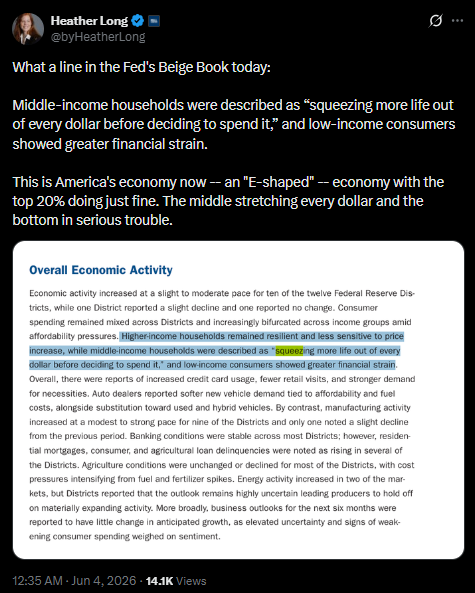 Heather Long on Federal Reserve’s latest Beige Book. Rising Business Strain
As discretionary spending slows, consumer-facing companies are feeling the pinch. Non-labor input costs and fuel spikes linked to global geopolitical tensions continue to rise faster than selling prices, driving widespread concerns about corporate margin compression.
Trending: Think you’re saving enough for your kids? You might be dangerously off — see why
Jeffrey Roach, Chief Economist for LPL Financial, told Benzinga that we may be at an economic crossroads as credit conditions appear to be weakening. To cope, many “firms are temporarily absorbing higher input costs to preserve customer demand,” Roach observed.
This margin-eating strategy typically occurs when businesses collectively realize that the average American consumer is on weaker footing.
Tepid Economic Outlook
Outside of specialized growth sectors like data center construction and defense spending, the broader labor market has settled into a quiet, low-hire, low-fire environment. Workers are increasingly reluctant to risk leaving stable jobs due to macroeconomic uncertainty.
While business investment is expected to sustain a modest 1.8% annualized growth rate for the second quarter, rising delinquencies in auto loans, credit cards, and mortgages signal that the consumer bedrock is becoming increasingly fragile.
See Also: Still Learning the Market? These 50 Must-Know Terms Can Help You Catch Up Fast
How Have Markets Performed In 2026?
The S&P 500 index has advanced 10.14% year-to-date. Similarly, the Nasdaq Composite index was up 15.57%, and the Dow Jones gained 4.76% YTD.
The SPDR S&P 500 ETF Trust and Invesco QQQ Trust ETF, which track the S&P 500 and Nasdaq 100, respectively, closed lower on Wednesday. The SPY ended down 0.70% at $754.24, while the QQQ was lower by 0.26% to $744.21.
Meanwhile, Dow tracker, State Street SPDR Dow Jones Industrial Average ETF Trust, closed 1.13% lower on Wednesday.
Photo courtesy: Shutterstock
Building Wealth Across More Than Just the Market
Building a resilient portfolio means thinking beyond a single asset or market trend. Economic cycles shift, sectors rise and fall, and no one investment performs well in every environment. That’s why many investors look to diversify with platforms that provide access to real estate, fixed-income opportunities, precious metals, and even self-directed retirement accounts. By spreading exposure across multiple asset classes, it becomes easier to manage risk, capture steady returns, and create long-term wealth that isn’t tied to the fortunes of just one company or industry.
Arrived
Backed by Jeff Bezos, Arrived Homes makes real estate investing accessible with a low barrier to entry. Investors can buy fractional shares of single-family rentals and vacation homes starting with as little as $100. This allows everyday investors to diversify into real estate, collect rental income, and build long-term wealth without needing to manage properties directly.
Vinovest
Fine wine and rare whiskey have historically moved independently of the stock market, making them a compelling alternative asset. Vinovest manages authenticated, insured portfolios of investment-grade wine and whiskey starting at $5,000 — sourcing, storage, and insurance all handled for you.
FarmTogether
Farmland has historically held its value through market volatility and delivered returns uncorrelated to stocks and bonds. For accredited investors, FarmTogether offers direct access to high-quality U.S. farmland starting at $15,000 — fully managed, with no landlord headaches.
EquityMultiple
For accredited investors looking beyond stocks and bonds, EquityMultiple provides access to vetted commercial real estate deals starting at $5,000, with only ~5% of opportunities passing their due diligence process.
Bitcoin IRA
For investors who want crypto exposure with tax advantages, Bitcoin IRA allows you to trade 60+ cryptocurrencies inside a self-directed IRA or roll over an existing 401(k), with 24/7 trading and institutional cold storage. Minimum $3,000 to start. Crypto investing involves substantial risk of loss and early withdrawal penalties apply.
© 2026 Benzinga.com. Benzinga does not provide investment advice. All rights reserved.