
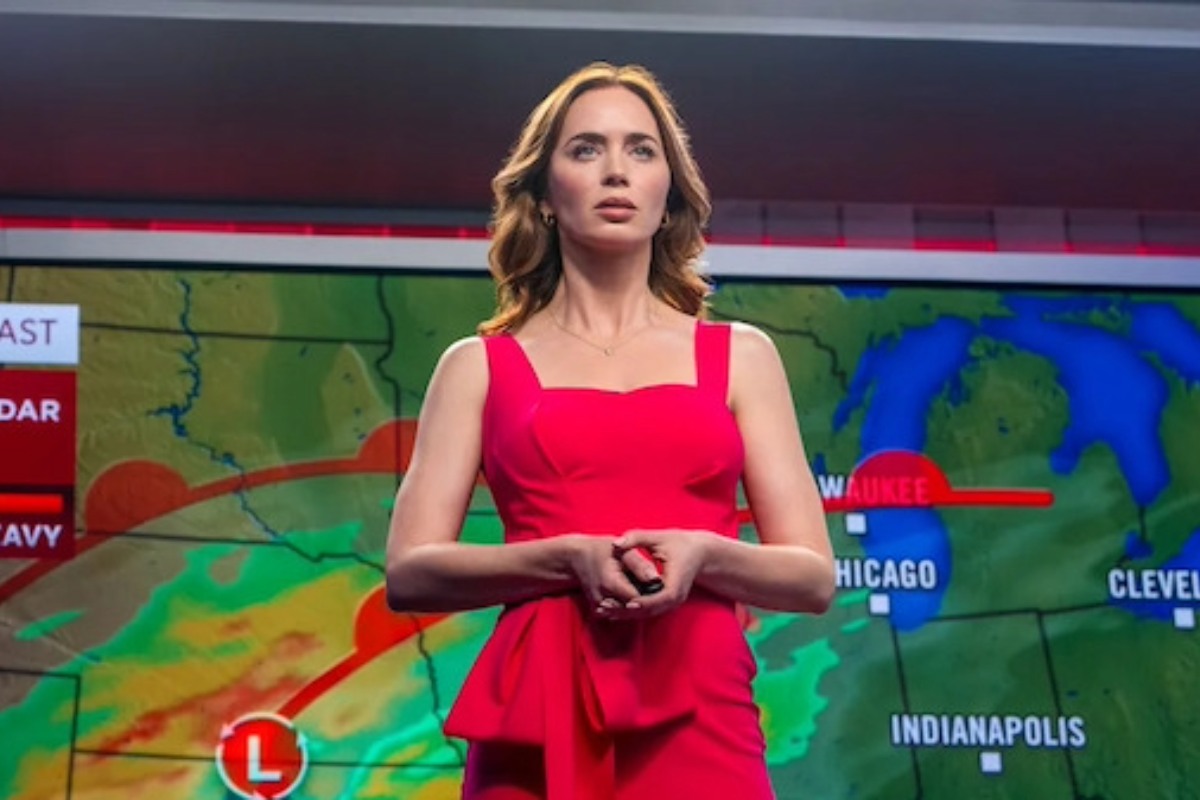
How did Emily Blunt handle a four-minute possession sequence in Steven Spielberg’s Disclosure Day without AI? She performed every sound herself, using clicks, buzzes, sharp consonants and strained breaths, captured on two microphones, one at her mouth and another at her throat, in a sci-fi drama arriving June 12, 2026.
For four unbroken minutes, a meteorologist surrenders her voice to something not of this Earth, and Emily Blunt won’t let a machine speak for her. She pushed aside AI and built the soundscape herself with clicks, buzzes, sharp consonants, and eerie breaths, captured on two microphones, one at her mouth and another at her throat. The result sits at the heart of Steven Spielberg’s Disclosure Day, a return to science fiction with a cast led by Blunt alongside Josh O’Connor, Colin Firth, Colman Domingo, Eve Hewson, and Wyatt Russell. It lands June 12, 2026, as anticipation swells over the tug-of-war between human performance and encroaching technology.
A bold choice in Spielberg’s sci-fi epic
There is a particular electricity when actors draw a hard line, especially on a set led by Steven Spielberg. In his upcoming sci-fi feature, Disclosure Day, Emily Blunt made one such call. For a pivotal sequence, she declined AI assistance and opted to craft the sounds herself, reaffirming a belief that human performance still anchors the biggest cinematic swings.
Set to reach US theaters, currently slated for June 12, 2026, the film marks Spielberg’s return to first-contact territory. The anticipation is palpable, not just for its scale, but for choices like Blunt’s that push craft to the forefront.
Inside the mysterious four-minute scene
Blunt portrays a TV meteorologist overtaken by an extraterrestrial presence during a live broadcast. The standout is a roughly 4-minute passage where her body, voice, and breath seem to split from themselves. Rather than AI processing, she shaped the moment with clicks, buzzing consonants, and fractured breathing patterns that edge into the uncanny.
To capture every contour, the team recorded her with two microphones, one at her mouth and another at her throat. That split perspective gave the sound designer raw, human textures to layer, keeping the final audio rooted in Blunt’s physical performance.
The film’s ambitious scope
The story looks squarely at first contact and the emotional whiplash that follows. This is the case with Spielberg’s larger sci-fi canvases, and early chatter compares the project to his own classics. Some buzz even frames it as possibly his strongest work in 20 years, a tall order that sets expectations sky high.
The ensemble backs that ambition. Alongside Blunt are Josh O’Connor, Colin Firth, Colman Domingo, Eve Hewson, and Wyatt Russell, adding star wattage and tonal range. The result is a film poised to play both as spectacle and character study.
The debate over AI in filmmaking
Blunt’s decision lands in the middle of Hollywood’s AI debate. Indeed, AI tools are now common in voice work, effects, and even drafting scripts, but many performers worry they can sand off the human edge. By choosing an analog route, Blunt puts technique and breath front and center, and Spielberg’s track record with practical choices supports that instinct.
Will audiences hear the difference? According to this stance, the point is less about perfection and more about presence, a quality that ripples through a theater when what you hear began in a human chest.
Spielberg’s return to sci-fi thrills audiences
Backed in the US by Universal Pictures, Disclosure Day already feels like an event. The premise is sharp, the cast is deep, and the filmmaking intent is clear. In addition to its extraterrestrial stakes, it holds a quieter promise: that performance, unfiltered, can still surprise us, even in a time of limitless digital possibility.