
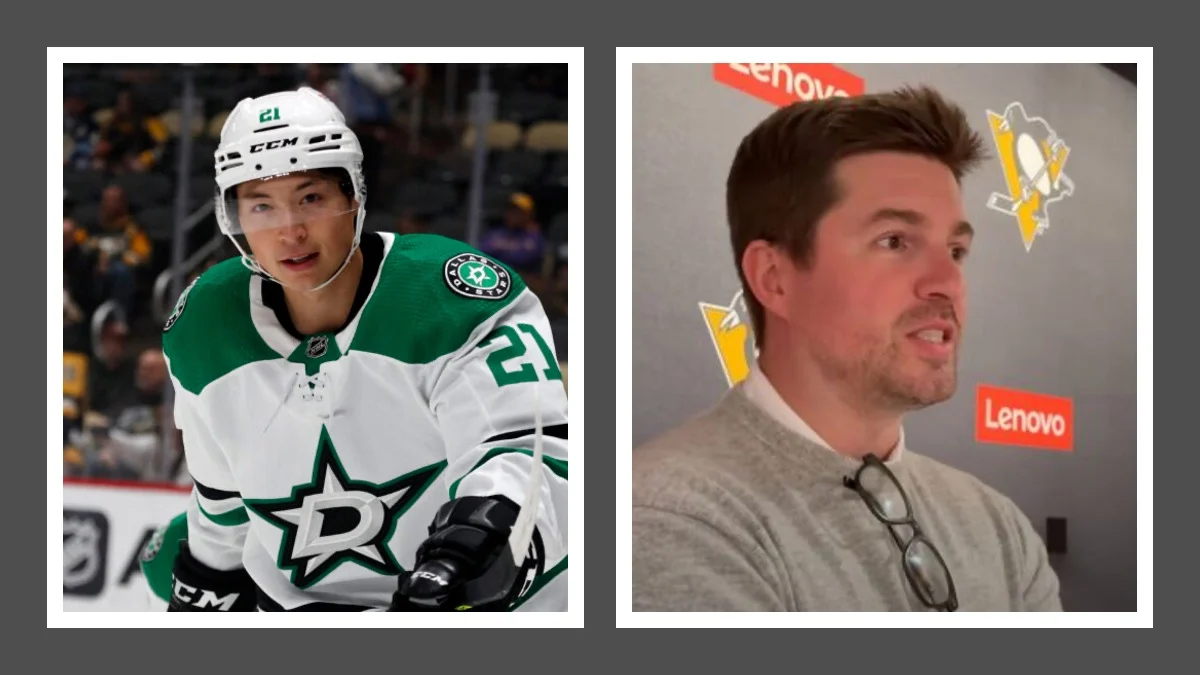
Pittsburgh Penguins general manager admittedly wants to trade for an impact player in his later 20s to serve as a bridge between the Penguins old and new. He could also leap forward in the 2026 NHL Draft to acquire a greater talent than would otherwise be available when the Pittsburgh Penguins are on the clock at No. 22.
Jason Robertson. Dylan Larkin. They are the big names out there in trade chatter.
“But I think if we’re going to take a really big step next year, one that’s sustainable, it’s going to be by using the combination of this cap space that we have, but (also) the assets that we have, draft picks, prospects, etc., to acquire somebody,” Dubas said in his postseason press conference on May 12. “Is that going to be possible? We’re sure going to find out.”
With their draft capital, prospects, and a couple of high-scoring veteran wingers, trading for what Dubas termed a “difference maker in his later 20s” or trading up in the draft are both entirely plausible scenarios this offseason. But what would make very little sense is to do both. Spending assets for the future while spending assets for the present would be a conflict equivalent to George Constanza’s worlds colliding.
And we know a George divided against itself cannot stand.
It’s also likely impossible to do both because acquiring an impact player will almost assuredly cost at least one first-round pick. Including that top draft selection is almost a tradition in the NHL for such big trades. With a few exceptions, it’s usually no first-rounder, no deal.
Such is the predicament the Penguins are facing. Certainly, Dubas has defied the odds and conventional wisdom during his Penguins tenure, and this season’s second place finish and playoff berth are proof. But the very obvious chasm between the Penguins and the true Stanley Cup contenders merely highlight the voluminous work still undone.
If not this summer, then soon, it certainly seems that Dubas must choose which path to pursue more vigorously: to build for the future or to continue patching the present while slowly building for the future.
Saturday morning at the NHL Combine, increasingly trendy prospect Viggo Bjorck spoke of spending a lot of time with the Penguins and watching game video with them. We learned of the Penguins’ Combine strategy last season when other prospects spilled the beans that the Penguins like to show draft potentials their screw-ups on video and get a reaction.
Some players shrink, others explain. Bjorck shrugged it off.
“At first, you’re kind of like, yeah. I mean, you’ve got to do better than that,” Bjorck said with some good humor. “I don’t know what else to say, but yeah, just kind of try to walk them through how you’re thinking (and) take responsibility for your bad actions.”
However, Bjorck is a prospect clearly in the top 10, and is making a charge on some boards toward being a top-five pick. So … why are the Penguins talking to him? Indeed, there has been some chatter in legitimate media outlets that teams are trying to trade up in the draft for Bjorck, and, yes, the Penguins are among those teams believed to be poking around.
Pittsburgh Hockey Now has already done the math and run the scenarios for the Penguins to trade up. You can read those here.
PHN has also run the numbers for a Larkin trade. And for a Robertson trade.
Such a move upward in the draft would give the Penguins a chance at a long-term franchise cornerstone. Even a little jump forward could net them a rising prospect such as Watt Cullen, who is gaining traction on draft boards across the league.
Of course, the risk of building through the draft is the unpredictability. Prospects can just as easily become lamented mistakes as they can be valuable contributors.
Conversely, acquiring an impact player with a proven track record comes with a lot less risk but a fair amount of cost. In fact, part of the cost to acquire a proven player is almost always to surrender that very lottery ticket known as a first-round pick.
For Dubas, sooner than later, two paths will diverge in a yellow wood, and for all of Dubas’s attempts to take both paths fair, he will have to prioritize one.
The view from here is that prioritizing youth would be the riskier but more prudent path because the Penguins are more than one impact player away from contending, and getting better in the immediate would extend their entrapment of drafting in the high teens or low 20s but is very unlikely deliver a Stanley Cup.
Everyone seems to forget that Evgeni Malkin will be 40 years old. Just because he scored more than a point per game this season is far from a guarantee that is can happen again. Sidney Crosby will be 39. Erik Karlsson is 36. Bryan Rust is 34 with a lot of hard miles. Age should be a real concern.
Certainly, one can hope for the same production and reliability as in the past, but for players in that age range, injuries become far more common, and numbers begin to drop, often significantly, and it usually ends with a whimper, not a bang.
Even if the Penguins’ core doesn’t experience a decline next season, it is coming within the next couple of seasons, and it is absolutely impossible to avoid. Dubas would need to acquire multiple impact players to make up for the losses. He will almost certainly need to flip other veterans for the magic beans of draft picks or prospects in the near future or disappointingly get nothing for them.
Also, Karlsson is a free agent next summer and has not yet fulfilled his goal of hoisting a Stanley Cup.
So, with the end of the road within sight for the top of the Penguins lineup, unless Dubas believes he can run the gauntlet of refreshing the roster through a handful more of magical trades like his heist for Egor Chinakhov, the difficult path fraught with peril of using the draft, and acquiring higher quality draft capital, is also the better path.
Categorized:Pittsburgh Penguins