
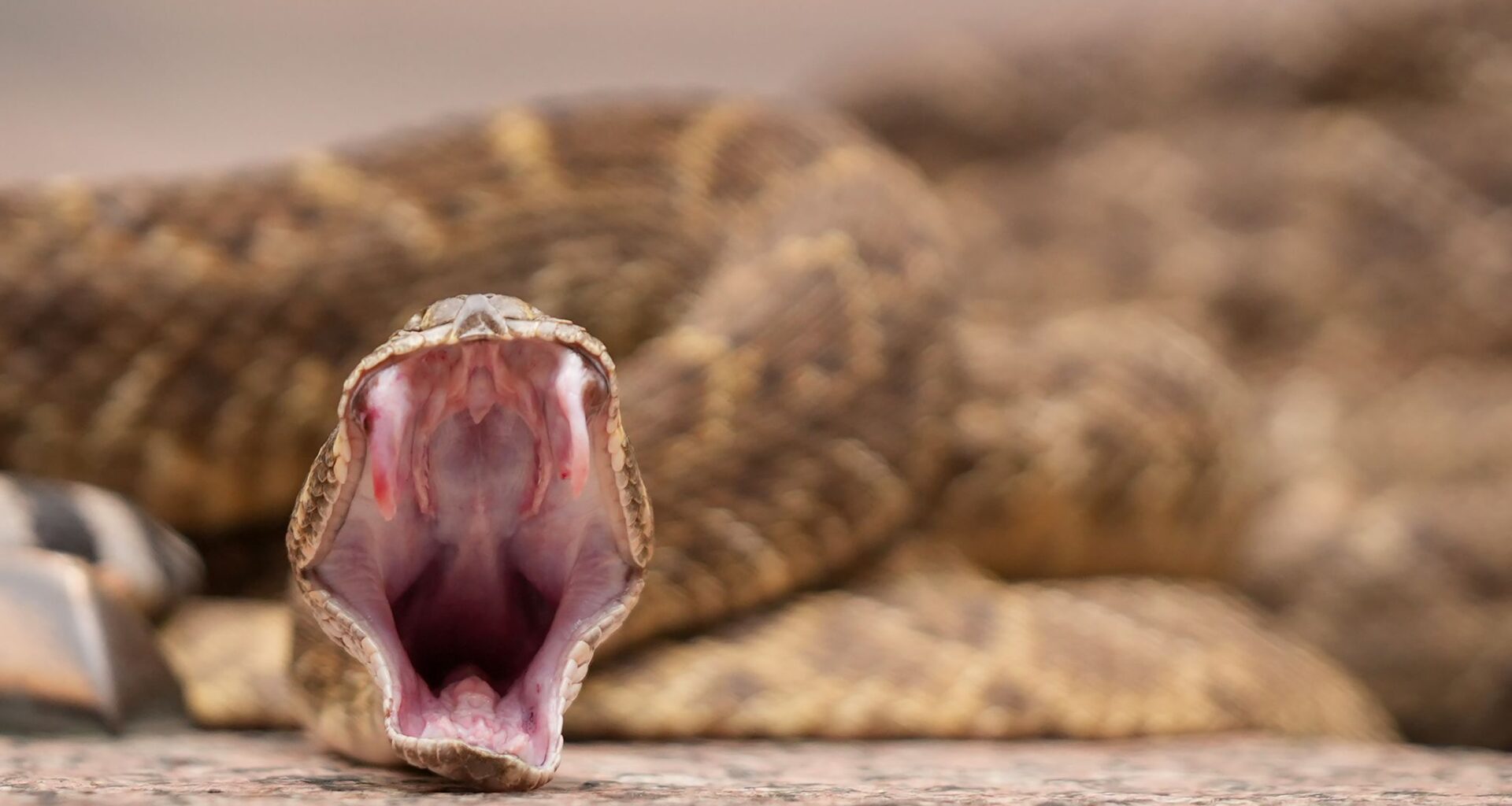
As temperatures climb in Austin, there are a few critters to keep an eye out for: The bats are back, the bugs are buzzing — and snakes are slithering across Central Texas parks, trails and waterways.

Most snakes pose no threat to humans, but Central Texas is home to four groups of venomous snakes: rattlesnakes, coral snakes, copperheads and cottonmouths, also known as water moccasins.
Here’s what to know about the snakes you might encounter this summer, where you’re most likely to see them and what to do if you’re bitten.
Article continues below this ad
Which venomous snakes live in Central Texas?
A western diamondback rattlesnake is seen on the outdoor rotunda at the Capitol on Tuesday, Feb. 10, 2026. Members of the Sweetwater Jaycees brought 22 live rattlesnakes to promote the 68th annual World’s Largest Rattlesnake Round-Up, scheduled for March 13–15 in Sweetwater. The event began in 1958 when area farmers and ranchers organized an effort to reduce rattlesnake populations affecting livestock and has since grown into a major local festival featuring a parade, a Miss Snake Charmer Queen contest, snake handling and milking demonstrations, and fried rattlesnake meat.
Jay Janner/Austin American-Statesman
Rattlesnakes
Texas is home to multiple species of rattlesnakes, all identifiable by the characteristic rattle on their tails. The western diamondback is the state’s most common rattlesnake. Rattlesnakes are most active at night when hunting for prey.
Article continues below this ad
Unlike a rattlesnake, which has front fangs, a coral snake, above, chews on its prey to deliver its venom, and ‘most people don’t tolerate that very well, and they rip the snake off,’ said Dr. Pat Crocker, chief of emergency medicine at Dell Children’s Medical Center. Consequently, most people don’t get enough venom to die of the bite, or need the antivenin. People and pets who are bitten still need to get emergency treatment right away and might need to be hospitalized, Crocker said. They could need a breathing device called a ventilator if their respiratory system is paralyzed by the venom. It can take days for the poison to work its way through the body and for the person or pet to come off the ventilator, doctors and veterinarians said.
Austin American-Statesman
Coral snakes
Coral snakes are identifiable by their red, yellow and black bands. Many Texans remember the rhyme: “Red and yellow, kill a fellow. Red and black, you’re OK, Jack.”
That means venomous coral snakes have red touching yellow on their bodies. Nonvenomous snakes, including the Texas milk snake, have red and black touching. Coral snakes have small mouths and bites are rare, but they can be very dangerous.
Article continues below this ad
The copperhead is one of four groups of venomous snake in Texas
Courtesy Texas Parks and Wildlife Department
Copperheads
Copperheads have gray and brown bands with a copper-colored head. Their coloring helps them blend into wooded areas and leaf litter, making them difficult to spot.
The Western cottonmouth is the only semi-aquatic viper in the world.
Courtesy Texas Parks and Wildlife Department
Cottonmouths
Cottonmouths are often called water moccasins because they rarely stray far from water. The inside of their mouths is white, giving them their name. They are known for defensive behavior and can bite underwater.
Article continues below this ad
Which nonvenomous snakes can be found in Austin?
All snakes — both venomous and nonvenomous — serve an important purpose to the ecosystems they live in. There are plenty of Austin-area snakes that you should leave alone if you spot them in your yard or garden — they might even help you control pests or keep your plants healthy and happy. Here are a few of the most common nonvenomous snakes you may spot in Central Texas, according to Tomlinson’s Feed.
PLAINBELLIED WATER SNAKE: Size: Almost 3 feet long. Description: Most commonly encountered nonvenomous aquatic snake in Travis County. It’s very often confused with the Western Cottonmouth. Young plainbellied water snakes are strikingly patterned with dorsal ’bars’ along the body and very distinct dorsoventral ‘teeth’ markings on the labial scales. They become more colorful with age. Where it lives: Primarily in or around water. It occasionally be found resting in aquatic vegetation and or tree branches overhanging water. Notes: Their favorite prey is fish, but it will also feed on crayfish and amphibians. [Austin Parks & Recreation]
Austin 360
Watersnakes
These snakes are often confused for cottonmouths — they look similar — but they’re harmless. The diamond pattern on their backs can also make them look like rattlesnakes, and they can grow up to 4 to 6 feet long — but let them take care of eating the insects in your yard or garden, and you’ll be grateful for them despite their unsettling appearance.
Article continues below this ad
UNSPECIFIED – OCTOBER 28: USA, California, Mojave Desert, Bull Snake (Pituophis catenifer sayi) (Photo by De Agostini via Getty Images/De Agostini via Getty Images)
DE AGOSTINI PICTURE LIBRARY/De Agostini via Getty Images
Bull snake
These are some of the biggest snakes in Texas — they can grow up to more than 9 feet long — and they make loud hissing noises when they feel threatened. But they’re harmless and won’t bother you or your pets. According to Tomlinson’s, they’re mostly found in fields and pastures and you can spot them by brown slightly square-shaped blotches on a light brown or yellowish body.
This Texas rat snake was returning from robbing a kingbird’s nest over the patio light over Mike Leggett’s back door. Rat snakes are common non-venomous snakes throughout Central Texas, where they spend their time chasing down rats, birds and other small animals. They can climb anything with any texture, such as the stones used to build the house.
Mike Leggett for Statesman
Western rat snake
If you see a snake in a tree, it’s probably a rat snake. They can have similar coloring to a rattlesnake, but they’re missing that telltale rattle. They can be up to 3 or 4 feet long, so they may look scary, but they’re only after the rodents they can snack on in your yard.
Article continues below this ad
Their appearance can vary from brown blotches on a gray body to black blotches on a red, orange yellow or white body, according to Tomlinson’s.
Eric Brittingham, president of Wildlife on the Move, asks Maggie Harris to touch Freckles, a king snake, to see if she could feel a spine Saturday at the Pflugerville Public Library. The event kicked off the library’s weeklong spring break activities for people of all ages.
Megumi Rooze/Special to Pflugerville Pflag
King snake
These snakes may shake their tail at you, pretending to be a rattlesnake when they feel threatened — but generally they like to mind their own business and will avoid you and your pets. They generally are recognizable by black blotches on a gray body.
Article continues below this ad
Ramona Beasley photo/The fight is almost over and the coachwhip has won. The rattlesnake is about to be swallowed whole.
Austin American-Statesman
Coachwhip
These snakes can even play dead when they feel threatened — the embodiment of “they’re more scared of you than you are of them.” They’re largely solid-colored, ranging from brown to tan, but they can also have wide bands of color, according to Tomlinson’s.
Racers
These snakes have their speedy name for a reason, so by the time you spot them, they’re likely on their way far away from you. You can spot them by their yellow bellies and green backs.
Article continues below this ad
Brown snakes and earth snakes
These two species are pretty much just digging for earthworms in your garden, so leave them be. They’re both brownish in color and generally less than a foot long.
CHECKERED GARTER SNAKE: Size: 18 inches to 2 feet. Description: Small, nonvenomous snake with a black and light gray “checkerboard” pattern and pale vertebral stripe extending almost the entire length of the body. Generally presents a bright red or pink forked tongue. Where it lives: It can be found area-wide, usually where moisture and humidity are more prevalent. It is not uncommon to find checkered garter snakes under logs and decaying vegetation. Notes: It is a very nondefensive snake that is extremely reluctant to bite, but it will readily excrete a foul-smelling oily musk if handled. Its primary diet consists of amphibians, but it will also take earthworms and fish when available.
Contributed by Austin Parks & Recreation, Austin American-Statesman
Garter snakes
You’ll often spot these near bodies of water and they’re identifiable by stripes or checkered patterns down their backs. They’re hunting for frogs or spiders, not you.
Article continues below this ad
Where are snakes most common around Austin?
Snakes can be found throughout Central Texas, including in Austin’s parks, greenbelts and neighborhoods. River corridors are also prime snake habitat.
Last year, WorldAtlas included both the Colorado River and Guadalupe River on a list of Texas’ most snake-populated rivers.
Along the Colorado River, visitors may encounter diamondback water snakes and blotched water snakes, also known as plain-bellied water snakes. Despite the similar name, the diamondback water snake is nonvenomous and is not related to the venomous diamondback rattlesnake. Both species prefer quiet, slow-moving water and are commonly found near vegetation along riverbanks.
Article continues below this ad
Along the Guadalupe River, rivergoers may encounter western cottonmouths, the only semi-aquatic viper in the world, according to Texas Parks and Wildlife. Cottonmouths can range from olive green to nearly black and often display the white tissue inside their mouths when threatened.
Even though more than 100 snake species can be found along Texas rivers, only a small fraction are venomous, and most snakes seen near waterways are harmless.
What should you do if you see a snake?
Most snake bites happen when people try to handle, kill or otherwise confront a snake.
Article continues below this ad
Your best bet is to keep your distance and allow the snake to move away. If a snake is in your yard, you can sometimes encourage it to move along with a broom handle or water hose from a safe distance.
Snakes play an important role in the ecosystem. According to Texas Parks and Wildlife, they help control populations of rodents, rabbits and other prey species.
If you encounter a snake outdoors:
Stay still and allow it to retreat.
If you need to move, back away slowly and carefully.
Do not attempt to kill or handle the snake.
Be especially cautious near water, tall grass, wood piles and rocky areas.
Article continues below this ad
How can you keep snakes out of your yard?
There are several steps homeowners can take to make their property less attractive to snakes:
Don’t leave food or water outside for pets or wildlife.
Keep livestock pens as far from the home as practical.
Remove piles of rocks, wood, brush and other debris.
Address rodent problems, since snakes are attracted to mice and rats.
Keep trees and shrubs trimmed.
Consider fencing at least 4 feet high.
Cover drainage areas and house vents with mesh to prevent snakes from entering.
Pet owners should also monitor animals closely outdoors and seek veterinary care immediately if a pet is bitten.
Article continues below this ad
How can you avoid being bitten?
Snakes generally avoid humans but may bite if stepped on, cornered or threatened.
Wearing closed-toe shoes outdoors.
Wearing boots when walking through tall grass.
Watching where you place your hands and feet.
Using a stick or garden tool to move logs or debris.
Carrying a flashlight at night, even in your own yard or neighborhood.
Article continues below this ad
What should you do if you’re bitten by a snake?
Texas Parks and Wildlife recommends:
Seek medical attention as soon as possible.
Keep the victim calm.
Watch for signs of shock.
Wash the bite area with disinfectant soap if available.
Remove restrictive clothing or jewelry near the bite.
Limit movement and splint the affected area if possible.
According to Texas Parks and Wildlife, antivenom is most effective within the first four hours after a bite.
Article continues below this ad
What should you NOT do after a snake bite?
Texas Parks and Wildlife advises against:
Cutting the bite area.
Using a tourniquet.
Applying ice or cold therapy.
Using electroshock therapy.
Drinking alcohol.
Taking aspirin.
Wrapping the bite tightly.
Administering antivenom unless trained.
Attempting to suck venom from the wound.
Article continues below this ad
Austin-Travis County EMS also advises people to seek medical care and, if it can be done safely, take a photo or make note of the snake’s appearance to help medical providers identify the species.