
Several of the most popular stats used to evaluate QBs in fantasy football are completely worthless. But others — and probably not the ones you think — are overwhelmingly valuable.
In this article, I’ll show you which stats belong in which bucket, then use that knowledge to highlight five of my favorite QB values for 2026 fantasy football. (Feel free to scroll down to that part if the fantasy takes are all you’re here for!)
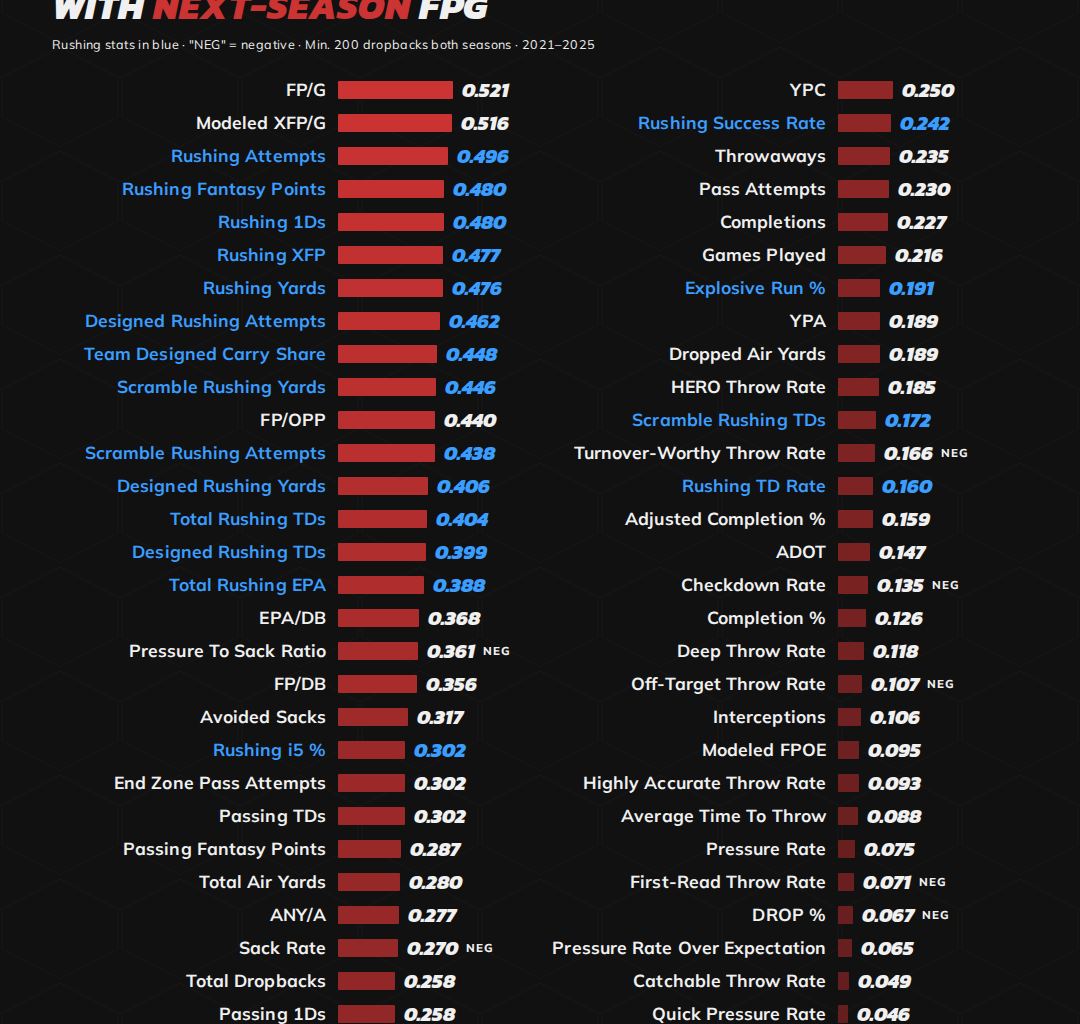
I tested almost every stat in the Fantasy Points Data Suite (along with a handful we haven’t even added yet!) for how well it predicts next year’s fantasy points per game (FPG). Results for the QB position are in the graphic below, sorted from highest to lowest correlation coefficient.
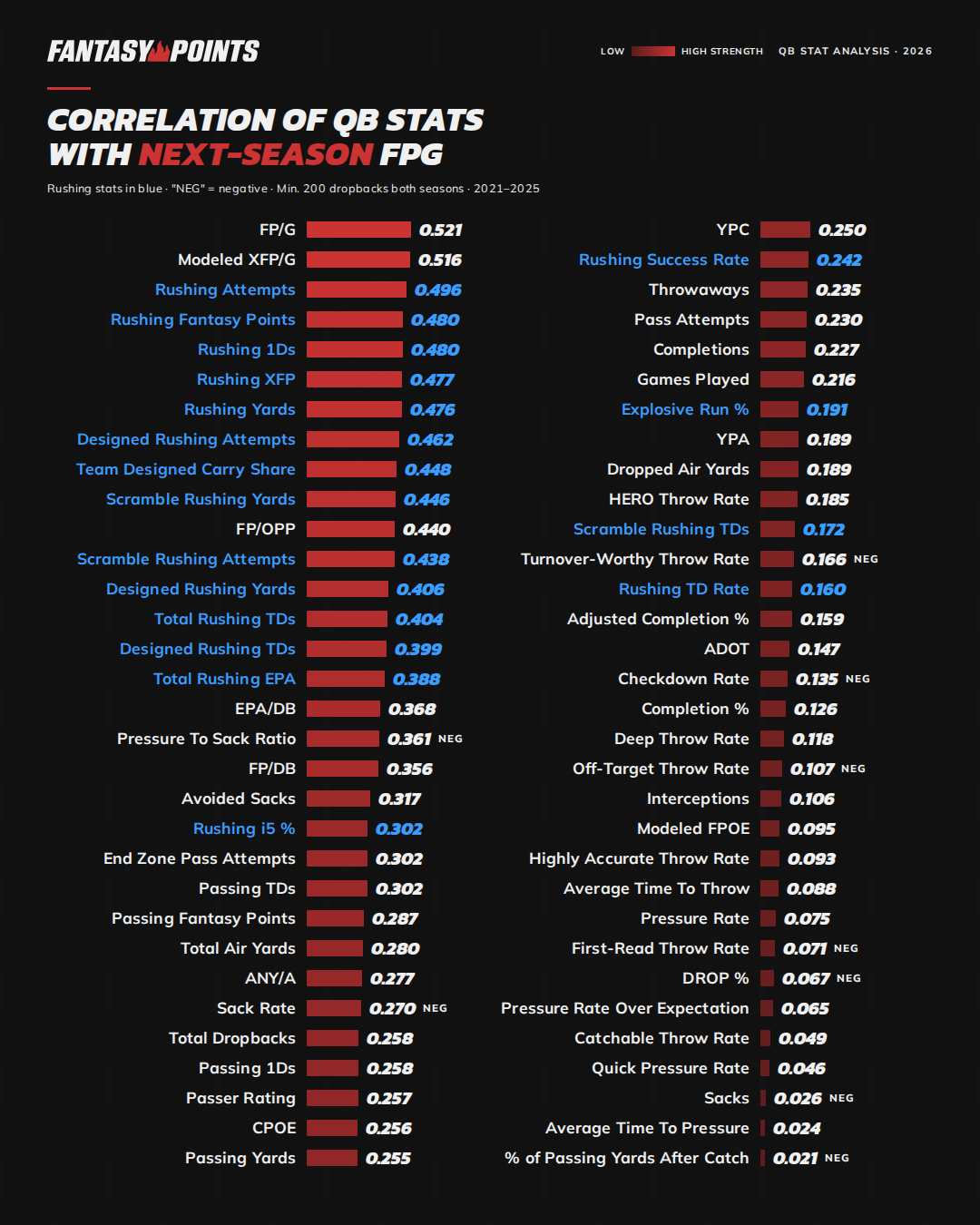
Metrics with stronger correlations are the best at predicting future fantasy scoring in isolation. As an obvious example to illustrate, “Josh Allen led all QBs in rushing attempts in 2025, so it’s likely he’ll lead the position in FPG in 2026” is a statement supported by the above analysis. Rushing attempts display a 0.576 correlation coefficient with next-season FPG, the strongest relationship on the list.
In contrast, “Drake Maye led all QBs in Completion %, so it’s likely he’ll lead the position in FPG in 2026” is not supported by the analysis above. Completion % has just a 0.154 correlation coefficient with next-season FPG, ranking closer to the bottom of the list.
That’s not to say that Completion % — or Pressure Rate, or Average Time to Throw, or Off-Target Throw Rate, or any of the other stats ranking near the bottom — can’t tell you anything. It’s just that they measure much narrower aspects of QB play and team environment that aren’t useful in isolation for predicting fantasy scoring, mostly because we can’t know in which direction they’ll move without other context.
For example, if you can demonstrate that a QB’s pressure rate will decrease in 2026 because of offensive line improvements, that could be part of a great argument in his favor! Every stat is just a tool in our tool belt.
QB fantasy points per dropback league-wide, since 2021…
When pressured within 2.5 seconds: 0.36
When pressured after 2.5 seconds: 0.40
When not pressured at all: 0.45
A potential 25% increase in fantasy scoring just from not facing quick pressure – @FantasyPtsData
— Ryan Heath (@RyanJ_Heath) June 4, 2026
How To Think About QB Metrics
While there are tons of individual stats I tested in the graphic above, we can broadly group them into a few categories, to which I’ll refer throughout my player write-ups below. Going in order of how predictive they are:
1A. Rushing volume and production — including rush attempts, rushing yards, scrambles, designed carry share, and any of their per-game variations. This shouldn’t be a surprise; we’ve known for years that the “Konami Code” (originally surfaced by Rich Hribar) is massively important for fantasy QBs. Seriously, rushing is insanely important, as Jacob Gibbs pointed out using an earlier version of this analysis:
In fact, just to make the rest of our analysis clearer, here’s a version of the graphic with all rushing-only stats removed.
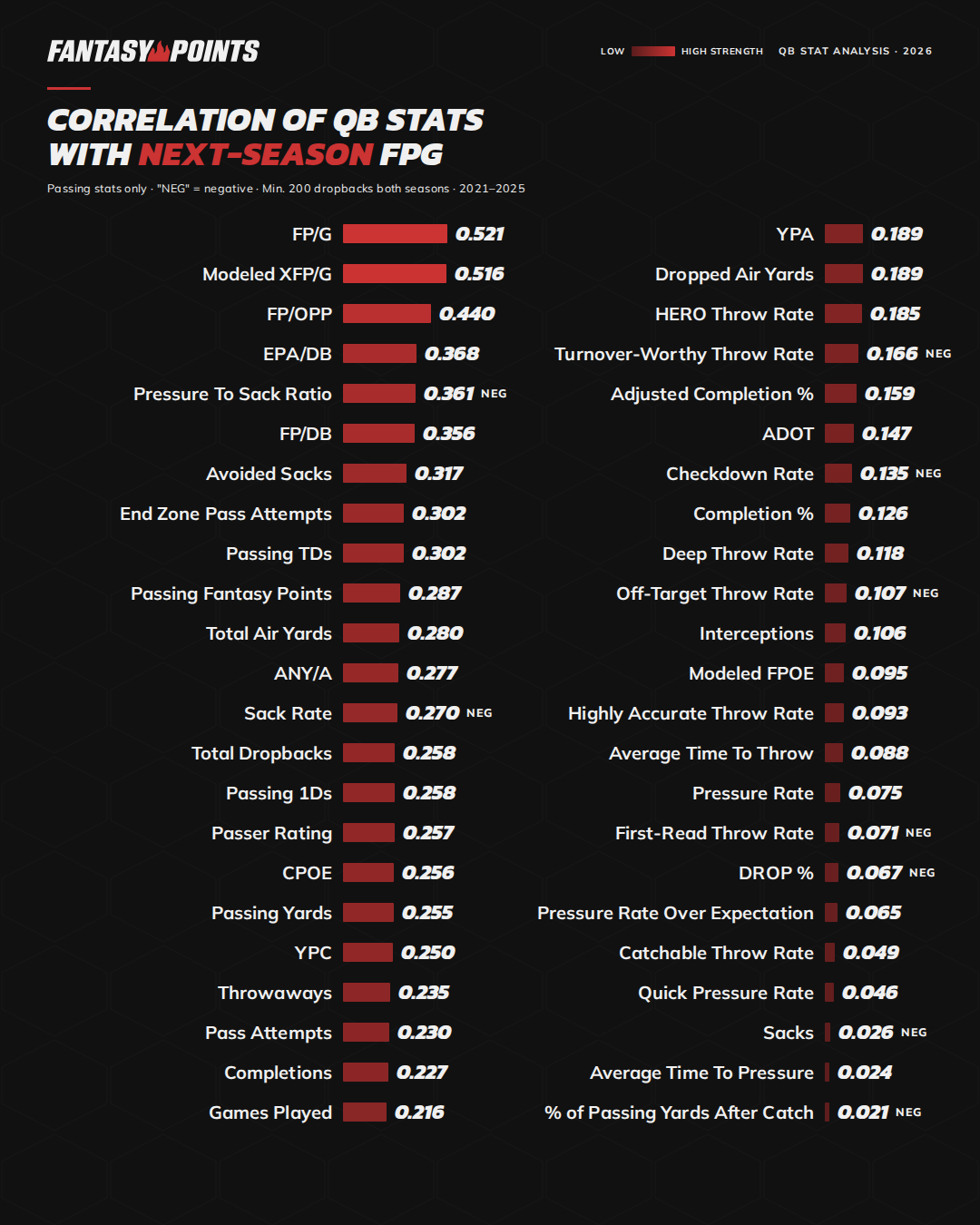
1B. Prior fantasy scoring — including FPG, fantasy points per opportunity (FP/OPP), fantasy points per dropback (FP/DB), and other variations. Intuitively, a QB having previously put together a big fantasy season makes it more likely he has all the tools required, and that he’ll do so again. (It also shouldn’t be lost on us that rushing is a massive part of those three calculations.)
*Tier Break*
2. Real-life results — including expected points added per dropback (EPA/DB), pressure-to-sack ratio (P2S), adjusted net yards per attempt (ANY/A), Passer Rating, and a lot of the statistical measures you might see people use to quantify real-life QB play. These are all different ways of measuring how effective a QB (within his offensive context, of course) is at sustaining drives and scoring points on an NFL field. Fantasy football and real-life value often don’t line up one-to-one, but it is an important factor; you want the offense to sustain drives and for your QB to avoid getting benched.
*Tier Break*
3. Everything else — including passing volume and production, as well as “tendency” or “style” stats like checkdown rate, catchable throw rate, or aDOT (which may have more pronounced effects on the pass-catchers’ fantasy output than on that of the QB himself).
The real-life results bucket discussed above does capture passing ability to a decent extent, so passing-only stats like total pass attempts are generally less useful for predicting fantasy output, as they’re prone to changes in environment (like a QB with a bad defense being forced to throw at higher volumes). Additionally — unlike at every other position — passing efficiency is generally more predictive than passing volume. Passer rating beats out total pass attempts!
That’s enough background. Let’s get into the players!
QBs To Draft Based On The Most Predictive Fantasy Stats
Kyler Murray, Minnesota Vikings
Perhaps more so than for any other QB, this analysis has left me high on Kyler Murray.
Based on Murray’s past production, I shouldn’t have needed much convincing. Since he entered the league in 2019, only three QBs average more FPG than Murray’s 19.4: Josh Allen (22.6), Lamar Jackson (22.0), and Patrick Mahomes (21.0). He’s above Jalen Hurts (19.0) and tied with Joe Burrow (19.4) and Dak Prescott (19.4). Each of these QBs goes at least 1.5 rounds earlier than Murray on Underdog.
More recently, seemingly every offseason since Murray tore his ACL in late 2022, I’ve scoured interviews for any sign that *this* would be the year Murray returns to running the football more often. I was dubious last offseason, but in the five-game sample we got, Murray’s 5.8 rush attempts/game (6th-most) and 34.6 rushing YPG (3rd-most) were both the most he’s posted since 2022. Additionally, he ranked 3rd in scramble YPG (28.4). And this was all after Murray himself said he wanted to run more!
So we’ve got a scrambling profile competitive with any other QB in the league, and Murray averages 18.2 FPG (~QB13) over the past three seasons. Those are strong baselines (relative to a QB17 ADP) for rushing and fantasy production, our two most important statistical buckets.
The “real-life results” bucket is where I know Murray gives many of us pause. But understand that Kevin O’Connell has gotten exemplary play out of every veteran QB he’s ever gotten his hands on. Nick Mullens, Joshua Dobbs, and Carson Wentz have averaged 18.1 FPG across 12 full games. Do you think Murray is better than those players? I do!
Passer Rating from Kevin O’Connell’s QBs since 2021
Sam Darnold – 102.5
Kirk Cousins – 96.2
Nick Mullens – 91.8
Carson Wentz – 85.8
Joshua Dobbs – 76.4 (played his first game five days after being traded mid-season)
J.J. McCarthy – 72.6
Max Brosmer – 53.0@FantasyPtsData
— Ryan Heath (@RyanJ_Heath) May 15, 2026
To compare with the O’Connell-driven QB passer ratings above, Murray averages a 91.6 rating since his ACL tear, and has never posted a lower rating than Wentz’s in any of his last five seasons. By EPA/DB, Murray has finished 18th and 15th over the past two years; Vikings QBs ranked 29th (-0.16) in 2025 (thanks to McCarthy and Brosmer), but 13th (0.06) in every other season under O’Connell. Murray is just a completely different class of player than the Vikings’ rookies were in 2025, and base competence has always been more than enough for O’Connell.
There’s also real upside for Murray to take a step forward in his production through the air. The Vikings have ranked top-5 in red zone pass rate across all four of O’Connell’s seasons, and Murray has actually been more efficient playing under center (below), where O’Connell will likely shift many of his dropbacks.
Since 2021, Kyler Murray’s Cardinals rank 4th-highest in shotgun rate (71.8%)
The Vikings ranked bottom-3 every year from 2021-24. Even in 2025 with Wentz/McCarthy, they ranked 8th-lowest (48.2%).
However, Murray has been more efficient from under center! Via @FantasyPtsData pic.twitter.com/ORSd1C1NiM
— Ryan Heath (@RyanJ_Heath) June 2, 2026
Throw in the fact that six of the top-nine late-round QB seasons by FPG over ADP-based expectation have come from the “McShanahan” coaching tree to which O’Connell belongs, and Murray checks essentially every box. He’ll be my go-to free QB at the end of drafts this year.
Bo Nix, Denver Broncos
Starting with what matters (rushing), the most natural point of comparison for Nix is Jaxson Dart. Dart has an earlier ADP across all platforms, largely due to the perception that he offers greater rushing upside.
But I think the difference between the pair is generally overstated. Even if we only look at Dart’s starts, he averaged 7.0 rush attempts per game (~QB3) and 26.1 scramble YPG (~QB7); Nix averaged 5.3 rush attempts/game (~QB8) and 20.3 scramble YPG (~QB11), including the postseason.
The main difference has been goal-line usage — Dart received 30% (4th-most) of the Giants’ rush attempts inside the five-yard line last year, to Nix’s 5% (23rd) — but that particular type of usage is less predictive of future scoring, and can vary with circumstance. Case in point: Nix’s inside-the-five rush share doubled without J.K. Dobbins last year, while Justin Fields’ career-lows in inside-the-five share (7.1%) and rushing TDs (2) came in 2021 under Matt Nagy, Dart’s new playcaller. Fields would go on to see 35.6% of his team’s goal-line carries over the next four seasons without Nagy. In fact, neither Fields nor Mitchell Trubisky ever exceeded 3 rushing TDs across four seasons under Nagy.
If we grant that the rushing competition between Dart and Nix is unclear or even leans slightly toward Dart, Nix looks better in most other predictive metrics. From a real-life perspective, he ranked 13th in EPA/DB (0.11) and displayed elite sack avoidance, recording the lowest pressure-to-sack ratio of any QB in 2025 (8.9%). Among all QBs over the past five seasons, Nix boasts the best career pressure-to-sack ratio, topping a list containing three future first-ballot Hall of Famers!
Best pressure-to-sack ratios since 2021
[min. 500 DBs]
1. BO NIX – 11.3%
2. Jordan Love – 12.3%
3. Josh Allen – 12.5%
4. Patrick Mahomes – 12.7%
5. Tom Brady – 14.3%
6. Brock Purdy – 14.8%
…
56. Deshaun Watson – 25.5%
57. Ryan Tannehill – 25.7%
58/last. Will Levis – 28.7% pic.twitter.com/wed32uS1Ol
— Ryan Heath (@RyanJ_Heath) June 2, 2026
Among the past five rookie QB classes, only Drake Maye, Jayden Daniels, and Brock Purdy (in a Shanahan offense that prints EPA) have averaged more EPA/DB than Nix through an initial two career seasons.
Best EPA/DB through two seasons
[since the 2021 rookie class, min. 400 dropbacks]
1. Brock Purdy – 0.28
2. Drake Maye – 0.19
3. Jayden Daniels – 0.13
4. Bo Nix – 0.09
5. Michael Penix – 0.06
6. C.J. Stroud – 0.05
7. Jaxson Dart – 0.05 (*Year 1-only)
8. Caleb Williams – 0.03
— Ryan Heath (@RyanJ_Heath) June 2, 2026
Would it be that surprising for Nix — who averages 19.1 FPG across 36 career games, 9th-most since he entered the NFL — to take a step forward into the elite fantasy tier as Maye and Daniels have done, especially with the addition of Jaylen Waddle in Year 3?
I know the median “film bro” opinion is that Bo Nix kind of sucks. Hell, that’s mostly how I feel when I watch him. But considering that most of the stats that actually matter for fantasy football disagree, and that Sean Payton QBs have been fantasy gold for years, it’s pretty clear to me Nix would smash if he gets at all better in his third season.
Sean Payton QBs [2018-2024]
Taysom Hill: 20.5 fantasy points per start
Washed Drew Brees (age: 39-41): 19.8
Bo Nix (rookie with trash receivers): 18.3
Russell Wilson: 18.0
Trevor Siemian: 18.0
Jameis Winston: 17.2
Teddy Bridgewater: 17.1
For perspective, Nix currently ranks as…
— Scott Barrett (@ScottBarrettDFB) November 18, 2024
Justin Herbert, Los Angeles Chargers
Justin Herbert is an athletic clone of Josh Allen, who ran the ball much more than you remember last year. Herbert ranked 6th among QBs in rushing YPG (31.1, ahead of Jalen Hurts and Lamar Jackson), 1st in scramble yards (439, ahead of Drake Maye), and tied for 5th in total rush attempts (83, ahead of Caleb Williams). He’s being drafted at least a round later on Underdog than all three of the QBs I just mentioned.
Of course, it’s exciting that Herbert gets to play under new OC Mike McDaniel in 2026, who engineered a season in which Tua Tagovailoa led the NFL in passing yards (4,624) and ranked 2nd in ANY/A (7.48), while the offense posted the 3rd-most in yards per play (6.4) of any team over the past five years.
But the more impactful change might be that Herbert gets LT Joe Alt back healthy this year. Herbert has already showcased top-shelf efficiency and fantasy production with Alt on the field:
Justin Herbert …
In 4 games with Joe Alt for over 50% snaps:
* 67.7% comp rate
* 8.2 YPA
* 272 yards per game
* 6.8% TD rate
* 1.5% INT rate
* 8.3% sack rate
In other 12 games:
* 66.0% comp rate
* 7.0 YPA
* 220 yards per game
* 4.5% TD rate
* 2.9% INT rate
* 10.0% sack rate
— Jared Smola (@SmolaDS) January 29, 2026
Herbert’s 6.8% TD rate within the four-game split with Alt that Jared Smola highlights above would have ranked 4th-best last year (behind only Matthew Stafford, Brock Purdy, and Lamar Jackson. His 22.4 FPG in that sample would have trailed only Josh Allen, and his 0.44 EPA/DB would have easily led every QB over any of the past five seasons! One could seriously argue he’d have won MVP had Alt stayed healthy.
And best of all, Herbert’s rushing production doesn’t seem to have been an artifact of him simply running for his life without Alt. His scramble rate increased from 8.2% to 10.1% with Alt playing in the above sample, while his overall rushing YPG also slightly increased to 32.8. The offense just worked so much better that all aspects of Herbert’s game were more productive.
Herbert may well be the earliest QB I’ll actually consider clicking come managed redraft season, as I’d put his upside up against any QB going ahead of him besides Josh Allen.
Malik Willis, Miami Dolphins
If this were 2019-2021 (in my mind, the golden era of arguing about NFL analytics online), you’d have heard a lot more about Malik Willis’s EPA this offseason.
On 117 dropbacks over the past two seasons, Willis easily leads the NFL in EPA/DB (0.47), nearly double that of 2nd-place Josh Allen (0.24). Since 2021, the best single season by EPA/DB is Lamar Jackson’s 2024 (0.35), coming in at 25% less efficient than Willis.
It’s obviously tempting to dismiss that as a small sample, but maybe that’s selling Willis short. Elite small-sample EPA spotted rookie Brock Purdy and Panthers Sam Darnold years before they were broadly considered to be good QBs!
Best seasons by EPA/dropback in “small sample” years since 2021
[Between 100-200 dropbacks]
1. Malik Willis with the Packers in 2024-25: 0.47
2. Brock Purdy as a rookie in 2022: 0.20
3. Sam Darnold with the Panthers in 2022: 0.17
A pretty unreal track record at the top tbh
— Ryan Heath (@RyanJ_Heath) June 3, 2026
Even sweeter for fantasy football, the EPA/dropback stat I’m referencing doesn’t include designed runs — only what happens on dropbacks (e.g., pass attempts, scrambles, and sacks). And a majority of Willis’s rushing fantasy production (53%) came on designed runs!
Naturally, Willis leads all QBs in fantasy points per dropback (0.72) and fantasy points per opportunity (0.75) over the same two-year sample. He averaged 23.6 fantasy points per start across three contests with the Packers, a mark that would have tied with Josh Allen for the most FPG of any QB last year. He also averaged 7.0 rush attempts and 58.0 rushing YPG over that sample — marks that would have ranked 3rd-best and best last year.
So on the sample we have, Willis checks the boxes of per-game production, rushing, and per-dropback efficiency with flying colors. There’s definitely a world in which he scores as a top-12 fantasy QB that you can get off the waiver wire in your home league this year.
But also, Willis really tests the limits of any statistical analysis. Sure, passing volume doesn’t correlate well with fantasy production in the aggregate, but will that hold at this new extreme, where we find Willis with just a career-high 21 pass attempts in a game?
Pass attempts by Malik Willis in all his career starts
10
16
23
14
19
21
3 total passing TDs, one game over 70 receiving yards for a pass-catcher (the GOAT Christian Watson) https://t.co/EdBbaWvCBG
— Ryan Heath (@RyanJ_Heath) May 15, 2026
Willis also sports a bottom-10 pressure-to-sack ratio among 62 qualifying QBs over the past two seasons (23.9%), with Geno Smith and Deshaun Watson the only starting QBs to fare worse than him. Though the Dolphins bolstered their offensive line with 12th overall pick Kadyn Proctor, it’s pretty easy to imagine drive-ending sacks killing this offense every time they hit 3rd-and-7 if Willis doesn’t improve his sack avoidance. With De’Von Achane the only relevant pass-catcher on the team and the offense ranking bottom-3 in Vegas implied points per game, this could be one of the least-productive passing offenses of the modern NFL era.
All told, Kyler Murray’s larger sample of past success and vastly superior offensive environment will likely make him my free late-round QB of choice for 1QB redraft leagues, rather than Willis. The ~two-round premium on Murray over Willis in best ball ADP also makes perfect sense to me. But even if there’s a 65% chance the Dolphins totally crash and burn, selecting Willis is sort of like getting to select Anthony Richardson back in 2024 (with similarly gaudy small-sample rushing efficiency metrics) if he were a late-round pick instead of the consensus QB6. The risk clearly doesn’t matter for Willis at cost (~QB21) when put in that light.
Jayden Daniels, Washington Commanders
I’m largely just going to focus on Daniels’ rushing numbers, as they’re both the most important consideration and hold the most intrigue for me. Despite an injury-plagued year, he led all QBs in rush attempts per game (8.3) and rushing YPG (39.7) in 2025 while ranking 4th-best in rushing XFP/G (4.3).
There’s a perception and fear that Daniels may not run the ball as much in 2025 after missing 10 games to injury. Worse, Kliff Kingsbury and his fast-paced offense were run out of town by HC Dan Quinn, who reportedly wanted the offense to play more slowly to help the defense. With new OC David Blough set to play less from the shotgun and more from under center, will that all translate to less play volume and less scrambling for Daniels?
I don’t really believe so! While Kingsbury was outlierishly fast-paced in Arizona (averaging 64.2 plays per game, which would have led all playcallers in 2025), that wasn’t nearly as true of his offenses in Washington. There, he sat at just 58.9 plays per game over the past two seasons, which would have ranked almost perfectly league-average. Especially compared to Daniels’ starts in 2025 (57.0 plays per game, ~26th), the play volume doesn’t have much room to fall.
Moreover, Daniels has actually posted a higher scramble rate on dropbacks from under center and the pistol (21.3% on 94 career dropbacks) than from the shotgun (12.0% on 749 dropbacks). The same pattern holds for all QBs league-wide (5.3% scramble rate from shotgun, 5.7% scramble rate from under center) and for certain other mobile QBs like Kyler Murray (5.9% from shotgun, 11.5% from under center) or Drake Maye (10.0% from shotgun, 13.0% from under center) over the past two seasons. There’s no reason I can see to believe the change in offensive style might reduce Daniels’ rushing volume; in fact, it could well increase it!
Even without getting into the weeds on the offense, Daniels fell from 44.0 rushing YPG pre-hamstring injury in 2025 to just 33.5 in the two games after he returned. That feels destined to come back up with Daniels’ lower body healthy again, and I have no major concerns about his long-term viability from a real-life perspective; over the past two seasons, Daniels ranks 12th-best by CPOE (+3.7%), 11th-best by EPA/DB (0.13), and 13th-best by passer rating (96.7) among 43 qualifying QBs.
Most actionably, the injuries and offensive uncertainty have created a buy window on Daniels in dynasty superflex formats, in which I’d love to acquire him for anything short of ~three 1sts while that’s still possible.