
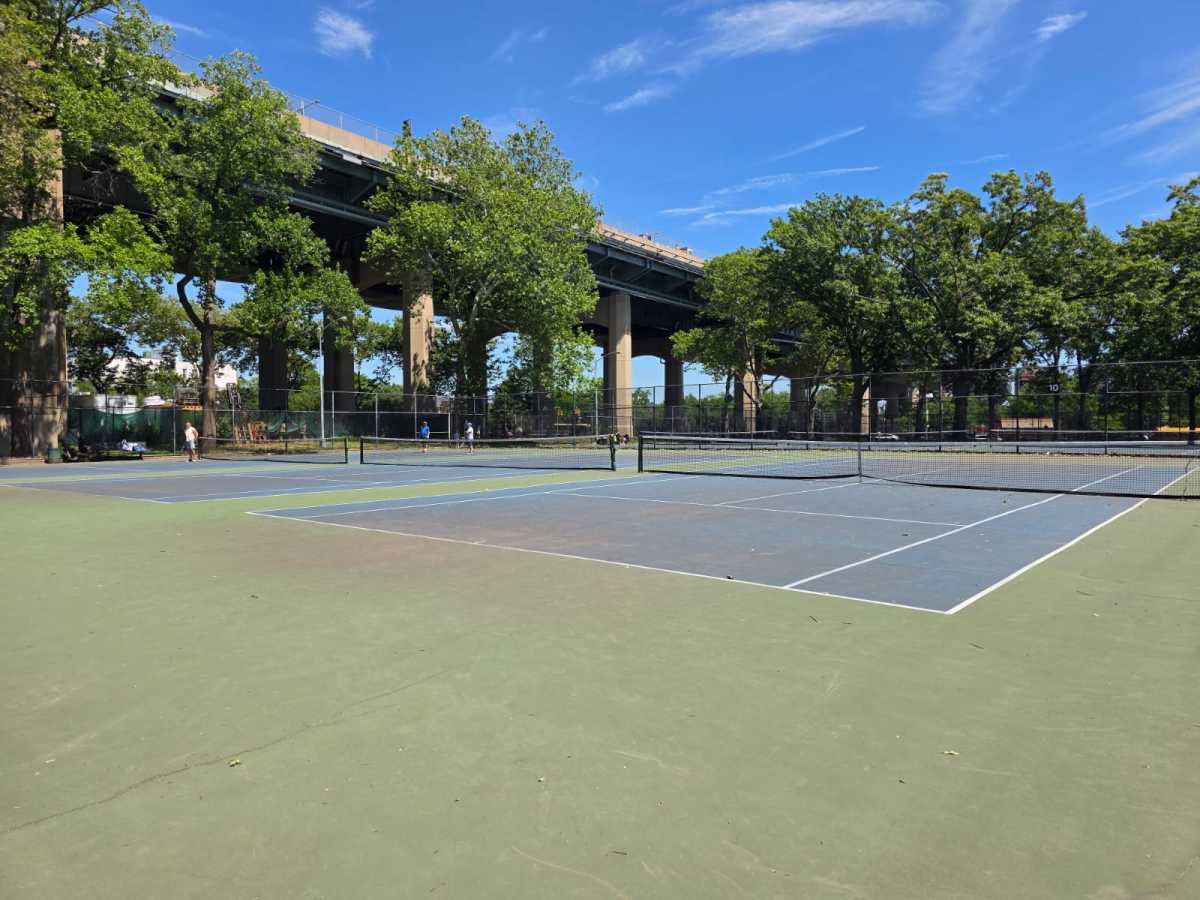
More than 2,500 people have signed an online petition against a proposed private seasonal enclosure at the Astoria Park Tennis Courts, which supporters say would expand access to the courts in colder winter months.
NYC Parks is strongly considering issuing a Request for Proposal for a seasonal enclosure at the courts, citing strong community interest in the initiative. NYC Parks officials said the department was considering a privatized concession model after the successful introduction of models in Cunningham Park and Alley Pond Park.
Officials also pointed to a petition in favor of the enclosure, which has received 336 signatures at the time of writing.
However, a petition in opposition to the measure, which has received 2,516, argues that a seasonal enclosure would mirror issues at a tennis bubble in McCarren Park, where players face hourly rates between $50-100.
Skeptics also pointed to how the McCarren seasonal bubble is in operation from mid-October to mid-April, overlapping with the official outdoor season, which runs from the first Saturday in April through Thanksgiving.
Parks officials insisted that some courts would not be covered by the seasonal enclosure, leaving some courts available for all-around use. Opponents, however, said the enclosure would cover eight courts, leaving a maximum of six courts free for year-round use. That figure, they said, would not be enough to cope with demand on warm days suitable for outdoor tennis.
Chris DeMino, an Astoria resident and frequent user of the courts who signed the petition opposing the measure, said local players want the courts to remain open to all players, “not just a select few who can afford to play there.”
He also raised concerns about a private company using public infrastructure to turn a profit and insisted that if a company wishes to run a private tennis facility, it should rent and convert a warehouse in nearby Long Island City.
“If they want to put up a (tennis) bubble, I’m totally for it… but maybe do it somewhere that’s not already open to the public,” DeMino said.
He is also concerned that the enclosure would encroach on the six courts left open to the public through facilities such as restrooms, further reducing the number of free-to-use outdoor courts.
However, Parks officials said the RFP would seek a requirement that the winning bid carry out improvements of the courts, such as resurfacing and lighting, which would provide more playable hours during the outdoor season. Parks will additionally seek low-cost or no-cost access and youth programming as part of the RFP.
“Parks is strongly considering a Request For Proposal for a seasonal tennis court enclosure at Astoria Park in response to strong community interest, with the goal of expanding public access and improving facilities while preserving the park’s open space,” a Parks Department spokesperson said in a statement.
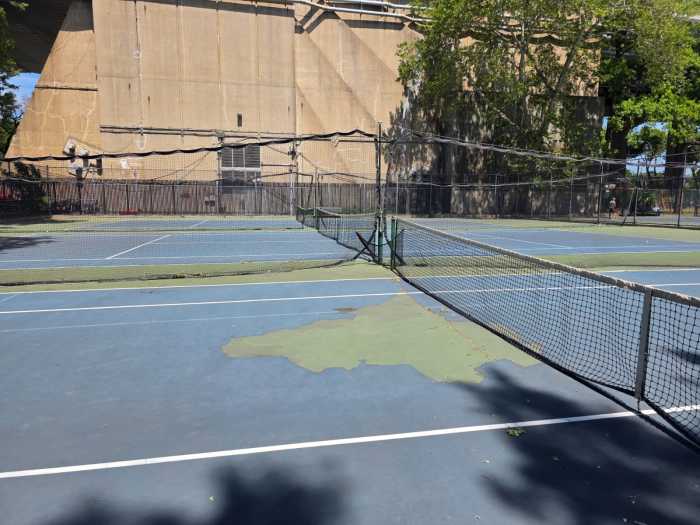 Resurfacing is required at some courts. Photo by Shane O’Brien
Lena Wu, who started the petition in favor of the enclosure, said the measure would help provide badly-needed funding for the courts, stating that conditions at the facility have deteriorated significantly over the past five years. Wu added that she does not believe the city would be able to provide funds to restore and improve the courts without engaging a private operator.
“New York City parks would never have the resources to maintain these courts,” she said.
Wu also asserted that winter weather in the city is mostly not conducive to playing outdoor tennis.
“This past winter was crazy. Even when the weather was ‘warmer,’ the wind was insane.”
Wu also believes that the addition of more seasonal enclosures can help lower prices at existing winter courts around the city by increasing supply to meet demand.
But a significant number of people are against the idea, with DiMino adding that it is almost impossible to get a slot at the McCarren enclosure because of private clinics.
“Sometimes you can’t even get a court at all,” DiMino said. “The rates are as high as $100 an hour, which is a lot of money for the average person.
“There is an incentive for clubs to jack up the rates even more,” he added. “I just don’t think the bubble will be in the best interest of everyone. It’s only going to serve a small niche of people.”
DiMino – and the online petition – have also raised concerns that the enclosure has the potential to become a year-round installation and said the city could “bend the rules” if it sees significant cash flow coming in.
The petition further raised concerns that trees would be cut down in order to make room for the enclosure. Parks officials said the RFP would stipulate that no trees can be removed to facilitate the enclosure.
 Photo by Shane O’Brien
Meanwhile, Richard Khuzami, chair of Community Board 1’s Parks, Recreational and Cultural Committee, told a CB1 meeting last month that the community board had outlined a number of conditions for approving a seasonal enclosure, including a requirement that trees must not be damaged to facilitate it. Khuzami said other conditions included a mandated restroom and that 4-6 courts be left available as free options.
Still, the petition calls on the Parks Department to withdraw plans for a private enclosure, calling for the establishment of a non-profit tennis foundation that would work in partnership with NYC Parks. DiMino pointed to the Fort Greene Tennis Association as a suitable model, noting that the non-profit had made use of community fundraising and USTA grants to resurface all six courts in the park at a cost of $348,000.
“Our priorities would include resurfacing the courts every few years, keeping the nets nice and new and acquiring maintenance tools,” Di Mino said.
Wu, however, questioned whether a non-profit would be able to consistently raise funds to provide continuous upkeep.
“Community fundraising and grants are not guaranteed,” Wu said. “And these are not one-time costs.”
Wu also alleged that she attempted to post her petition in an Astoria tennis group on Facebook but was blocked from doing so by admins, who are opposed to the seasonal enclosure.
“It’s disappointing,” Wu said. “I just thought fellow tennis players would be interested.”
DiMino, meanwhile, expressed fears that privatized tennis courts would prove prohibitive for low-income and first-time players.
“New York City is about everyone having an opportunity to play in the park,” he said.