
CHICAGO — Jeff Blashill has been addicted to watching this season’s Stanley Cup playoffs.
For the coach of the Chicago Blackhawks, that’s not all that surprising. But it’s not like he hasn’t been an NHL coach before.
“I would say, I’ve probably watched more of this playoffs than I have ever,” Blashill said on a recent afternoon in his office at the Blackhawks Ice Center, the team’s practice facility. “Not to say I hadn’t in the past, but I’ve watched a lot and from a lot of different angles. A little bit of the coaching decisions, you know, matchups. How hard are teams matching? What are their tactics when they’re trying to match certain players? To calling timeouts, to challenging, to all those things, just seeing what other coaches are doing.”
Then, he’s looked at the style of play.
“I’m a huge believer there’s a lot of different ways to play hockey,” Blashill said. “I know that because different teams win a lot in different ways. So, there isn’t like a style that has to fit your personality, your team. But within the different styles of the way teams play, what’s a common factor in success? For example, if you want to score in this league, you have to be really, really hard at the net. And that just shows in the playoffs over and over and over again. It’s just a good reminder to me that, hey, that’s gotta be a priority coming into next year, things like that.
“So, it’s been fun to watch. And just different players having success and how they’re having success and why? Is it the right chemistry? Is it the team at the right time? Is it all those things? So just kind of watching all that has been a good continued education process for me.”
It’s been nearly two months since Blashill and the Blackhawks played their last game. He has mostly been at his home in Florida since then and will spend time in Michigan for another part of the summer. During a brief stop back in Chicago, Blashill sat down with The Athletic to talk about the playoffs, this past season, the future and more. This is part one of the interview.
(Note: Questions and answers have been lightly edited for length and clarity.)
Do you feel like you saw a defined playing style from the Blackhawks this season?
It’s a good question. I think I would say, yes and no. Yes, in a sense that I think our guys understand certain things that are important to me — taking time and space away, pressuring in almost what I would call smart pressure, some of what we talked about in the penalty kill. But I also think it’s hard to really show your identity as a team when you don’t have the puck enough, and we didn’t have the puck enough. I think that’s just for numerous reasons, mainly because we’re really, really young. And so, I think your style gets more on display as your team grows and continues to get better and better.
Do you think you want to do anything different next season?
I would say, from a systematic standpoint, I wouldn’t anticipate any big changes within our systems. One of the advantages I think that teams have that have been together for a while is that systems become second nature to them. And so, you don’t have to think about them. You don’t have to practice them as much. And then, you can practice different things. So, I think from a systemic standpoint, don’t anticipate major changes.
I thought from an offensive standpoint, our expected goals on line rushes … was fairly good. From an offensive zone standpoint, I think there’s more offense to be created in our O-zone. A little bit of where our emphasis is in the O-zone is something we’re going to look at through the course of the summer and make sure we have a good plan. Other than that, systematically, it’ll be similar, which is important too because our training camp’s shorter and we’re playing more games.
Beyond that, I think it becomes what are some key factors that are points of emphasis? Certainly, we want to continue to grow our habits, our daily habits. I think a piece of it is making sure we emphasize winning puck battles. We have to continue to win more of those 50-50 puck battles. That’s where a lot of offense comes from, to be honest with you, is kind of a puck battle wanting to transition, and it goes back the other way. I look at — it wasn’t a puck battle off a turnover, but a transition goal, I think, Carolina scored in its second goal (in Game 2). That kind of quick transition out of either a turnover or a loose puck recovery and you go. So, that’s an area that we’re going to emphasize.
We’ll see what the offseason brings, but Anton Frondell finished the season in the NHL, and Roman Kantserov is signed. It seems like you have potentially two top-six players you didn’t start last season with. What can that change?
I’ve seen Frondell up close, having come here and played for us. In Kantserov, I’ve watched a lot on video. Certainly, until you kind of get right in the action, you never know for sure exactly what you have. But I think in both those guys, we have guys that are going to be top-six players, and as soon as next year. Will they have their ups and downs? Yes. And can we expect them to just hit the ground and everything to be great? No, there’s gonna be adjustment time, whether it’s right away, whether it’s at Game 52, who knows, but there’s going to be learning the league.
Kantserov has played a number of years of pro. Frondell had the advantage of playing some years of pro before this. They both have what I think are really complete games, and I think that’s probably the No. 1 barrier for young players coming in terms of gaining the ice time they want is when they don’t have complete games. These guys already have complete games, so that’s gonna help their adjustment. But there’s still gonna be an adjustment. There’s still going to be ups and downs.
They’re both really, really, really talented players. You know, as a coach, when you get the opportunity to be able to help really talented players grow and get better, that’s all you want. Then both of them, I think, from a personality standpoint, seem to be really A-plus people, A-plus competitors. So it’ll be fun to add both those guys to our mix. I think they’re going to help us be better. I know they’re gonna help us to be better long term. I think they’ll help us better pretty quickly. But we’ll see how quickly, based on their adjustments.
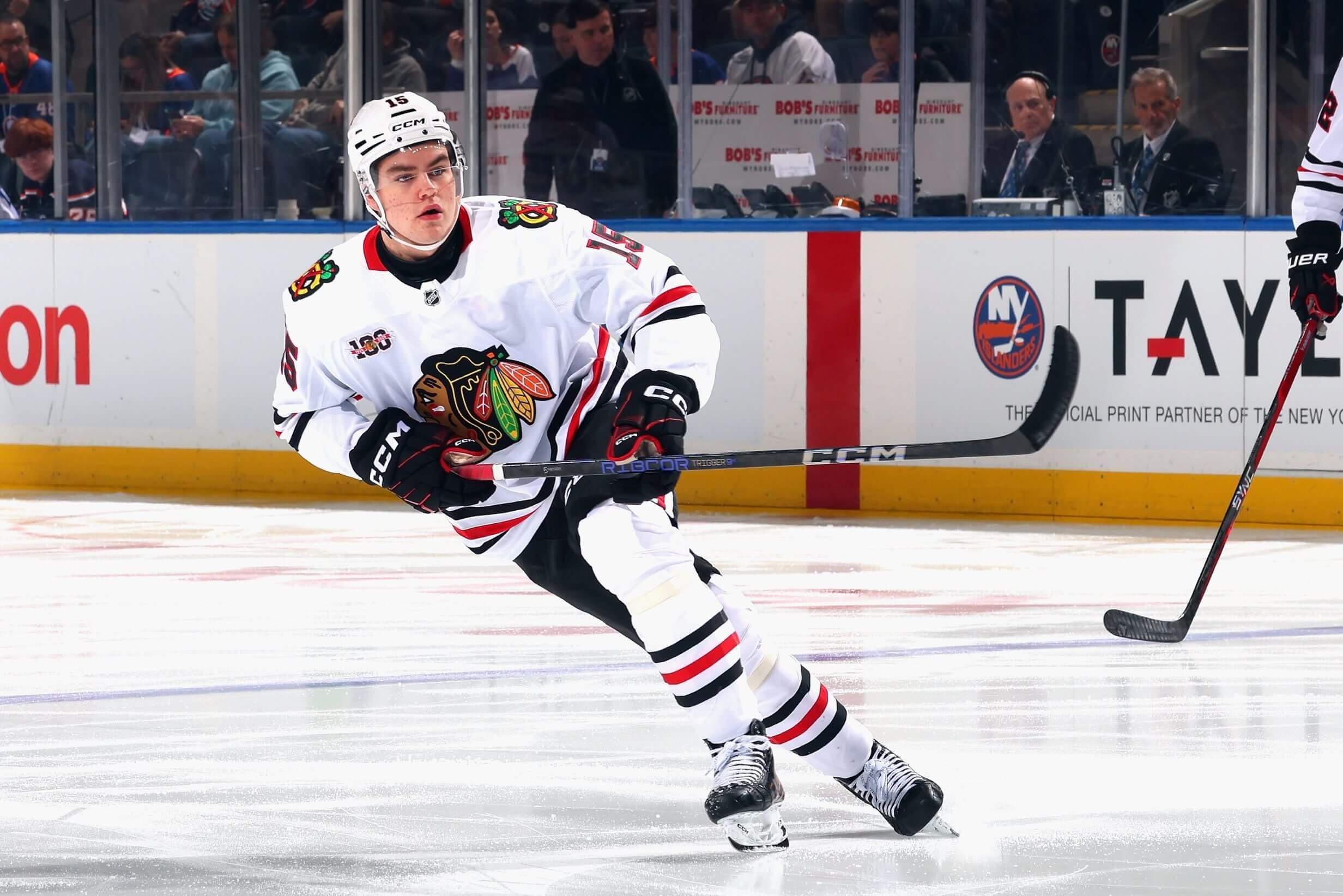
Anton Frondell got a taste of the NHL last season. Now, a full season awaits. (Bruce Bennett / Getty Images)
You started Frondell at wing, but you already had in mind a big-picture plan with him at center. Where do you see Kantserov fitting in?
It’s a good question because Roman played a lot of center this year and liked it. He and I spoke about that. First off, I would say, and Anton said this to me as well, the way that we play, there’s a lot of interchangeable pieces between centers and wings, so it’s probably not as big a deal either way as maybe it’s made out to be at times. Anton, I think, at his kind of size and based on the team we have, I just felt long-term with his skill set that he was a really good fit to kind of be a center on our hockey team. I think Roman could do either. I really do. But I also think, you may end up playing wing to put him in a position to play with players that I think that he kind of can, I guess, exponentially be better with.
I certainly have had a lot of times in my own coaching career where, first off, seeing other teams that do it, no different than maybe like a (Leon) Draisaitl and a (Connor) McDavid, where they at times play apart, at times play together. I had Pavel Datsyuk and Henrik Zetterberg, who would play center, but then at times they would play together. And when those guys played together, it didn’t matter who was the center. And so, whoever I piece Roman with, it’s not gonna matter who’s the center. They’re both gonna spend time down low in D-zone coverage. They’re both gonna spend time in the middle of the ice. I think Roman’s skill set, he can be equally as good at wing as at center and vice versa. I think it’s great to be able to add somebody with that type of versatility, but yet that type of high-end skill set.
What was your takeaway from playing five forwards on the power play?
I liked it. I thought Connor (Bedard) was very, very good up top. He did a really good job of condensing the zone, did a good job of distributing the puck. He did a very good job of being a shot threat. Whether it’s the right thing for us next year, that kind of remains to be seen based on the group that we have. He’s a little further from the net, so it probably takes some of his scoring threat away as just a pure scorer. So, we’ll see what the best fit is. I think he enjoyed it. I liked him up there.
I think the key to five forwards in a power play is that the guy who was up there is really good at it. I’ve done it before with five forwards, and it didn’t work because the guy just wasn’t comfortable up top. When I watched Mitch Marner (in the Stanley Cup Final), he was very comfortable up top. Now, Mitch and Connor are different players, but he’s certainly really comfortable up top, and I thought Connor was too. But if somebody else is equally as good up there, and Connor can play the flank and be a little close, that can make sense, too. So, we’ll see where it goes.
Do you feel like that’s an incentive for Artyom Levshunov, Sam Rinzel or Kevin Korchinski to win that spot in training camp?
I’m sure they want that position. Yeah, for sure you want that. If you’re one of those guys, you want that position, and so, come in and be great at it. I think that competition’s an important piece of this, too. I think we let a number of those guys, certainly two of those guys that you mentioned, get lots of opportunity up there, and that was part of our plan. But also part of it is, at some point, you’ve got to grab it and be good at it. So, if one of these guys comes into camp and looks like they’re great right up top, maybe that moves Connor to the half wall. If not, maybe Connor stays up top. We’ll see where it goes.