
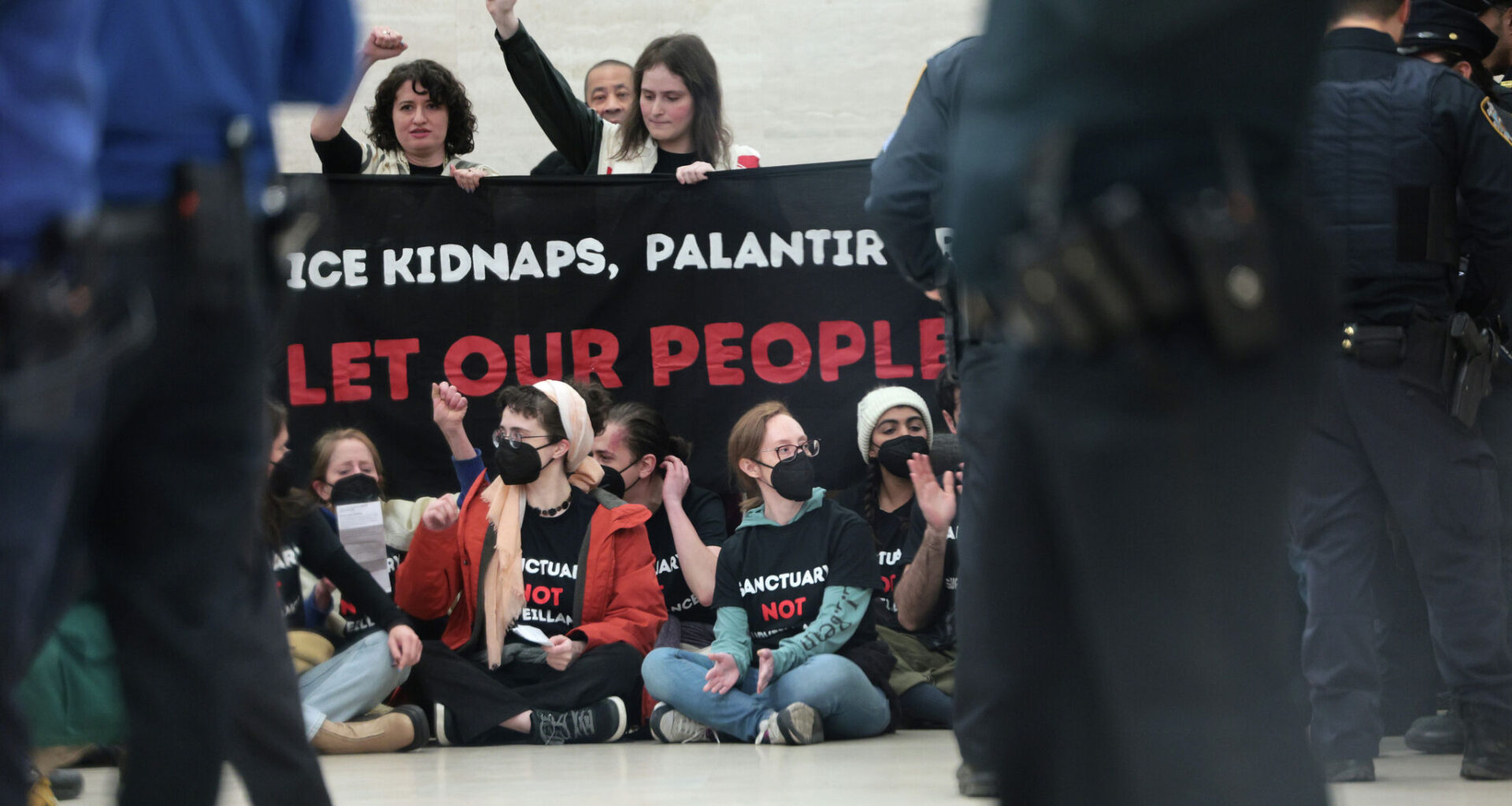
Protesters occupy the entrance to the New York City offices of Palantir. The state pension fund’s investment in the tech giant has become a flashpoint in the race for state comptroller, with two progressive challengers hitting incumbent Thomas P. DiNapoli on the issue.
Michael M. Santiago/Getty Images
ALBANY — Raj Goyle and Drew Warshaw have spent much of their respective campaigns for New York state comptroller arguing that stock investments carry ethical obligations.

As they vie to become the steward of one of the largest public pensions in the country, the two progressive Democratic candidates believe that duty should involve divesting from companies that support immigration enforcement, the fossil fuel industry and other business pursuits they disfavor.
Article continues below this ad
At issue in Thomas P. DiNapoli’s first primary fight since taking office nearly 20 years ago is whether the investment power of New York’s nearly $300 billion public pension fund should be deployed to exert political and ethical pressure. Goyle and Warshaw want to redirect those assets to help everyday New Yorkers shoulder the state’s high cost of living into companies that better align with progressive values.
The other path, followed by DiNapoli, is to continue the passive, broadly diversified strategy that has guided the fund since the 1970s.
One of Goyle and Warshaw’s most visible targets is Palantir Technologies Inc., a multi-billion-dollar analytics company in which the state pension fund has invested millions of dollars. But until recently, Palantir was also part of the investment portfolios of the two Democratic challengers.
Make the Times Union a Preferred Source on Google to see more of our journalism when you search.
Add Preferred Source
In fact, all three of the Democratic candidates competing in the June 23 primary have reported personal investments tied to Palantir and other companies that have formed the backbone of President Donald J. Trump’s immigration enforcement dragnet.
Article continues below this ad
Raj Goyle, a Democratic challenger for New York state comptroller, has been the most vocal critic of the public pension funds invested in Palantir.
is interviewed ahead of his primary on Monday, June 8, 2026, at the Capitol in Albany, N.Y. (Will Waldron/Times Union)
Will Waldron/Times Union
Those investments also include Amazon, telecommunications giant AT&T and the company that runs Delaney Hall, a New Jersey immigration detention center that has become the most recent flashpoint in Trump’s immigration crackdown.
When questioned about their personal investments and how they square them with criticism of the state pension fund’s management, both Warshaw and Goyle told the Times Union they have since dumped their holdings in index funds with investments in Palantir.
Both said they had divested from the Palantir-linked funds while DiNapoli had not.
Article continues below this ad
‘Untested, unfounded’
DiNapoli said the pension fund’s investment decisions should not be driven by the question of whether a company is drawing political scrutiny at the moment; the goal is delivering steady returns, a strategy that has nearly doubled its assets during his nearly two-decade tenure.
“Whatever strategies they’re talking about are untested, unfounded and run the risk of really undoing and jeopardizing the retirement security of our 1.3 million members,” DiNapoli said.
Broad market indexes are a cornerstone of the pension fund’s investment strategy, he said, and excluding companies based on political controversies could undermine performance.
Article continues below this ad
Rather than divest, DiNapoli said the state can use its influence as a shareholder to pressure companies to change their behavior. In 2022, for example, he announced an investigation of whether more than two dozen fossil fuel companies were prepared for the transition to a lower-emission economy.
Both Warshaw and Goyle reject DiNapoli’s argument.
They said the comptroller can make investment decisions that could exclude companies, such as Palantir or fossil fuel firms, without abandoning the fund’s financial objectives.
Candidate for state comptroller Drew Warshaw.
Will Waldron/Times Union
Warshaw, a former affordable housing executive and aide to former Gov. Eliot Spitzer, said DiNapoli has overstated how passive the fund actually is, pointing to hundreds of outside investment managers employed by the retirement system. He said that retirees’ benefits are constitutionally protected and that taxpayers, not pensioners, ultimately bear the cost when the investment returns fall short.
Article continues below this ad
Goyle, a former member of the Kansas House of Representatives, said that the comptroller already makes active choices about how the fund is invested. That includes selecting benchmarks and choosing private equity investments.
In Goyle’s view, excluding companies such as Palantir would not represent a radical departure from the fund’s current management but rather an acknowledgement that the investment decisions already reflect value judgments.
But the debate over divestment often assumes that it is a powerful tool for changing corporate behavior, said Bruce Usher, the co-director of Columbia Business School’s Tamer Institute for Social Enterprise and Climate Change.
In practice, the impact of disinvestment is limited: “You’re simply transferring the shares to someone who says, ‘I don’t care,’” Usher said.
Article continues below this ad
Usher noted that it’s shareholders who retain voting rights and can engage with corporate leadership, while investors who sell their holdings surrender those rights and lose a mechanism for advocating change.
Rising stock in Palantir
Pension fund managers from California to New York City are facing pressure from groups that want them to pull money out of companies associated with the Trump administration’s policies as well as from fossil fuel firms. Palantir, founded by tech billionaire Peter Thiel, has contracted with the U.S. Immigration and Customs Enforcement for more than a decade.
In February, citing concerns about potential civil rights implications, New York City comptroller Mark Levine requested an independent investigation of Palantir. But Levine has stopped short of saying he would divest from the company.
Article continues below this ad
As pressure mounted in opposition to New York City’s investments in Palantir, Goyle became particularly vocal on the issue. In April, he rallied with activists outside of Palantir’s Manhattan office.
Last month, the Democratic candidates sparred over the direction of the pension fund during a contentious televised debate. Warshaw opened his shirt to show a T-shirt that said “ICE Out,” and Goyle lambasted DiNapoli’s use of retirement funds to purchase Israel bonds — due to that nation’s conduct of the war in Gaza — and buy shares in Palantir.
Goyle noted that in 2025 New York’s fund significantly increased its investment in Palantir. He said the increase demonstrated an active investment decision by DiNapoli’s office and accused him of misleading the public by describing the position as passive.
Almost 40% of the fund’s assets are invested in publicly traded equities that attempt to reflect the broader economy. The number of shares the fund owns rose sharply in the last year, increasing in value from nearly $90 million to $339 million in that period.
Article continues below this ad
A significant portion of the fund’s assets are invested through indices that mirror benchmarks created by a firm called FTSE Russell.
That financial company regularly reshuffles its indices by adding, subtracting or reweighting companies based on market performance. The refresh process forces fund managers to adjust portfolios that reflect the new weightings and components.
FTSE Russell’s restructuring reflected Palantir Technologies’ rapid stock gains in the previous year. New York’s pension fund subsequently adjusted its holding to match the benchmark.
So did New York City’s public pension fund, as well as the state and city teacher retirement funds, and others across the country. The total value of shares in Palantir has over the past year risen but then fallen back; it’s currently hovering near its June 2025 price.
Article continues below this ad
Goyle said that while FTSE Russell determines the composition of the state pension fund’s indexes, the comptroller chooses which benchmarks to follow and how the pension fund is structured.
Warshaw said the customized indexes that omit companies such as Palantir or fossil fuel producers are commonplace on Wall Street and could be adopted by the state pension fund without abandoning a broader passive strategy.
But carving companies out of benchmark indexes risks distorting the portfolio and weakening performance, DiNapoli said. “It would throw our indexes out of whack to the point that it would be hurtful for our bottom-line return,” he said.
DiNapoli has rejected calls to divest from Palantir, saying such a move would constitute an active investment decision driven by public policy concerns rather than fiduciary obligations to pension beneficiaries.
Article continues below this ad
Rather than divest, DiNapoli said he believes the state can use its influence as a shareholder to pressure companies to change behavior.
‘Continued concerns’
DiNapoli said his office has “continued concerns” about Palantir’s relationship with ICE and has been pressuring the company for more information about why it continues to maintain its relationship.
He has also sent letters to other companies with ICE contracts — including Amazon, Microsoft, Motorola and others — touching on potential financial and reputational risks associated with the contracts.
Article continues below this ad
The state comptroller has also filed lawsuits on behalf of the fund as a shareholder to raise concerns with companies about risks that could affect long-term value, including corporate governance issues, executive misconduct and government contracts.
Thomas P. DiNapoli has been state comptroller since 2007, when he was initially appointed by the state Legislature to fill the role following the resignation of Alan Hevesi.
Times Union/Rick Karlin
His office said its conversations with Palantir are ongoing, and pointed to incidents in which shareholder engagement had yielded positive change. They include Amazon’s 2024 racial equity audit and National Grid’s decision not to renew membership in a climate-policy lobbying group.
Warshaw said shareholder engagement can be useful, but only up to a point. If a company refuses to change a business model that investors consider financially risky, he said, the threat of divestment becomes part of the comptroller’s fiduciary duty.
Article continues below this ad
Goyle also said shareholder advocacy has a role, particularly with large technology companies such as Amazon. But he said that DiNapoli has failed to use the pension fund’s leverage aggressively enough, saying letters alone have not produced meaningful changes at companies such as Palantir.
Columbia’s Usher said that both supporters and opponents of divestment often overstate its practical significance. In his view, divestment is primarily symbolic because it does little to alter corporate conduct or public policy outcomes.
Warshaw and Goyle disagreed, arguing that divestment by a fund as large as New York’s would send a broader market signal and reduce exposure to companies they view as financially risky.
For Warshaw, that includes oil and gas investments.
Article continues below this ad
DiNapoli said that even pension funds — such as New York City’s — that are often cited by divestment advocates have not fully abandoned fossil fuel holdings. His office has divested from some coal and fossil fuel holdings, but he said broader exclusions from index funds could hurt the fund’s returns.
Personal investments
All of the candidates vying for state comptroller have disclosed investments with ties to Trump’s federal immigration crackdown, according to financial disclosures filed with the New York State Commission on Ethics and Lobbying in Government.
AT&T is DiNapoli’s single largest individual holding and is valued between $150,000 and $250,000. The holding stems from his telecommunications career before his election to the Assembly in 1986.
Article continues below this ad
The telecommunications giant was awarded $90.7 million in 2021 — during the Biden administration — to provide ICE with IT, network products and support. The contract included a potential end date of 2032 that could push the deal’s value to $165.2 million. Among DiNapoli’s other holdings is a Vanguard Wellington Admiral mutual fund, valued between $50,000 and $75,000, that includes Palantir in its portfolio.
DiNapoli rejected the notion that investments should be judged on whether a company does business with the federal government, regardless of who’s in the White House. He noted that many large corporations have government contracts and argued that pension managers cannot continuously reshape portfolios around which company is under political scrutiny.
“You can’t manage your pension fund by whatever the political hot potato is and then suddenly start moving all your money around,” DiNapoli said.
Warshaw has owned stock in an index fund with Palantir holdings that was valued between $20,000 and $50,000, according to reporting by independent journalist Timmy Facciola, who authors the newsletter Judge Street Journal. Warshaw told the Times Union he sold the fund last month and replaced it with another index fund that doesn’t include Palantir.
Article continues below this ad
He also invested in a Vanguard extended market index fund, which includes the GEO Group, Inc., the Florida-based private prison company that operates immigration detention centers, including New Jersey’s Delaney Hall.
Warshaw said his decision to replace the funds with alternatives that excluded Palantir and GEO Group demonstrated that investors could maintain diversified portfolios while screening out specific companies.
Goyle disclosed owning an S&P index fund worth between $500,000 and $750,000. The index’s holdings have included Palantir since 2024.
Goyle said he sold the fund earlier this year, but could not recall when. He said the sale reflected the same standard he wants applied to the state pension fund.
Article continues below this ad
In financial filings, Goyle also disclosed owning stock valued at $250,000 to $500,000 in Amazon, which is contracted to provide the U.S. Department of Homeland Security’s primary cloud data storage.
Asked why he would not divest from Amazon, Goyle pointed to his proposal to place his assets in a blind trust if he’s elected comptroller. He said that the state’s much larger stake in the company gives the pension fund leverage that individual investors do not possess.