
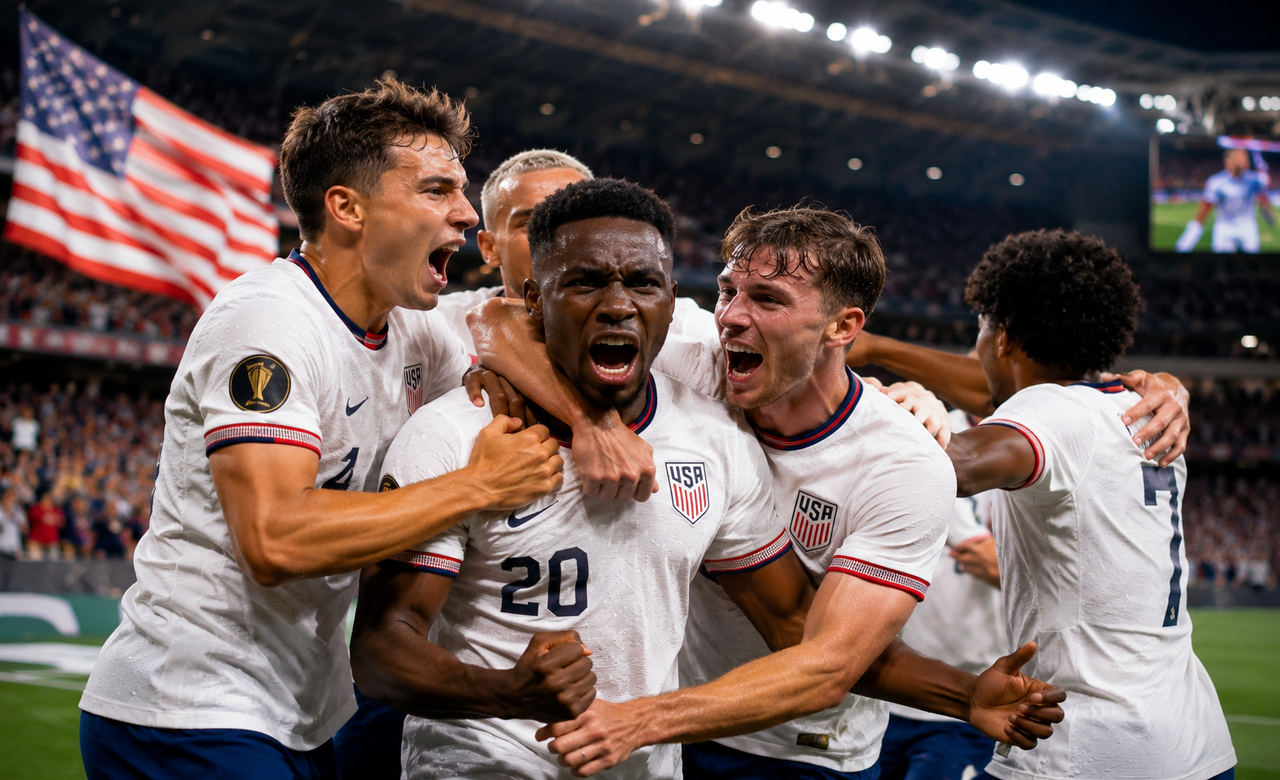
For years, American soccer has existed in a space between promise and expectation. Each generation seemed to edge closer to a breakthrough without ever fully achieving it. This time, however, the feeling is different. In its opening match of the 2026 FIFA World Cup, the United States did more than win. It convinced. And in a tournament where first impressions often shape the narrative, the 4-1 victory over Paraguay delivered something more significant than three points: the sense that the host nation is prepared to compete with an ambition that extends well beyond the simple obligation of playing on home soil.
The result itself was emphatic. Yet the true value of the American performance lay in the way it was constructed. From the opening minutes, Mauricio Pochettino’s team displayed an intensity rarely seen in previous editions of the national side. High pressing, rapid ball recovery and explosive movement into open space turned the match into a constant challenge for a Paraguayan defense unable to cope with the pace imposed by the hosts.
The most visible figure was Folarin Balogun. The striker scored twice and added a memorable chapter to his growing story with the national team. Yet reducing the victory to an individual performance would overlook the collective dimension of a squad that appeared to operate with a level of synchronization seldom seen on major international stages.
The United States attacked with determination, but also with intelligence. Every ball recovery became a transition opportunity. Every forward movement was supported by coordinated runs and precise positioning. Rather than succumbing to the anxiety that often accompanies host nations, the team embraced a direct, aggressive and efficient style of play.
That blend of speed and precision was arguably the most striking aspect of the performance. For long stretches of the match, Paraguay seemed to be reacting a step too late. Whenever it attempted to reorganize defensively, the Americans were already launching another attack. Whenever it tried to build from the back, the relentless pressure forced mistakes that further reinforced U.S. control of the game.
Mauricio Pochettino’s influence is becoming increasingly evident. Since taking charge, the Argentine coach has emphasized the need to build a competitive identity rooted in intensity, collective commitment and the courage to take risks. Against Paraguay, those ideas ceased to be theoretical concepts and became a tangible reality on the field.
The victory also revealed an emotional maturity that may prove just as important as the team’s footballing qualities. The stage was enormous. It was the first men’s World Cup match played on American soil in more than three decades. The stands were packed. Media attention was immense. Expectations were unavoidable. Yet the team responded with composure.
At the heart of that stability stood an unexpected figure for many observers: Tim Ream. At 38 years old, the defender became the oldest player ever to represent the United States in a World Cup. Far from being overwhelmed by the intensity of the occasion, he provided leadership, tactical awareness and distribution from the back that helped launch numerous attacking sequences. His presence served as a bridge between experience and the energy of a predominantly young squad.
The performance also offered encouraging signs regarding the team’s depth. Gio Reyna came off the bench to score and add creativity. The midfield controlled large portions of the match. The attacking line generated chances with remarkable consistency. Beyond the individual names, the display suggested the existence of a solid structure supporting the team’s talent.
Naturally, one match does not define a World Cup. The challenges will become greater. Australia awaits in the next fixture, followed by opponents capable of demanding much more both defensively and tactically. The tournament is only beginning. Yet teams that aspire to leave a lasting mark often send early signals. The United States has just sent one of them.
Perhaps the most significant takeaway was not the scoreline or the record-setting offensive output. It was the confidence the team projected. For decades, American soccer sought legitimacy among the sport’s traditional powers. Now it appears to be pursuing something different: relevance and influence.
The 2026 World Cup represents a historic opportunity for the growth of soccer in the United States. The country possesses the infrastructure, financial resources and expanding fan base necessary to support the sport’s continued rise. What it needed was a national team capable of reflecting those strengths on the field. Against Paraguay, at least for one night, it appeared to have found one.
It remains far too early to discuss championship credentials. The European and South American giants still occupy that territory. Yet World Cups have a habit of rewarding teams capable of evolving as the tournament progresses. And if this opening performance is any indication, the United States has begun its journey with a combination of speed, determination and efficiency that demands attention from the rest of the field.
The victory over Paraguay was far more than a positive result. It was a statement of intent. And in a World Cup played partly on home soil, that message may resonate far beyond Los Angeles.