
(TNND) — Another report pointed to weakness in the housing market, as builder confidence fell two points to a Housing Market Index reading of just 35 in June, according to the National Association of Home Builders.
Fifty is the break-even point in the 0-100 Housing Market Index scale, so 35 is squarely in pessimistic territory.
The NAHB said Monday that June marks the 14th straight month that builder sentiment has stayed under 40, a streak not seen since 2011 and 2012 during the foreclosure crisis.
Builders are surveyed on current and expected sales, as well as how much foot traffic they’re getting from prospective buyers. All three index components were within a range indicating unfavorable conditions for builders, with the customer traffic component especially low at just 25.
NAHB Chief Economist Robert Dietz said in a news release that “costly and inefficient regulatory policy” was hurting builders’ ability to increase housing supply. Dietz said a NAHB study determined that government regulation, taxes, fees and other costs add more than 26% to the price of an average single-family home.
Bankrate Financial Analyst Stephen Kates said regulatory costs vary from state to state. California, for example, has “extremely high” regulatory costs, he said.
But builders in a lot of markets are simply having to work harder to get people to buy their homes, Kates said.
The NAHB said nearly a third of builders cut prices in June, with the typical reduction at 6%. And close to two-thirds used sales incentives to help move their homes off the market.
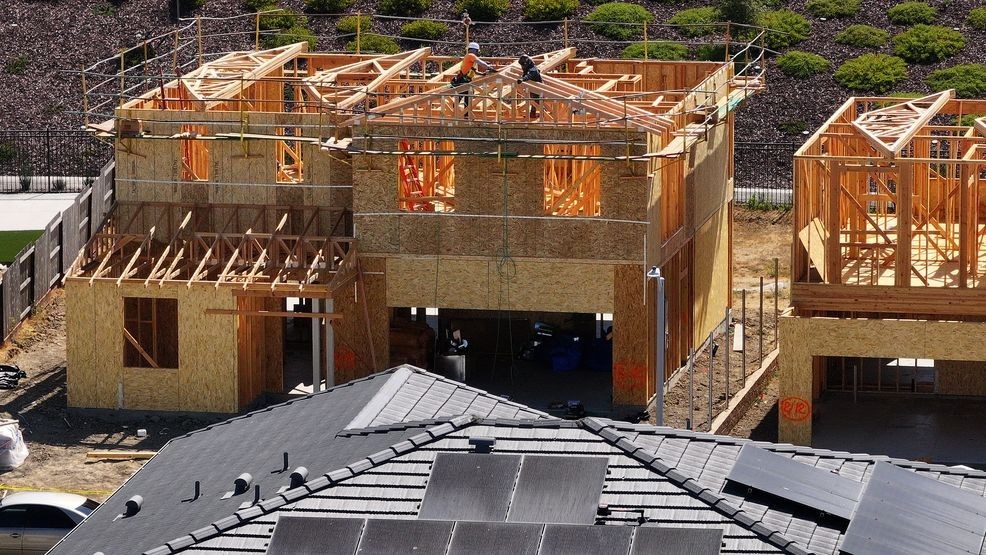
FILE – In an aerial view, construction workers build a home at a new housing development on July 1, 2025, in Richmond, Calif. (Photo by Justin Sullivan/Getty Images)
The NAHB said June marks the 15th consecutive month that the use of sales incentives topped 60%.
“They can’t sit on something for a couple of years and wait for the market to recover,” Kates said. “They’re trying to churn those things out in a couple of months.”
And the struggles builders are having now might mean fewer housing starts and fewer new houses hitting the market in the next six to 12 months, Kates said.
Builders’ overall mood is “poor to very poor,” Kates said.
And Kates said homebuyer traffic is a “major pain point” for builders.
“If you are financially capable, this could be a great time to buy,” Kates said.
While builders have levers to pull to try and overcome customers’ affordability challenges, existing homeowners and prospective buyers in the resale market are often far apart, Kates said. And current homeowners with lower mortgage rates locked in have an incentive to stay put, which caps supply.
Lawrence Yun, the chief economist for the National Association of Realtors, told The National News Desk last week that housing supply is still too low. And he said supply could easily tighten if home sales rise, a potential counterpunch to housing affordability if mortgage rates cool enough to entice more buyers.
The average 30-year fixed-rate mortgage is now 6.52%, according to Freddie Mac. That’s down from around 6.8% a year ago but remains a significant cost hurdle for buyers already dealing with home prices that have jumped a whopping 50% or so over the last six years.
Price increases have slowed considerably compared to a few years ago, but the National Association of Realtors still reported last week that the typical resale home hit a May record of $429,300.
The median price for a new house sold was $422,500 as of April, according to the latest figures from the Census Bureau.