
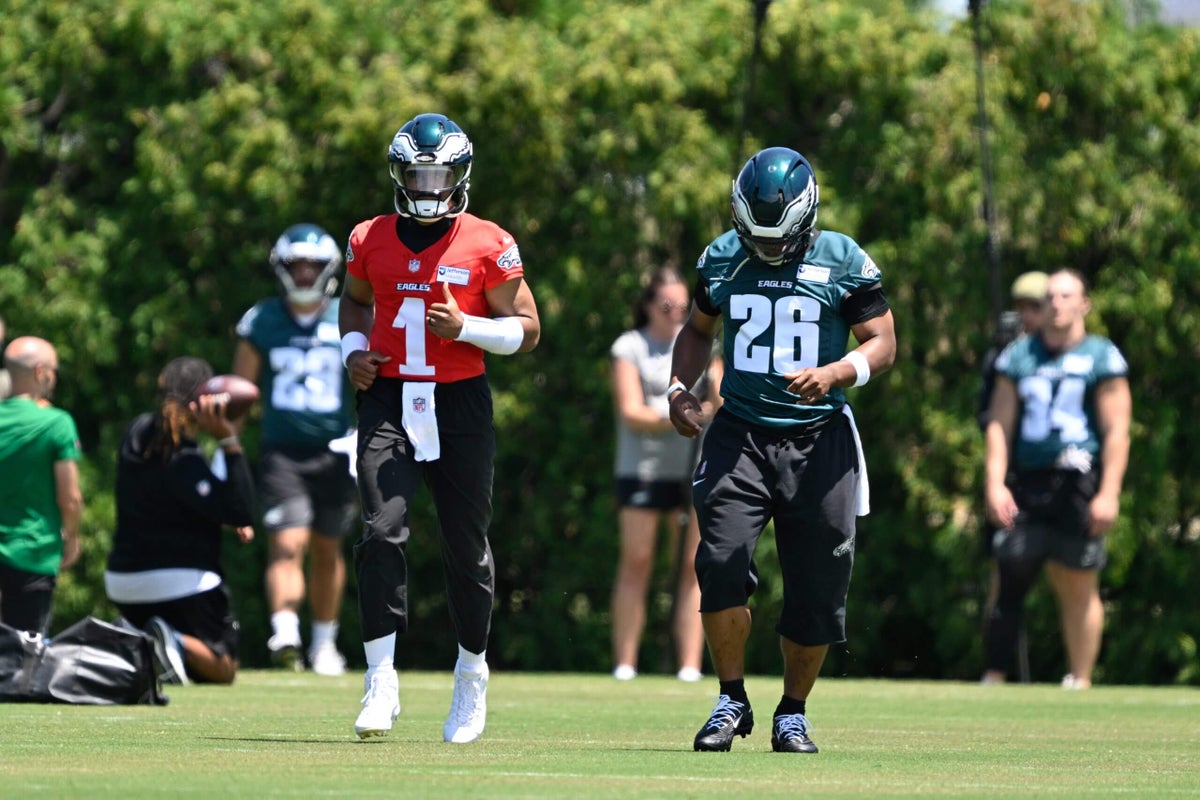
PHILADELPHIA — The Eagles concluded their offseason program this week, starting six-plus weeks of summer break before training camp begins, a stretch of football the organization hopes extends into February. A busy spring included eight practices and 16 times on the field, an installation of a new offense, a blockbuster trade of A.J. Brown to New England and the draft weekend deal to acquire Jonathan Greenard that headlined the Eagles’ acquisitions.
So, what were our major takeaways from the Eagles’ spring? The Athletic’s Zach Berman and Brooks Kubena answered the questions here:
What I learned about Sean Mannion’s offense…
Kubena: Perhaps more important than the new concepts themselves, which are only just emerging, is a strong sense coming from key players that Mannion’s plans are comprehensive, organized and pragmatic. The same could not be said in 2023 or 2025. Nick Sirianni’s stories about Mannion’s work ethic are appealing.
But it’s more revealing to hear Jalen Hurts say he can see Mannion’s vision, to hear Lane Johnson say they’ll be able to evolve and be more efficient. The Eagles failed to establish an identity in 2025, and it seems one is already surfacing — one that blends both the past and present, as Sirianni insists annually. Johnson said they can leverage their new concepts, which include more wide-zone runs, to wear defenders out by making them cover significant ground, then “really tee off on them” by possibly pivoting to a more power style later in games.
The Eagles indeed have the talent and intelligence to fulfill multiple schemes, as Kevin Patullo attempted last year. A more intentional approach — as Cam Jurgens described, “you want to be the one with the foot on the gas” — will serve them well.
Berman: The first impression is that it looks different in the spring. If you wanted change, the Eagles have already displayed concepts that have not been heavily featured in past years. They’re under center more than they’ve ever been. The wide-zone running scheme is on display. You’re seeing more motion and movement.
The Eagles are in the basic installation stages at this point, so the offense will be more refined and customized by the time they play in Week 1. But the scheme change is real. Johnson used the term “evolve.” Further, you made the most important point about how players feel about this. My sense of excitement and intrigue is genuine. You’ll never hear players tell you an offense isn’t going to work in June — this is the time of year for optimism — so it’s important to distinguish banal platitudes from substance.
When Johnson and Jurgens show how this can meaningfully maximize the group, and Saquon Barkley points out how this can enhance the run game, you realize the vision. “Not saying we’re going to be better, there’s a lot to learn,” Johnson said. “But I think we have the ability to be more than we were last year.”
What I learned about Vic Fangio’s defense…
Kubena: This looks more like the sort of drive-killer defense Fangio fielded in 2024. Super Bowl LIX embodied a top-ranked unit in both three-and-out percentage (39.0) and yards per drive (26.7). The 2025 defense’s three-and-out percentage ranking dropped to 23rd (27.8) and dropped to 11th in yards per drive (29.4), which is somewhat owed to an uptick in reliance (the offense’s three-and-out percentage was its highest since 2008).
But last year’s defense was also younger, more prone to mistakes and had significantly less depth — especially at edge rusher. This year’s defense made the offense fight for every yard in OTAs and minicamp, and it’s not hard to imagine that continuing throughout the season. They look physical in the secondary. Riq Woolen’s size and strength offer more press coverage opportunities for Fangio, who spent last season masking his shortfall at CB2.
Philly’s front owns a tough reputation, but Jalen Carter, Jihaad Campbell and Jonathan Greenard did not participate in team drills this offseason while managing shoulder injuries. Those red flags won’t go down fully until seeing them in action.
Berman: The defense is the biggest reason for optimism about the Eagles and raises their floor on the season. It was so far ahead of the offense this spring, which you would expect: It’s Year 3 in Fangio’s scheme and they return seven starters from last year. Woolen is a major upgrade at cornerback, giving the Eagles the best cornerback trio in the NFL.
The defensive front is loaded and in the primes of their career. We didn’t see Carter or Greenard in team drills this spring, so the Eagles will add two blue-chippers to a front that includes Jordan Davis, Moro Ojomo, Jalyx Hunt and Nolan Smith.
It’s hard to say this will be Fangio’s best defense because the defense finished No. 1 in 2024, but the personnel might be better and they have experience in the system. Zack Baun said Fangio is ready to take the defense to a “different level” because of the familiarity with the players. That should be a scary thought for opposing offenses.
What I learned about Jalen Hurts…
Kubena: Much has been made of Hurts’ resistance to some of the 2025 offense’s direction under Kevin Patullo. The more removed the Eagles are from that inefficient season, the more players (including Hurts) endorse the new direction under Mannion, and the more it seems Hurts’ resistance was justifiable. My conversations with coaches at the scouting combine contributed to a conclusion that systems must meet a distinctly high bar of trust for Hurts to buy into them.
Seven play-callers in seven seasons amplify this. So, it was quite notable to hear Hurts open OTAs by saying of Mannion, “He’s come in and he’s very clear, giving good direction. You can definitely see the vision, being able to answer all of my questions, very instructive, very helpful.”
The system changes can play to Hurts’ strengths. He owns a high EPA per attempt on under-center throws in his career (0.29), per TruMedia, and his technique looked sharp throughout OTAs and minicamp. The new play-action concepts should assist his vision of throwing lanes and create additional space on over-the-middle throws. Still, a familiar question remains: How much will Hurts run?
Berman: You nailed it with how receptive Hurts has been to changes to the offense. My sense is Hurts wants to know the “why” behind changes, and from all indications, he likes the answers Mannion is offering. On the field, it’s been hard to read too much into Hurts’ performance given the limited sample of practices and the reality that they’re still in the installation stage, so I’m not ready to say how he’ll fit in the scheme.
He doesn’t appear out of his element, though, and there could be some benefit to a blend between under center and shotgun. The Eagles need him to spread the ball around to different pass catchers, although the connection with DeVonta Smith, Dallas Goedert and Barkley is a meaningful carryover even with the new offense. I expect a motivated Hurts entering the season after how last season finished and the Brown trade.
The most impressive player…
Kubena: I think it’s indisputably Woolen. His 6-foot-4, 210-pound frame is physically imposing. He’s fast enough to have kept pace and blanketed DeVonta Smith and Hollywood Brown on deep throws. Woolen also showed burst by hitting the gas on an overthrown deep ball that he nearly tracked down. He’s physical enough to offer Fangio more press coverage opportunities. He neutralized Smith on a fourth-and-goal situation, and only lost a similar rep against Dontayvion Wicks because Wicks battled back hard enough for Woolen to look to the official for a flag that never came. Fangio said he was surprised after watching Woolen’s tape that he didn’t get any long-term offers in free agency. You can’t really call a one-year, $12 million deal a bargain. But it seems like the Eagles will get their money’s worth.
A sense of Riq Woolen’s height (6-4) pic.twitter.com/2HJJNnBZ0v
— Brooks Kubena (@BKubena) May 27, 2026
Berman: You’re correct about Woolen — and that it cannot be disputed. There might be some novelty bias because we haven’t seen him practice before, but he’s excelled this spring. The question with him was not the high-water mark, because he’s shown he can be one of the top cornerbacks in the NFL. It was more about the inconsistencies. Those didn’t appear in the spring. Beyond Woolen, one under-the-radar offensive player who stood out was running back Tank Bigsby. In spring camp, you’re swayed by movement. His acceleration with the ball was on display, and he should be considered a contributing skill player on offense, just like the No. 3 wide receiver or No. 2 tight end. Bigsby averaged 5.2 yards per carry last season and had 61 offensive touches. He should push toward 100 touches — even if Barkley remains healthy.
The biggest surprise…
Kubena: Markel Bell was the first-team right tackle when Lane Johnson was away from the facility during OTAs — not Fred Johnson. Yes, Bell was “a passion player” for the Eagles throughout the draft process. He’s now the biggest human on the roster at 6-9, 346 pounds. He didn’t surrender a sack all season for the Miami Hurricanes during their run to the CFP National Championship Game. But that’s still a pretty quick appearance for a rookie, especially when Fred Johnson has served as the offense’s primary swing tackle for the last two seasons.
As effective as Fred Johnson has been as a backup, the Eagles have never made a long-term commitment to him. Sometimes, they haven’t even made a short-term commitment. He initially signed with the Jacksonville Jaguars to pursue a starting opportunity in 2025, but, after he became expendable in training camp, the Eagles brought him back at the cost of a 2026 seventh-round pick. Bell’s pedigree suggested he’d eventually rise in the depth chart, but rookies generally don’t get that nod until the middle of training camp. To what is that owed? Bell’s maturity? Fred Johnson’s ceiling? Perhaps a little bit of both?
Berman: My biggest surprise was that the Eagles have a competition at No. 2 quarterback. Tanner McKee and Andy Dalton are splitting time behind Jalen Hurts this spring. Even with Dalton’s experience, that’s a surprise because McKee was entrenched in that role last season and there had been strong organizational confidence in McKee. When Dalton was acquired, I figured it was insurance for a potential McKee trade and an experienced voice to add to the room. I did not expect Dalton to potentially unseat McKee. Asked if McKee was still his No. 2 quarterback, Siranni said he does not need to make that decision yet and the two are rotating. The fact that the answer was not “yes” indicated that this is a competition that will need to be monitored this summer and a departure from how the Eagles entered last season’s training camp.
The biggest disappointment…
Kubena: No matter how expected it was, it was ultimately disappointing to see Brown leave. According to NFL Network, Brown stopped by the facility one last time to pick up a few things and say his goodbyes, and, in doing so, signed his picture in the hallway with the words, “The best to ever play here. Always open.” Sirianni often said Brown was the greatest wide receiver in Eagles history. Brown holds the top two spots on the team’s all-time, single-season receiving yards list. He was the focal point of a passing game centered on exploiting one-on-one matchups. The Eagles knew they’d have to adapt their approach without him. But Brown was clearly miserable on the field and desired a change of scenery. It’s hard not to view the divorce between Brown and Hurts in the same way as that of Shaquille O’Neal and Kobe Bryant. How much more could they have accomplished together if they had found a way to work things out?
Berman: The biggest disappointment was not seeing much of Makai Lemon this spring because of a hamstring injury. I’m not going to overreact to a spring injury — Cooper DeJean missed the spring in 2024; Campbell missed the spring in 2025 — but it was more the chance to see him in this offense and have a better sense of the post-A.J. Brown receiving corps. The Eagles need Lemon to have a big role this season. He doesn’t need to have Justin Jefferson’s rookie year, but he cannot have Jalen Reagor’s rookie season. Lemon must adjust to the offense quickly during the summer.
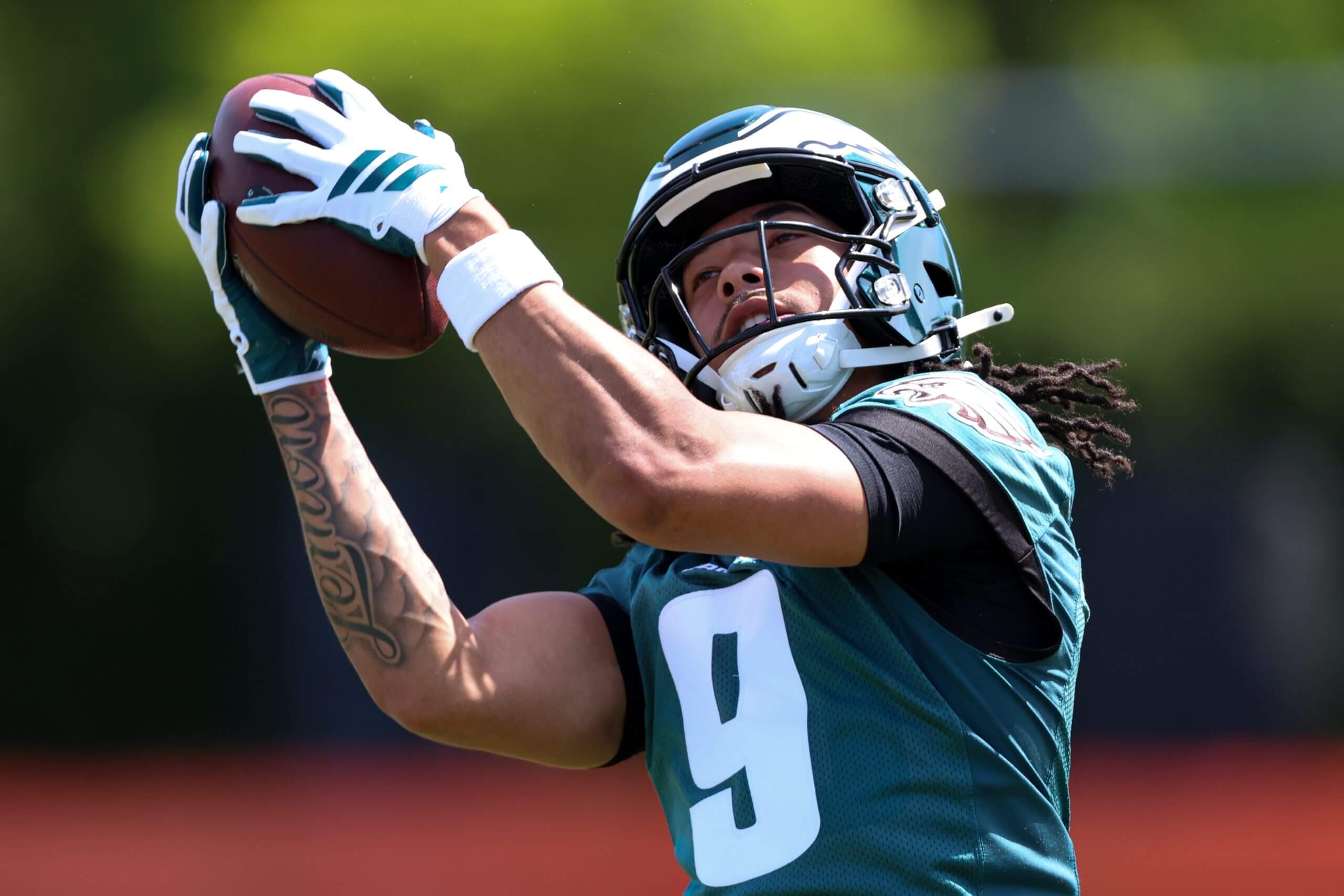
Philadelphia Eagles wide receiver Makai Lemon runs drills during rookie minicamp. A hamstring injury kept him out for most of the spring workouts. (Bill Streicher / Imagn Images)
What I’m most eager to see in training camp…
Kubena: I’m ready to see more of Lemon. Reporters only got to see the first-round pick during rookie camp and one session of OTAs before he was sidelined with a hamstring injury. Without Brown, the Eagles have a noticeable shortfall of targets who can get open because of their physicality. Wicks showed hints of promise. But Lemon’s elusiveness, strength and ability to break tackles is what endeared him to the Eagles. I’m eager to see Lemon and his 5-11, 194-pound running back build bowl through would-be tacklers.
Berman: The offensive line — in pads — is where I’ll focus this summer. For the offense to improve, the Eagles need better play from the line. That group is healthier this offseason. They’re adjusting to a new scheme and a new offensive line coach. When the Eagles are at their best, it’s usually because of how they play on the line of scrimmage. There are glimpses of the changes during camp, but there’s little you can learn about the offensive line in the spring. It needs to come with pads. Beyond the returning starting five, I want to see how the Eagles develop depth on the offensive line in case there are injuries. Will Bell or Fred Johnson be the top swing tackle? Will Drew Kendall be the top interior reserve? We’ll have more answers a few weeks into August.