
Back to Article List
A delicate waxing crescent Moon creates an elongated triangle with bright planets Jupiter and Mercury in the evening sky.
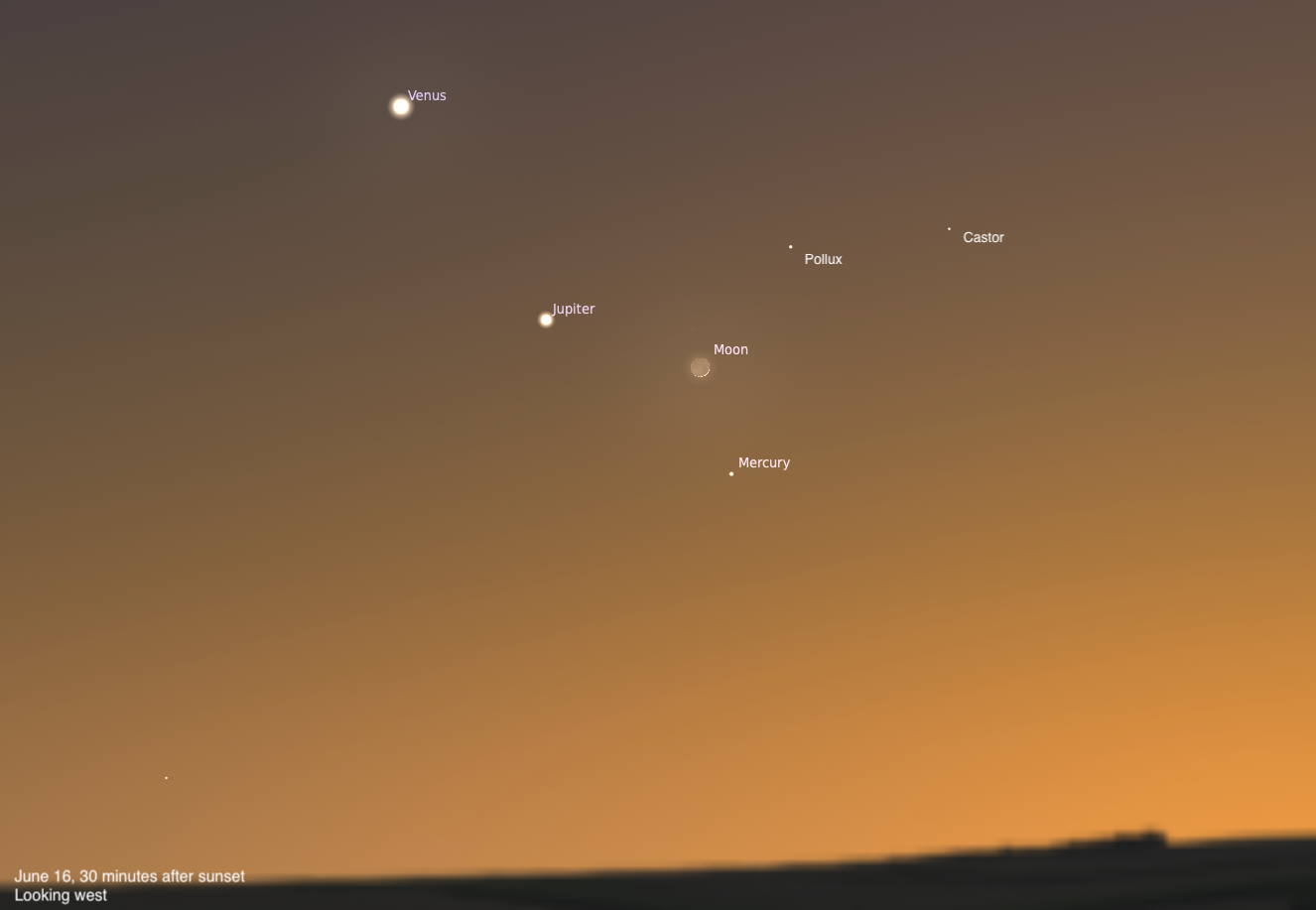
On June 16, the delicate waxing crescent Moon creates an elongated triangle with Jupiter and Mercury in the evening sky. Credit: Stellarium/USGS/Celestia/Clementine
Looking for a sky event this week? Check out our full Sky This Week column.
June 15: Mercury at greatest eastern elongation
The Moon passes 3° north of Mercury at 4 P.M. EDT. Looking west again after sunset this evening, the Moon now sits above Mercury, forming a triangle with Mercury and Jupiter.
Half an hour after sunset, the trio is over 10° high; an hour after sunset, they’re still 8° above the horizon. The Moon is a slightly wider crescent, now 6% lit as dawn breaks across its surface from east to west. Just north of the Moon, to our satellite’s upper right, is the bright star Pollux in Gemini; to the right of Pollux is slightly fainter Castor. As darkness falls, these stars should be some of the first to pop out of the twilight. It’s a beautiful grouping you should be able to capture with a cellphone camera.
Additionally, Venus still lies to Jupiter’s upper left, shining brightly in Cancer the Crab. Note in particular how far the Moon seems from Venus’ position — by tomorrow afternoon, our satellite will catch up to the bright planet, passing in front of Venus in a daytime occultation. Stay tuned for details on that event in tomorrow’s entry.
Sunrise: 5:31 A.M.
Sunset: 8:31 P.M.
Moonrise: 6:50 A.M.
Moonset: 10:35 P.M.
Moon Phase: Waxing crescent (6%)
*Times for sunrise, sunset, moonrise, and moonset are given in local time from 40° N 90° W. The Moon’s illumination is given at 10 P.M. local time from the same location.
Alison Klesman is senior editor of Astronomy magazine. She holds a Ph.D. in astronomy and has studied a variety of topics, from minor planets to supermassive black holes.