
With the growing salary cap, teams have more money to spend this summer. Except it’s tough to find difference-makers to invest in this summer.
In today’s NHL, fewer star players reach free agency, with most extending early. So teams with money to spend either have to look to the trade route or be bold with an offer sheet.
The latter sounds like a pretty ideal path, on paper. It’s a way to get up-and-coming talent before they reach the later stages of their prime and potentially hit free agency. There is no hammering out a return with another team because the parameters and compensation are outlined based on the average annual value offered.

Via PuckPedia
But even with this mechanism available to teams (assuming they have the draft picks needed within those parameters), offer sheets are few and far between in the NHL.
Could this season’s underwhelming crop of unrestricted free agents finally inspire general managers to take a more aggressive approach?
It’s easy to point to names like Connor Bedard, Leo Carlsson and Adam Fantilli, who lead this year’s RFA class. Playoff breakout Zach Benson is tempting, too. And maybe it is worth throwing an offer to some of those rising stars to at the very least create future cap hoops for those teams to jump through.
But the focus should be on some really interesting and realistic targets in the next few tiers of the restricted free agent class. Here are six offer-sheet candidates who won’t break the bank.
An adorable tradition: Putting babies in the Stanley Cup
Joe Smith and Madison Eades
Pavel Dorofeyev, Vegas Golden Knights
What is the perfect time for a playoff breakout? Right before contract negotiations.
After a rough 2024 postseason, Pavel Dorofeyev’s regular-season goal scoring translated when it mattered most. The big question now is how much that’s worth and whether the Golden Knights can afford it.
Dorofeyev’s coming off a two-year deal with an annual average value of $1.84 million a year. His market value, per Dom Luszczyszyn’s model, is projected to be about $11.2 million on average over the next seven years. Projection models, like Evolving-Hockey and AFP Analytics, have him coming in closer to the $9 million mark.

The key for an interested team is having a system that can help Dorofeyev play to his strengths. He isn’t a play-driver on his own, so it’s important to have him paired with someone to do the heavy lifting. Just look at how Jack Eichel and Mitch Marner teed him up with some really crafty passes this postseason.
With the right support, he can be worth the cost because goal scorers don’t grow on trees and he’s an excellent finisher. Without it, there’s a much lower chance of him playing like a $9-10 million player. And then it’s not worth the compensation for a deal in the $9.55-11.9 million range of two firsts, a second, and a third-round pick.
If a team has that foundation, it’s absolutely worth pursuing, considering Vegas’ cap situation. The Golden Knights always operate close to the ceiling, leading to offseason cost-cutting. That’s bound to happen this year to fit either Rasmus Andersson or Dorofeyev, or both.
So an offer sheet can accomplish one of two things: landing a team a dynamic goal scorer or creating a trickier cap bind for Vegas. The first outcome is obviously ideal for an acquiring team, but the second one should also be really appealing. The Golden Knights have managed to sign players below their market value in the past to stay in that winning environment. And maybe that will be the case with Dorofeyev unless there’s outside interference. Vegas has made a reputation for its ruthless approach, so if other teams want to compete with that, it’s time to dish it back.
Mackie Samoskevich, Florida Panthers
Not every offer-sheet candidate is in those top two compensation tiers. In some ways, it’s harder for a team to swoop in and steal players at this level because their extensions are generally more affordable and easily matched. AFP Analytics only projects Mackie Samoskevich’s next deal to carry a $3.08 million cap hit over two years. Evolving-Hockey has an extension coming in at four years with a $4.7 million AAV.
The Panthers don’t have too much work to do this summer. Florida has 11 forwards and six defensemen already signed, so the bare-minimum summer checklist includes adding two forwards, one defenseman and two goalies. So, unless this team is planning on making a splash with a trade, extending Samoskevich should be pretty cut-and-dry — unless another team steps in and is willing to take a gamble with a pricey contract.
Evolving-Hockey points to a $5.25 million cap hit on a six-year deal if Samoskevich were to sign outside of Florida. A new team would probably have to go bigger than that to 1) keep him out of the Panthers’ grasp and 2) account for the tax factor. While Samsokevich doesn’t have a long track record, he could be worth that swing. The 23-year-old is projected to have a market value worth $6.7 million, on average, over the next six years.

While some comps point to a concerning path forward, like Patrick Eaves, Sven Andrighetto and Troy Bouwer, his range of outcomes also includes that of Troy Terry and Adrian Kempe. In a more consistent top-six role, with more power-play usage, maybe he will have a better chance of channeling that higher-end trajectory. That could be worth the cost of a first and third. A rebuilding team could be interested based on his age. Playoff teams without the time or patience to develop a prospect could also make sense.
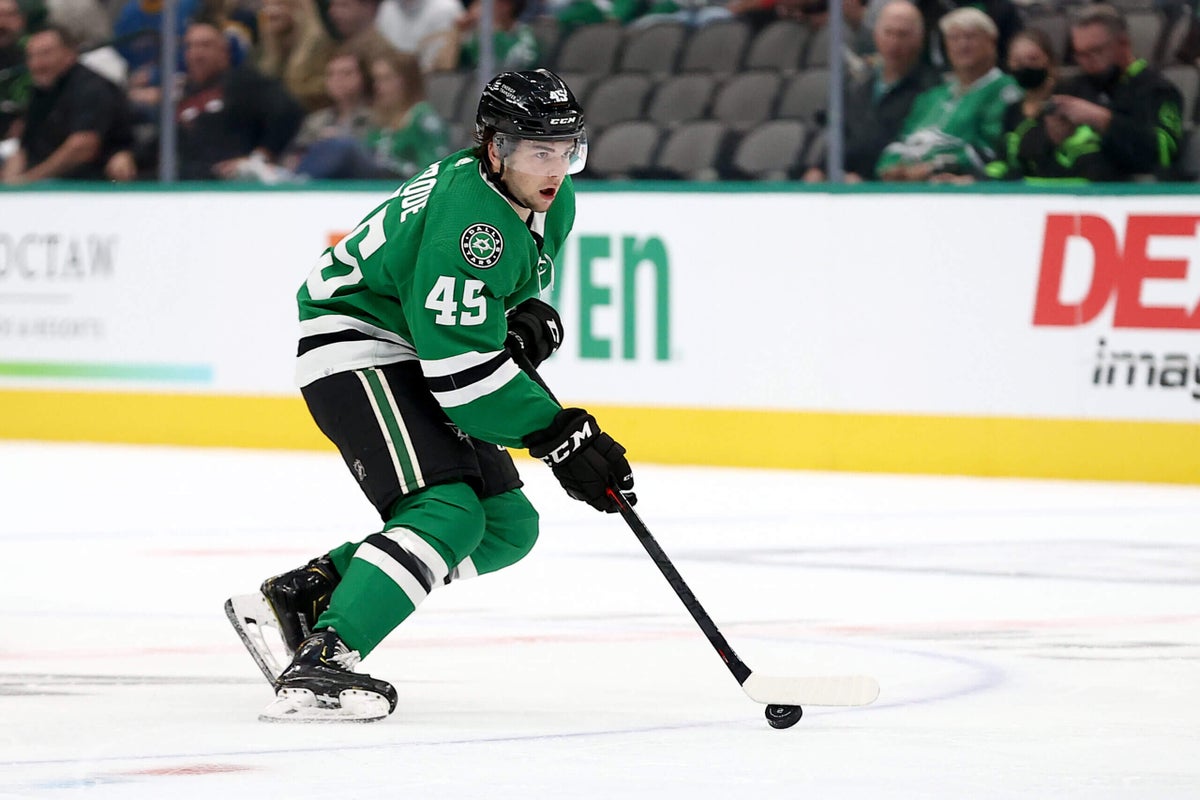
Mavrik Bourque, Dallas Stars
The Stars, as things stand, project to have even less cap space to work with this summer and more work to do. Ten forwards, seven defensemen and two goalies may already be signed for next year, but one of those unsigned forwards is Jason Robertson.
Robertson answered any lingering questions this year. He was the Stars’ regular-season MVP, especially at even strength, and was the playoff scorer this team needed. Between his play over the last year-plus and market trends, he’s worth all of that $11 million in remaining cap space, and then some. That could make Mavrik Bourque more attainable.
Like Samoskevich, Bourque hasn’t established himself as much of a needle-mover at the NHL level, despite looking like a prime breakout candidate. His AHL scoring, like his 77-point campaign in 71 games in 2023-24, just hasn’t translated enough in Dallas. To his credit, this year he did play a more important role with the big club, alongside Roope Hintz and Robertson in a complementary role.
Without all-star production in the NHL, some of his comps are unsurprisingly underwhelming, like Tyler Kennedy, Eeli Tolvanen and Scottie Upshall. But it’s also possible he’s just a late-bloomer and still has some Conor Garland, Jason Zucker, Alex Killorn or Bryan Rust in him.

With the right forecasting, a team could feel confident offering him a deal closer to his market value. Something in the $5-6 million range could be enough to create problems for Dallas. Anything above $4.78 million puts him out of the second-round pick compensation tier, and up to a first and a third. So this probably makes more sense for a playoff-caliber team, whose late-first isn’t as valuable.
Jack Drury, Colorado Avalanche
The Avalanche have a few obstacles to keep this window wide open: some aging players, very little early-round draft capital in the near future (two picks total in the first three rounds of the next three drafts) and limited cap space. The last is most pressing, with just under $3 million next season and at least one forward and three defensemen to sign. Cale Makar’s new deal in 2027 will cost a pretty penny, too.
While there are contracts they could move to clear space (which could net draft capital), teams should still try to take advantage and target Jack Drury.
Bottom-six players who shine in a playoff environment can be a slippery slope. Unless Drury is just scratching the surface as a 26-year-old, his 27 points in 82 regular-season games aren’t as promising a sign as his postseason highlights. That’s where things get tricky because he could go in a few directions. There is the Drew Miller and Torrey Mitchell trajectory. There’s a step up to the Mattias Janmark zone. And then there’s the best-case scenario: untapped utility à la Blake Coleman, Chandler Stephenson or Artturi Lehkonen.

If the Avs view him as such, it’s going to be even tougher to extract him because he could be an ideal replacement for any cap casualties. But it doesn’t mean opposing teams shouldn’t try. So many teams need help down the middle, and if there’s more in the tank here, it’s worth betting on proactively.
The challenge is figuring out the right cost. The idea should be to stay below that $4.78 million mark so the compensation is only a second-rounder. His market value doesn’t project to be worth more than $4.5 million over the next four years, either. That valuation could tick up if he grows into a more meaningful role, but paying for that now comes with the risk of being saddled with the contract and losing a first and third in the process. So it’s a balancing act to find a dollar amount that puts him out of Colorado’s range without being too pricey.
Brandt Clarke, Los Angeles Kings
Aside from center, one of the most coveted positions in the NHL is right-handed defenseman. That should put Brandt Clarke on a lot of radars this summer.
Unlike some of the aforementioned teams, the Kings actually have some cap to work with this summer. Extending Clarke should be a top priority, considering his strengths relative to the rest of this blue line as the only one with real offensive puck skills. But management may not be ready to take that leap with Clarke just yet. The 23-year-old’s skill hasn’t materialized into consistent needle-moving production just yet. While his average ice time was third on the Kings’ blue line this past season, he was still sheltered against top offensive competition.
Pair that with general manager Ken Holland’s tendencies toward more defensively-minded veterans and other offseason priorities (including finding a top-six center to fill the void left by Anze Kopitar’s retirement) and Clarke could get pushed to the back burner for now — which could open the door to an offer sheet.
There is still some risk in Clarke’s game and long-term future. The worst-case scenario has him flaming out and becoming the next Michael Del Zotto, instead of the next great top-pair offensive defenseman. But he also shares similar traits to players like Keith Yandle, Mikhail Sergachev and Kris Letang. That’s worth betting on in L.A., especially with Drew Doughty’s age in mind. But others should try to steal him from the Kings with a bold offer.
AFP Analytics projects a seven-year deal worth $8.52 million a year. An offer sheet would likely have to be even splashier. There’s room within that compensation tier (two firsts, a second and a third), which goes up to $9.55 million.

A contract of that magnitude obviously would have a bit more uncertainty, but it still has a high probability of delivering positive value. It’s easy to think of $9 million-plus range as cornerstone territory, because it was before the cap exploded. But nowadays, that’s more reasonable for someone in that “top pair but not necessarily elite” range. Considering how pricey the middle class has become in recent years at later points in their careers, it’s an even stronger bet to make on a righty with upside.
Olen Zellweger, Anaheim Ducks
The Ducks have a ton of cap space to work with this summer. But management also has a lot of work to do, because both Leo Carlsson and Cutter Gauthier are up for new contracts (and AFP Analytics projects long-term deals for both to add up to about $20 million in cap space), and only two defensemen are signed for next season.
Ideally, the Ducks can get Zellweger on an inexpensive short-term deal. His usage dropped by about two minutes on average this season and he was only used in three games this postseason. When he was dressed for the playoffs, he added a real spark from the back end, which Anaheim should want to develop and harness.
A two-year deal worth $3.24 million could be the perfect show-me deal that gives Zellweger the chance to boost his earnings and the Ducks more time to assess where he fits in the big picture.
But what if a team jumps in and offers something longer in the $6.52 million range instead? Right now, that would actually be above his projected market value, but there is room for growth there as he develops. The player has to sign off, though, and it’s possible this kind of deal would limit him too much considering his ceiling and market trends.

To be clear, it’s a number the Ducks should be able to afford too. It’s likely cheaper than any other second-pair defensemen this summer, who are older with less upside. And even if it doesn’t work out with Zellweger, it’s likely a movable contract at a later date.
Still, it could be worth throwing a dart at Zellweger somewhere in that $6.5 million to $7.1 million range, to keep the compensation at a first- and third-rounder. At worst, it adds a crimp to the Ducks’ cap picture that makes the early stages of their playoff window more challenging to navigate. At best, it brings in an up-and-coming defenseman who could have shades of Brandon Montour or Ryan Ellis in him.
Data via Evolving-Hockey, HockeyStatCards, All Three Zones, Dom Luszczyszyn, CapWages, PuckPedia and AFP Analytics. This story relies on shot-based metrics; here is a primer on these numbers.