
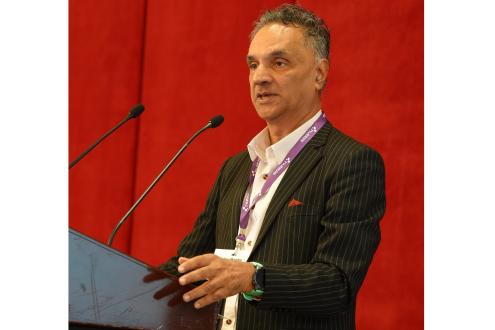
At the Hubbis Independent Wealth Management Forum – Hong Kong 2026, Jay Moghe, Head of Sales, Prime Brokerage and Investment Solutions at CGS International Securities, set out a practical case for why alpha generation needs to be understood more broadly in today’s markets.
His presentation argued that alpha is no longer simply the result of identifying the right manager, stock, fund or market theme. In a more complex and fragmented environment, the ability to generate and preserve alpha increasingly depends on the infrastructure around the investment decision – execution, financing, custody, market access, structuring and advisory support.
For family offices and private clients, the implication is clear. As portfolios become more global, more tactical and more exposed to complex or restricted markets, investment outcomes are shaped not only by what investors buy, but by how efficiently they can access, finance, hold and manage those positions.
Key Takeaways
Alpha Is Becoming Harder To Unlock: Markets are more complex, fragmented and crowded, while traditional beta is increasingly commoditised through ETFs and passive vehicles.
Infrastructure Matters: Moghe argued that execution, financing, custody, market access and structuring can all affect whether investment alpha is captured or diluted.
CGS International Combines Prime Brokerage And Investment Solutions: The platform brings together institutional-grade execution, cash and synthetic prime solutions, financing, bespoke strategies, advisory support and portfolio construction.
Family Offices Need Institutional-Grade Tools: Capabilities such as swaps, total return swaps, hard-to-borrow access, short exposure and synthetic market access are increasingly relevant beyond traditional hedge fund users.
Restricted Market Access Can Create Practical Advantage: Synthetic access can help clients gain exposure to markets or securities that may otherwise require local accounts, complex onboarding or operational friction.
Investment Solutions Can Fill A Portfolio Construction Gap: CGS International’s offering allows clients to build bespoke mandates, systematic strategies or managed allocations without necessarily building a full in-house investment platform.
Structuring Is Part Of The Alpha Equation: For single family offices and private clients, entity structure, custody arrangements, VCCs, FATCA, CRS and jurisdictional set-up can materially affect investment efficiency.
Moghe opened by focusing on a term familiar to every investor, but increasingly difficult to deliver consistently: alpha.
He acknowledged that much of the industry discussion around alpha focuses on investment skill – manager selection, stock picking, market timing or thematic positioning. But his central argument was that this is only part of the equation. In practice, alpha can also be won or lost through the mechanics of implementation.
That includes execution quality, financing terms, custody architecture, counterparty access, synthetic exposure, reporting, risk management and structuring. These elements may sit below the surface, but they can determine how effectively an investment idea is translated into a realised outcome.
“Alpha is not just what sits in the portfolio,” Moghe said. “It is also what sits beneath it – the access, execution, financing and structure that allow the idea to work.”
This matters because broad market exposure has become easy to obtain. ETFs and passive products have made traditional beta abundant and increasingly commoditised. The harder task is identifying differentiated opportunities and accessing them efficiently.
An Integrated Platform For A Fragmented Market
Moghe positioned CGS International’s proposition around the integration of prime brokerage and investment solutions.
On the prime side, the platform offers institutional-grade execution, synthetic and cash prime solutions, financing expertise and access to global markets across asset classes. On the investment solutions side, it provides research-led portfolio construction, systematic and bespoke strategies, advisory support, portfolio oversight and risk management.
The point, Moghe argued, is that these functions should not be viewed separately. A strong investment idea still needs effective implementation. A brokerage relationship becomes more valuable when it can also support portfolio construction, financing and advice.
“The broker and the portfolio manager both contribute to the final outcome,” he said. “If the idea is right but the execution or financing is wrong, alpha can still be diluted.”
For family offices and private clients, this integrated model is designed to provide flexibility. Some clients may want to trade directly. Others may want CGS International to manage a defined portion of capital, build a bespoke allocation, provide synthetic access, or support a more institutional operating framework.
Bringing Institutional Prime Tools To Family Offices
A core part of the presentation focused on the migration of institutional prime brokerage tools into private wealth and family office use cases.
Moghe described CGS International’s prime services as designed for hedge funds, asset managers, family offices, proprietary traders and broker dealers that want institutional strength with more bespoke service. The platform includes round-the-clock market access, high-touch trading, direct market access, financing, stock borrowing and lending, synthetic prime, clearing, settlement and custody support.
This is becoming more relevant as private clients and family offices become more sophisticated. Investors may want to access restricted markets, hedge exposures, short securities, trade through swaps or total return swaps, or obtain financing without building multiple direct counterparty relationships.
Moghe used examples such as TSMC and SK Hynix to illustrate the point. In some markets, direct access may require local account opening or more complex operational set-up. Through synthetic structures, investors may be able to gain exposure and financing through one package.
“Restricted market access can be an alpha source,” he said. “If one investor can access the trade efficiently and another cannot, that difference is not just operational – it can affect return.”
He also stressed that shorting and hedging should not be seen as tools reserved only for hedge funds. In volatile or expensive markets, the ability to express negative views, hedge downside risk or access hard-to-borrow securities can form part of a more complete investment toolkit.
CGS International’s Backing And Regional Footprint
Moghe also used the presentation to explain the institutional substance behind CGS International.
The firm is part of a wider group with significant shareholder backing. The presentation noted that China Investment Corporation is effectively the largest shareholder of CGS Group, and described CIC as one of the world’s largest sovereign wealth funds, with assets under management of more than USD1.35 trillion.
Established in 1979, CGS International has developed a strong and well‑established footprint across ASEAN, with offices in Singapore, Malaysia, Thailand and Indonesia, as well as key markets in other parts of Asia. The firm also maintains a global presence spanning more than 15 countries and regions. Its regional heritage includes a strong equities platform supported by award-winning research, underscoring its deep roots in Southeast Asia’s financial markets.
For Moghe, this matters because platform strength is not just a branding point. When clients are using financing, custody, execution and synthetic access, they need confidence in the counterparty and the operating base behind the solution.
“Backing matters,” he said. “When clients are accessing global markets and financing positions, they need to know there is substance behind the platform.”
Investment Solutions Beyond Brokerage
The investment solutions business, Moghe explained, emerged because clients wanted more than trade execution and financing.
Some clients approached CGS International with specific investment objectives, asking whether the firm could manage or advise on a defined pool of capital over a particular time horizon. Others wanted exposure to a theme, region or strategy but did not want to build a full internal investment management function.
The resulting offering includes systematic models, bespoke portfolios, thematic ETFs, liquidity management, fixed income solutions, cross-asset advisory, alternative investments, managed product access and portfolio oversight.
Moghe described this as a highly customised framework. Clients may want a systematic approach, a bespoke portfolio, a thematic allocation, or a managed solution that takes the operational burden away from the family office or private client.
“We are not asking every client to fit into the same model portfolio,” he said. “The point is to build around the client’s objective, risk profile and time horizon.”
He also highlighted the role of proprietary multifactor models and rules-based processes. The objective is to combine fundamental and quantitative research in a transparent way, rather than relying on an opaque black-box approach.
Structuring As Part Of The Alpha Equation
Moghe then widened the discussion beyond markets and portfolio construction to structuring.
For single family offices and private clients, he opined that legal, tax, regulatory and operational structures can materially influence investment efficiency. The right framework can support governance, custody, reporting, succession planning and tax treatment. The wrong one can create avoidable friction.
The presentation referenced support around family office structures, fund set-up, entity incorporation, coordination with external legal counsel, MAS tax incentive applications, immigration matters, independent tax reports, FATCA and CRS. It also made clear that CGS International does not provide legal or tax advice directly, but works with experienced third-party experts.
Moghe also highlighted VCCs as an area of current demand. The presentation described features such as sub-funds for different strategies, flexibility in share issuance and redemption, consolidated administration, non-public financial statements and access to Singapore’s treaty network.
“Structuring is not separate from alpha,” he said. “For a family office, the structure can determine how efficiently the investment strategy is actually delivered.”
Access, Advice And Execution As One Framework
Moghe concluded by returning to the idea that alpha today is not about simply chasing the next investment idea.
Instead, he argued that investors need a more integrated framework built around access, discipline, advice, execution and structure. The right solution may involve active management, passive exposure, systematic models, bespoke portfolios, synthetic access, direct execution, structured products or external managers. The important point is choosing the right tool for the objective.
For family offices and private clients, the message was that investment outcomes are increasingly shaped by platform capability. As markets become more complex, the operational layer of investing becomes more important.
“Alpha today is not one product or one trade,” Moghe said. “It is the integration of access, advice, execution and structure.”
The presentation ended with a practical conclusion: investors may be better equipped to manage complexity and generate alpha consistently when their brokerage, financing, investment solutions and structuring needs are treated as connected parts of the same investment framework.