
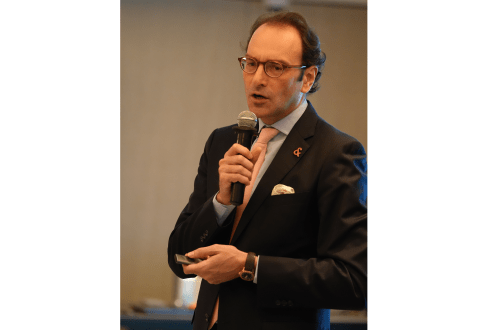
Remarks delivered by Andrew Hendry, CEO Asia and Senior Managing Director, Head of Asia Client Group, Janus Henderson Investors, at WealthTHINK Singapore 2026
Opening WealthTHINK Singapore, Andrew Hendry of Janus Henderson Investors set the tone with a candid assessment of Asia’s private wealth industry, the shifting appetite of high-net-worth and ultra-high-net-worth clients, and the strategic pressures now facing private banks, EAMs, multi-family offices and investment advisers.
Drawing on the third annual Janus Henderson survey conducted with Hubbis, based on more than 300 respondents across Hong Kong and Singapore, Hendry highlighted a market in transition. The survey, conducted in October and November 2025, captured the views of CIOs, senior private banking professionals, family office representatives, EAMs and other wealth industry leaders before several major market developments in early 2026. Even so, its findings point to several clear themes: risk appetite is rising, concerns around US valuations remain high, passive adoption is becoming more structural, and alternatives continue to attract strong interest.
Risk Appetite Has Shifted
The first major finding was the clear movement in client risk appetite. Hendry noted that despite concerns around frothy markets, elevated US valuations and technology concentration, respondents were reporting a more constructive and more aggressive stance from clients.
The proportion of moderately adventurous clients rose from 35% to 54%, while the moderately defensive cohort almost halved. At the same time, capital preservation as a primary portfolio objective fell from around half of respondents in 2024 to just over 30% in the latest survey.
For Hendry, the conclusion was straightforward. The pendulum has moved away from fear and towards greed.
“People are a little bit more aggressive,” he observed, noting that the industry is seeing “a general movement of people being more aggressive, more greedy.” Despite the headlines, clients appeared more willing to take risk, pursue capital appreciation and allocate towards growth-oriented opportunities.
This shift, he suggested, reflects a broader change in mood across the region’s private wealth market. After the defensive posture that followed 2022, clients are now once again prepared to engage more actively with risk assets.
The Market’s Contradiction
Yet the data also revealed a striking contradiction. While clients are becoming more aggressive in portfolio positioning, they remain deeply concerned about the very markets to which they are still allocating.
On US valuations, 73% of respondents said they were somewhat concerned, while only 9% had no concern. Hendry described this as a form of investor “schizophrenia”: clients say they are worried, but their allocations show they remain constructive.
“This is very, very bizarre,” he said. “On the one hand, people are saying they’re very worried. But on the flip side, their allocations are becoming much more aggressive.”
That tension has important implications for advisers. It suggests that clients are not simply retreating from perceived risk. Instead, they are trying to reconcile concern with opportunity. They are aware of valuation risk, geopolitical volatility and concentration in US markets, but still see reasons to remain invested, particularly in areas linked to technology, artificial intelligence, commodities, defence and security.
Hendry urged attendees to consider whether the survey findings matched what they were seeing in their own client books, and how they were responding to that contradiction in client behaviour.
AI, Technology and Defence Lead Allocations
Looking at forward allocations, Hendry pointed to strong interest in AI, technology, commodities, defence and security. These were among the themes clients expected to allocate to over the next 12 months.
He noted that some of these allocations had already performed strongly since the survey was conducted. Technology markets had continued to rise despite concerns around valuations, while defence and security names in Europe had also delivered strong returns.
“If you did allocate last year, well done,” he said, pointing to names in Germany and France as examples of the defence theme’s strength.
The broader message was that client appetite remains directed towards some of the most volatile and momentum-driven segments of the market. That may seem counterintuitive given the level of concern respondents expressed, but it also reflects where clients believe structural growth, innovation and policy-driven spending are most likely to create opportunity.
Passive Adoption Becomes Structural
One of Hendry’s strongest warnings centred on the active-versus-passive debate. When the Janus Henderson survey began in 2023, active management still held the majority position. The latest results, however, show a 50/50 split between active and passive.
For Hendry, this is not a minor data point. It is a structural warning for the industry.
“This is a bad slide,” he told the room, explaining that the rise of ETFs and passive products could materially affect the business models of private banks, EAMs and wealth advisers.
Ultra-high-net-worth clients, particularly those with USD30 million to USD50 million or more, are increasingly seeking ETF exposure for parts of their portfolios. Hendry said this trend is already visible in discussions with private banks across the region, and in the marketing presence of major ETF providers.
The issue is not simply whether clients hold ETFs. It is where they hold them, how much of the portfolio they allocate to them, and whether advisers remain central to that relationship.
“If folks are using passive ETFs and they’re not with you, then potentially they’re building up a separate portfolio,” Hendry said. “At some point they might say, that’s easier and cheaper.”
A Challenge to the Adviser Proposition
Hendry was clear that passive adoption creates a direct challenge to the value proposition of the wealth industry. If clients can access broad equity exposure cheaply and easily, advisers must be able to articulate why their role still matters.
He used the example of long-term index returns to frame the risk. Over the past three decades, he noted, broad technology and global equity indices have delivered strong annualised returns. If clients can access that exposure for 20 basis points or less, the burden of proof shifts heavily onto active managers and advisers.
Janus Henderson itself is a fully active manager, Hendry noted, and its business depends on the belief that skilled active management can deliver superior long-term outcomes. But the client conversation becomes harder when passive alternatives are cheap, transparent and increasingly familiar.
“What happens if clients start experiencing this passive element?” he asked. If they begin to question manager selection risk, fees and underperformance, advisers may find themselves facing the same pressures already seen in Europe and the US.
His challenge to the room was direct: advisers need to develop areas of their business that cannot be easily replaced by passive products. That may mean more complex portfolio construction, better manager selection, stronger alternatives access, or, importantly, deeper wealth planning.
Wealth Planning Becomes Harder to Ignore
Hendry identified wealth planning as one of the areas that may become more strategically important as passive adoption rises. Historically, he noted, many institutions treated wealth planning as an expensive, low-margin add-on, often provided only where the client relationship generated enough return on assets to justify the cost.
Yet in an environment where ultra-high-net-worth clients can move liquid market exposure into low-cost passive vehicles, wealth planning becomes harder to disintermediate.
The problem, as Hendry put it, is that wealth planning is often “the most boring and unprofitable” part of the business. But it is also one of the hardest to replicate through a low-cost ETF platform.
That creates a strategic question for EAMs, private banks and multi-family offices. If passive products erode the value of simple market access, firms must become indispensable elsewhere. Advice, structure, governance, family planning and portfolio resilience may become more important than product distribution alone.
Portfolio Construction Still Matters
Despite the concerns around passive adoption, Hendry also highlighted one encouraging finding: confidence in the 60/40 portfolio remains intact.
The continued relevance of 60/40 suggests that clients and advisers still believe portfolio construction matters. That is positive for discretionary portfolio management, advisory relationships and broader asset allocation work.
For Hendry, this showed that the industry’s role is not disappearing. Clients still see value in thoughtful portfolio design, diversification and risk management. The challenge is to ensure that the adviser’s contribution is clear, measurable and resilient in a world where low-cost beta is readily available.
Alternatives Continue to Gain Ground
Alternatives remain a major area of interest. The survey showed that 86% of respondents expect to increase allocations to alternatives, up from 76% in the prior year.
Hendry described this as an encouraging sign for the wealth industry. Alternatives create a role for advisers, portfolio constructors and investment specialists, particularly where clients need diversification, access, due diligence and manager selection.
However, he also warned that the composition of alternatives allocations matters. Private credit remains popular, but the market is changing. Hendry referenced a discussion in Seoul with a senior institutional investor, who noted that return expectations for private credit had been reduced from around 14% historically to approximately 8%.
That has significant implications for private wealth clients.
“If you had that conversation with your clients and said, for lock-ups or semi-liquid structures, I’m only going to give you 8% before fees, that can be problematic,” Hendry said.
The message was not that private credit is broken. Rather, it is that clients and advisers need to be more realistic, more selective and more attentive to liquidity, structure and return expectations. The era of assuming that large flagship private credit funds will automatically deliver superior outcomes may be ending.
Optimism With Caveats
Hendry closed with a balanced message. Clients remain constructive. Flows have been strong. Many firms had a strong first quarter. Risk appetite is back, and alternatives remain a clear opportunity.
But the optimism comes with caveats. The market is frothy. Passive adoption is putting pressure on traditional business models. Private credit return expectations are moderating. And clients are simultaneously anxious and risk-seeking.
In that environment, Hendry’s message was one of opportunity, but also discipline. Wealth managers must understand where client behaviour is changing, where product economics are under pressure, and where their own value proposition remains defensible.
The survey points to a market that is more optimistic than fearful, but not necessarily simpler. For advisers, the task is to convert that optimism into resilient portfolios, stronger client relationships and advice-led propositions that cannot be replaced by low-cost market access alone.