
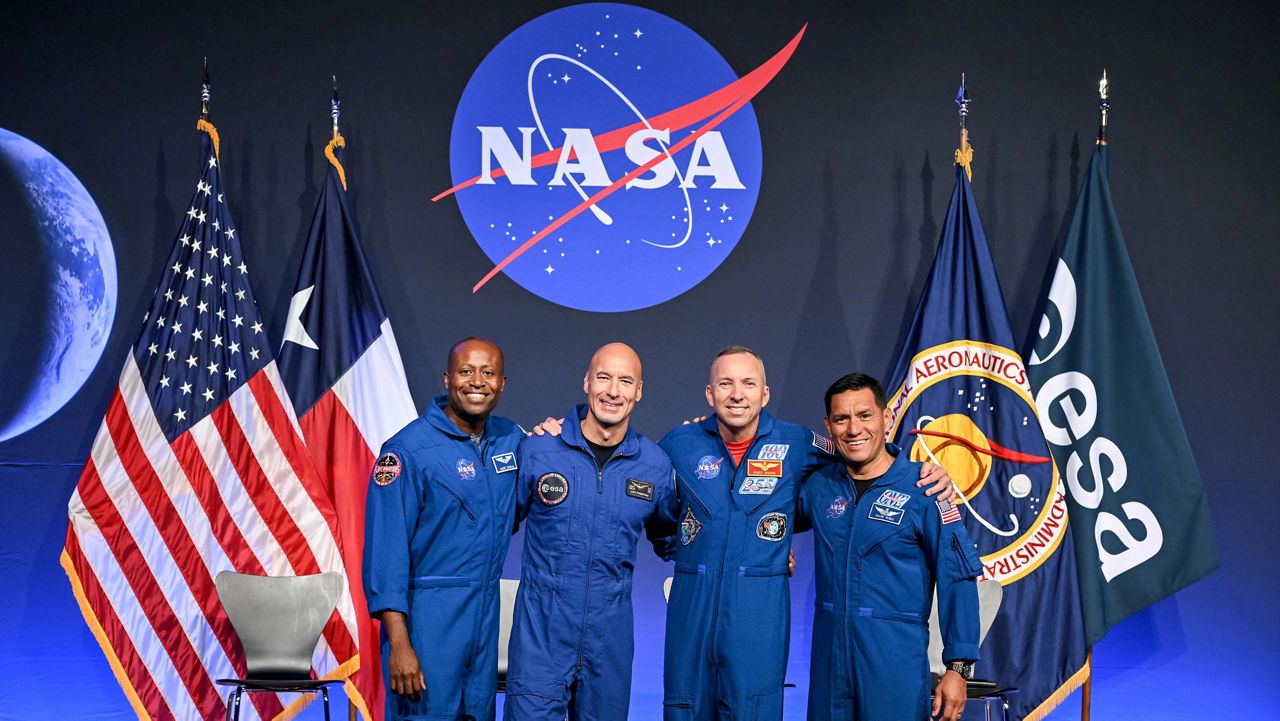
NATIONWIDE — When NASA announced the Artemis III crew last week, it was met with a lot of excitement as it will be instrumental in testing the lunar landers that will return humans to the moon’s surface.
However, there were mixed reactions because all four members are men, and many took to social media to voice their opinions over the lack of women on the mission.
What You Need To Know
Many took to social media to express their dismay over the lack of female representation of the all-male Artemis III crew
Camille Bergin, AKA The Galactic Gal, shares her thoughts with Spectrum News about the mission
NASA explains the process of the astronaut selection for the Artemis III mission
Andre Douglas, Luca Parmitano, Randy Bresnik and Frank Rubio are the new faces of the Artemis III mission.
Originally, the mission would have seen Americans return to the lunar surface, but back in February of this year, NASA Administrator Jared Isaacman announced a major changeup: The mission will now take place at low-Earth orbit, where it will test various systems, such as docking the Orion capsule with SpaceX’s Starship and/or Blue Origin’s Blue Moon lunar landers.
The mission is set for 2027, with Artemis IV seeing the moon landing in 2028.
While there is excitement in seeing the four men docking with lunar landers, many noticed that no women were selected for Artemis III.
It was Christina Koch who became the first woman to complete a lunar flyby during the Artemis II mission back in April, where she became the new face to inspire girls to join STEM.
Many were taken aback that there was no woman picked as an Artemis III member. In fact, the backup member for that mission is Bob Hines, who was the pilot for the Crew-4 mission in 2022.
One of those people who were surprised by the lack of female representation is Camille Bergin, chief marketing officer for Star Catcher and better known across social media as The Galactic Gal, where she shares with her nearly a million followers about space, technology and the business and policies behind them.
“My (reaction) lasted for a couple of days is … ‘Why is there no woman on board,’ right? And that’s what I, I talked to social media like, pretty, pretty quickly after the announcement, and I just asked the question like, ‘Why is there, why is there no woman on board?’ And I think a lot of us did that,” she shared.
Bergin continued that the lack of a female astronaut has created a conversation.
“And, you know, we got various answers and some really great conversations that came out of it. And so I think that my, my general, you know, opinion now is like, yeah, it really would have been amazing to have a woman on board. But we should also be celebrating the diversity on board that we did and that we did achieve,” said the aerospace engineer.
When people noticed the all-male crew and started asking why, NASA officials explained why the decision was made not to include a woman for the Artemis III mission.
In a lengthy post on X, Isaacman explained that he understands why there was disappointment, but also said that the decision was based on the best experience for the mission and that astronauts are currently in lunar-specific training.
“I have seen reactions ranging from disappointment to outrage. I have personally been to space twice with 50% female crews. My closest advisors and some of the smartest engineers I know are women,” said Isaacman, who talked about his time on the civilian Polaris Dawn and Inspiration4 missions before becoming NASA’s administrator. “For example, those raising this concern may not be aware of the pipeline of crews already preparing to launch to the Space Station, or those who have been undergoing lunar-specific training that would be a better fit for a future surface mission.”
Starting with some energy, and my inability to write brief updates, I am just extremely proud of the NASA crew, our industry, and our international partners. We are getting into a rhythm here at NASA. Earlier this year, setbacks put the Artemis II rocket back in the VAB for…
— NASA Administrator Jared Isaacman (@NASAAdmin) June 10, 2026
Bergin said that she did see Isaacman’s response, but says there is a political component that is hard to ignore.
“… I saw the administrator, I saw his response and I by no means pretend to understand everything that goes into these decisions. But I do have a general understanding of it. I just don’t, you know, none of us really know, like, all of the assignments for all these astronauts in the future, right? Like NASA has to announce that, and so, yes, absolutely. Is there a world in which it truly is all the women were either assigned to other missions or, you know, our, you know, being saved, I guess, for, for future lunar landing missions? Absolutely. I still do think that we are ignoring a key component in that that response, that there is absolutely a political component. And I don’t think that we can look at these decisions outside of the context of the world and the political climate that we live in,” she said.
Spectrum News reached out to NASA to explain further the astronaut selection process that went into the Artemis III mission.
Amber Jacobson, NASA’s acting press secretary for the Associate Administrator Amit Kshatriya and Deputy Associate Administrator Casey Swails, described the selection process.
She stated that several factors, including upcoming mission needs, training timeline requirements, crew availability, mission-specific technical requirements, and astronaut experience, all played a part.
“These astronauts come from all over the country, from a variety of backgrounds, and represent the best of America. They bring years of experience in medicine, military service, engineering, piloting, and more. This crew was selected to carry out the Artemis III mission due to their skill and competency as it pertains to this test flight,” she stated in an email.
Still, for Bergin, she said Isaacman’s response may have done more harm than good.
“And, you know, NASA is trying to go back to a world of transparency, which I do think is really important, especially because our taxpayer dollars are funding this mission. But I also, as a space communications professional, think that tone really matters in those types of responses on taken (and) in that response did a lot more harm than good and led to a lot more distrust in the decision than trust,” she said.
While many agreed with Bergin’s reaction post on social media, many disagreed with her, which developed into a separate conversation about race.
“I do not think that we can ignore the race aspect of this as well. But that doesn’t mean that I have the full perspective, right? That doesn’t mean that I see or that doesn’t mean that every other little girl who isn’t white can see themselves in Christina, fully, right? And that’s the kind of conversation that was raised that I think was actually really, really valuable in response to, you know, feelings like my own or other women that shared perspectives like that,” she said.
Bergin hopes that by raising awareness of the Artemis III and the perspectives raised, she hopes at least one woman and a person of color will be selected for future moon-landing missions.
“And it would be really awesome if we had a woman of color so that other women can see themselves fully in Christina, because representation is so, so, so important, right? And that is the point of the Artemis program. I mean, not the point, not the only point, right? But it is a huge point is that we are going for all humanity and humanity looks like a bunch of different things,” she said.