
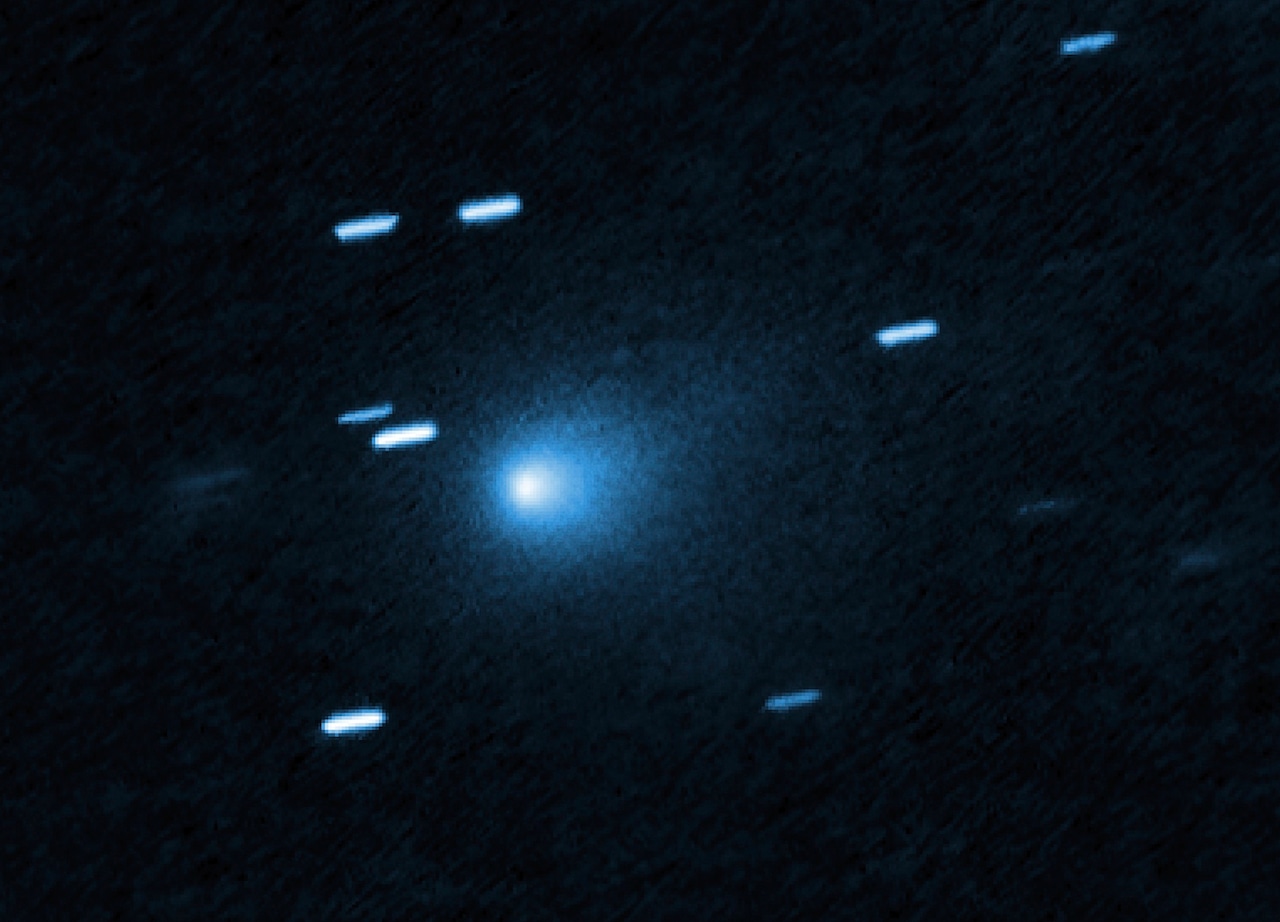
Is it an alien spaceship or an ancient comet? That’s the question puzzling UFO enthusiasts, NASA, and the European Space Agency since an interstellar visitor entered our solar system last month.
It seems everyone has been talking about the unidentified object, and there’s been a lot of speculation about its origin.
It’s only the third known interstellar visitor to pass through our solar system, after ‘Oumuamua (2017) and 2I/Borisov (2019), published reports say.
The Hubble Telescope and its Wide Field Camera 3 shed some light on the object’s composition when it caught a clear view of what experts say is likely a comet on July 21 when the object was 277 million miles or 445 million kilometers from Earth, CNN reported.
The image appears to be “a teardrop-shaped dust cocoon” that was spotted streaking from the comet’s “icy nucleus,” the report said.
A comet’s nucleus is its solid core, often comprised of ice, dust and rocks. When comets travel close by stars, heat causes them to output gas and dust, the report explains.
According to published reports, here’s what we know about 3I/ATLAS:
It’s likely a comet: NASA and the European Space Agency have classified 3I/ATLAS as an “interstellar comet, based on its trajectory and composition.It’s ancient: Estimates suggest it could be 7 to 11 billion years old, predating our solar system.The object is incredibly fast-moving: It was clocked traveling at 130,000–152,000 mph — that’s faster than any previously observed interstellar object.It’s enormous: Experts have estimated its diameter is up to 12 miles. However, newer data suggests it’s closer to 6 miles. But that’s still much larger than its predecessors.
The object also has an unusual appearance: The Hubble images show the teardrop-shaped cocoon of dust, but some experts have said its lack of a visible tail makes it atypical for comets.
But the question that has stumped experts from around the world is: Where did 3I/ATLAS come from?
According to published reports, one theory about 3I/ATLAS’s origin is that it’s a thick disk of the Milky Way, a region above and below the galaxy’s thin plane that is populated by older stars and an abundance of ancient material.
If you purchase a product or register for an account through a link on our site, we may receive compensation. By using this site, you consent to our User Agreement and agree that your clicks, interactions, and personal information may be collected, recorded, and/or stored by us and social media and other third-party partners in accordance with our Privacy Policy.