
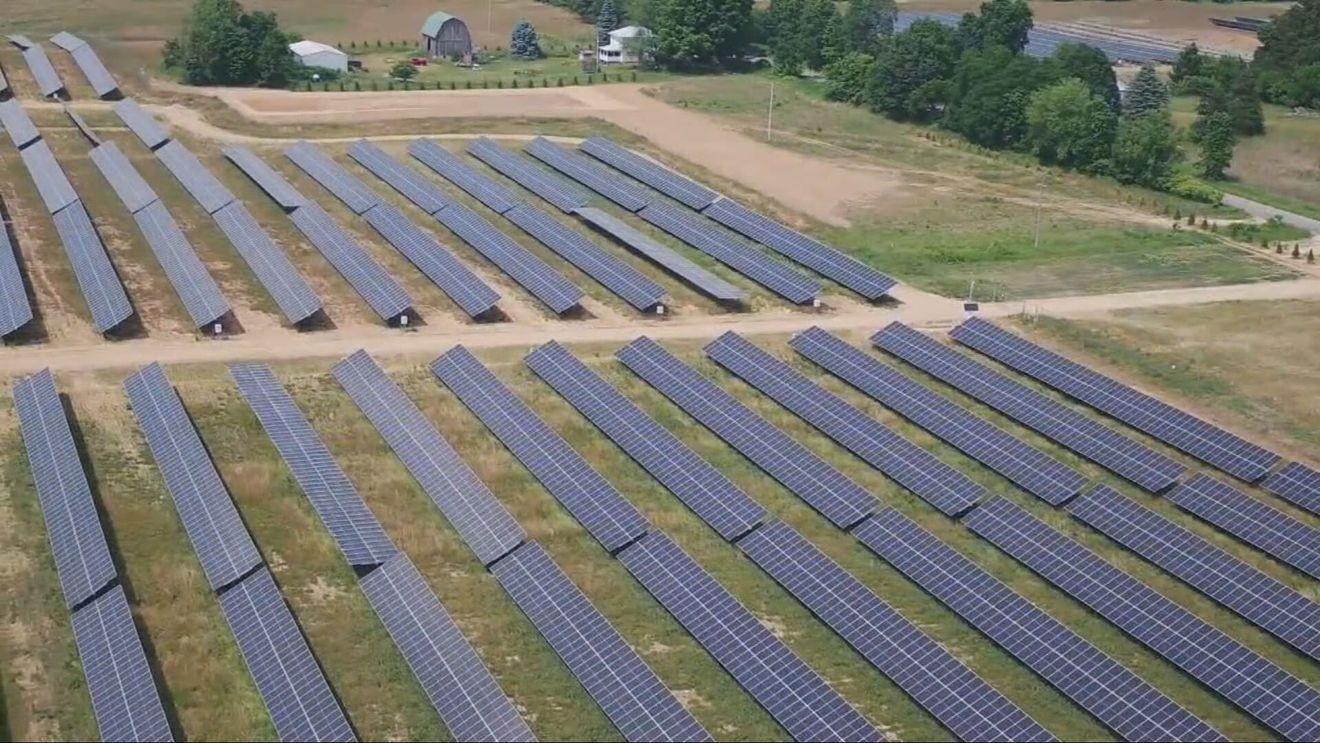
MONTGOMERY COUNTY, N.Y. (WRGB) — New York’s push to build more renewable energy is transforming parts of rural upstate New York, fueling a growing debate over where large-scale solar projects belong and whether local communities have enough influence over the approval process.
For Canajoharie homeowner Jennifer Stein, the issue is personal.
“It’s where I plan to grow old,” Stein said of her property. “Sit on our porch, drink a cup of coffee and watch the wildlife across the street.”
Stein lives across the road from where a portion of the Flat Creek Solar project will go. The 300-megawatt facility will span the towns of Root and Canajoharie.
“It’s 3,000 acres with a thousand of it being solar panels,” Stein said, who fears how the project will impact her own property.
“When they’re out there drilling into the earth, messing up the natural flow and you lose water to your well –what do you do?” she said. “We work hard for our home. If this goes in, it’s going to plummet my market value of my home and how is that right?” she expressed.
In addition to Flat Creek Solar, the approved Mill Point Solar I project in the Town of Glen is expected to generate up to 250 megawatts and span roughly 2,000 acres. A second Mill Point project remains under review. The county is also home to the Mohawk Solar project.
Critics argue the projects are transforming rural landscapes on a scale not previously seen in the region.
But supporters emphasize these projects aren’t being forced onto private property– they rely on landowners who choose to lease their land for solar development.
So how are these projects approved?
In 2020, the state created the Office of Renewable Energy Siting and Electric Transmission, known as ORES to meet state climate and energy goals,
The agency was designed to streamline permitting for large-scale renewable energy projects.
“It was created out of a recognition that years and years of precedent showed kind of a patchwork of different rules and permit conditions, and so the state said two things– one, we’re not building infrastructure fast enough, so we need to streamline the process and make it more predictable for development.And two, we need to consolidate all of that history into a set of uniform standards and conditions,” said Jessica Waldorf, chief of staff and director of policy implementation for the Department of Public Service, which oversees ORES.
Under the process, developers must conduct studies examining farmland, wildlife, drainage, visual impacts and other potential effects before submitting applications to the state. Local governments, residents and outside experts can review the projects and submit comments. ORES then determines whether projects should be approved and under what conditions.
“We have wildlife experts, natural resource experts, engineers, folks that have spent their decades reviewing these types of applications,” Waldorf said. “They’re able to kind of see the major issues and address them appropriately.”
Once an application is deemed complete, state law gives ORES one year to make a decision on a final siting permit. If a decision isn’t made, under state law a final siting permit is automatically issued.
BRIANA SUPARDI: Has there ever been a time where a permit has been denied or a project altogether denied?
JESSICA WALDORF: Sure, there’s been one. And I would say that the reason why we’ve seen so few projects get denied is because that engagement and work that happens before a permit even comes in the door weeds out the projects that are not suitable for review.
Waldorf rejected claims that local concerns are ignored.
“Local concerns, particularly from rural communities, are very important to take into account, and we do that in our decisions,” she said.
“Everything that we do at the office is to ensure that the permits that come before us, we review and make sure that they are in compliance with state laws,” she said.
Waldorf also noted that renewable energy projects rely on agreements with willing landowners, many of whom are farmers.
As operating costs rise and profit margins tighten, some farmers view solar leases as a way to generate income and maintain family-owned farmland.
“This farm and its members have made countless sacrifices to keep this business operating and to preserve the land. It is our choice to decide what the best option is for our land and we do not take that responsibility lightly. By leasing a couple hundred acres to host solar panels, we will earn enough additional income to continue the family business my great grandparents started over 85 years ago,” wrote local farmer Clark Egelston in a letter submitted for public comment for the Mill Point Solar project.
In Montgomery County, the dispute over solar development is now playing out in the courts.
Montgomery County Attorney Meghan Manion has filed lawsuits challenging ORES approvals, alleging the agency and developer failed to adequately consider local laws and cumulative impacts associated with the multiple projects set to be built in the county.
“We had one law in particular the cumulative impacts law which the county passed because there’s so much solar coming to Montgomery County that there was a real health and human safety concern about impacts across the whole county for these projects. ORES staff is supposed to do the review of those laws. They did not review that law at all,” she argues.
The lawsuit claims county-wide impacts on farmland, the environment, and local economy were not properly evaluated prior to approval of the projects.
The debate extends beyond Montgomery County.
In neighboring Washington County, the proposed Fort Edward Solar project has generated controversy because of its location near one of New York’s largest remaining grassland bird habitats.
While town officials support the project, it has faced great opposition because of its location – an area known to serve as a habitat for grassland birds. .
The approximately 100-megawatt project would span roughly 500 acres of private land in patches around state protected land.
Conservation advocates with the Grassland Bird Trust became involved after raising concerns about potential impacts to grassland bird species.
“We got involved because the project was threatening the grasslands, and we wanted to do what we could to conserve as much land as possible for the grassland birds,” said Katherine Roome, the organization’s board secretary.
Under state mitigation requirements, developers can offset habitat impacts through conservation efforts elsewhere– but conversations argue ‘elsewhere’doesn’t necessarily help the birds who occupy that area. For the Fort Edward project, the state required approximately 216 acres of mitigation, less than the project’s footprint.
The Grassland Bird Trust ultimately negotiated an agreement with the developer, securing funding as a land trust to acquire and permanently protect grassland bird habitat in the Washington County Grasslands. They hope to secure land close to where the project is going..
“Even if the project were stopped, the land would be entirely unprotected and continue to be threatened by development,” she said.
“This agreement is the result of years of meaningful engagement, thoughtful project design, and a shared understanding of what makes this landscape so important,” said Darren Suarez, Vice President of Public Affairs and Communication with Boralex, the developer behind the project.
Supporters of the agreement say it demonstrates compromise may be possible even in contentious projects.
The broader debate has also reached Albany.
Assemblymember Carrie Woerner, a Democrat whose district includes Fort Edward, said the state should place greater emphasis on developing solar projects on already-developed properties such as parking lots, warehouses, brownfields and commercial sites.
“I think the ORES process is quite flawed,” Woerner said, adding that incentives could help make solar installations on developed sites more financially attractive.
State Sen. Patricia Fahy, another Democrat and longtime advocate for renewable energy who represents Montgomery County, said ORES was created to address concerns that renewable energy projects were taking too long to move through the permitting process.
“The only way to really move toward energy independence are these investments in geothermal networks, in solar, in wind,” Fahy said.
The debate comes as New York prepares for growing electricity demand.
The New York Independent System Operator, which manages the state’s electric grid, recently warned that electricity demand is expected to increase as more buildings, vehicles and industries become electrified. The organization has called for an “all-of-the-above” approach to meeting future energy needs, including renewable energy, storage, transmission upgrades and other resources.
Supporters argue renewable energy can help reduce dependence on volatile fossil fuel markets and provide long-term price stability.
At the same time, critics point to infrastructure costs associated with the transition. A previously disclosed memo from the New York State Energy Research and Development Authority warned that achieving the state’s climate goals could require significant investments in new infrastructure, costs that can ultimately affect utility bills.
As New York continues building new energy infrastructure, the central question remains unresolved: how to meet growing energy demand while balancing farmland preservation, wildlife protection, local concerns and affordability.