
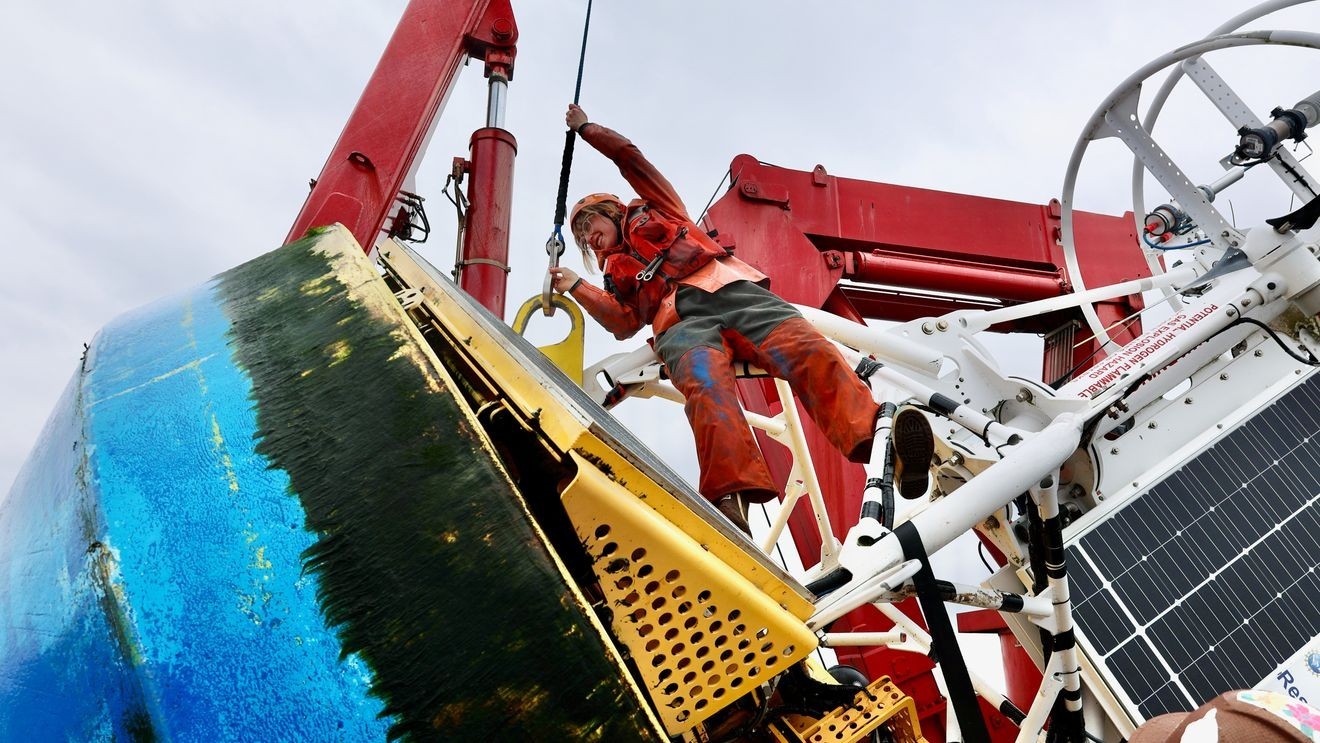
The National Science Foundation (NSF) has paused plans to dismantle key ocean monitoring equipment off the Oregon coast following pressure from an Oregon congressmember and state lawmakers who argued the network is critical to coastal safety, fisheries, and weather forecasting.
The announcement came Thursday after U.S. Sens. Jeff Merkley, D-Oregon, and Lisa Murkowski, R-Alaska, led a bipartisan effort to stop the planned removal of sensors that are part of the Ocean Observatories Initiative, or OOI.
“The National Science Foundation has reversed course and agreed to preserve the OOI’s critical sensors that provide essential data for managing our fisheries, forecasting weather, and understanding climate change,” said Merkley in a statement.
The decision follows the Senate’s passage of the bipartisan “Saving the OOI” Act, which would prohibit the use of federal funds to decommission the system until NSF conducts a review of the network and consults with stakeholders.
READ MORE | Scientists warn Oregon could lose critical ocean data under federal cuts
The federal announcement came one day after Oregon’s bipartisan Legislative Coastal Caucus formally urged NSF to halt the removals.
In a June 17 letter, lawmakers said the Coastal Endurance Array, a network of offshore moorings, sensors, and autonomous underwater gliders that collects ocean data off Oregon and Washington, had become essential for maritime safety, fisheries management, weather forecasting, and emergency preparedness. They argued the proposed cuts had moved forward without sufficient scientific review or consultation with affected communities.
“The removal of these buoys is not an abstract policy decision,” Sen. David Brock Smith, R-Port Orford, vice chair of the Coastal Caucus, said in a statement Wednesday. “It is a direct threat to safety, economic stability, and our ability to respond to rapidly changing ocean conditions.”
In an announcement on Thursday, NSF said it would immediately stop further removal or downsizing of equipment from the remaining OOI arrays and continue operating the system, including planned maintenance. The agency also revealed that the Coastal Endurance Array had already been removed from the water as part of the previously announced downsizing effort.
However, NSF said it is now developing plans to redeploy the equipment after it undergoes servicing.
“The U.S. National Science Foundation appreciates the concerns raised by the range of stakeholders that have informed us they rely on data from the Ocean Observatories Initiative,” the agency said in a statement.
NSF also said it plans to seek public input through a “Dear Colleague Letter” and convene an expert panel to evaluate future observational needs, assess available data sources, and recommend a long-term path forward for the agency’s ocean observing systems.
READ ALSO | 30 years on the Newport Line has captured the heartbeat of the Pacific Ocean
The Ocean Observatories Initiative includes offshore buoys, underwater gliders and other instruments that continuously collect information about ocean conditions.
The announcement marks a significant shift from the agency’s earlier plans, which would have eliminated much of the monitoring network off Oregon and Washington.
Before Thursday’s announcement, researchers warned the cuts would affect far more than academic research.
In a June interview with KATU conducted before NSF announced the pause, Oregon State University oceanographer Jack Barth said the Coastal Endurance Array helps scientists monitor changing ocean conditions while providing information used by weather forecasters and fisheries managers.
Barth said one of the network’s biggest strengths is that it continuously collects data year-round, something satellites and research vessels cannot fully replicate.
He also said long-term records are essential for understanding when ocean conditions are behaving unusually.
“If you don’t know what’s normal, the normal cycles, that sort of thing, you don’t really know when things are unusual,” Barth told KATU in the June interview.
At the time, Barth said the prospect of removing the equipment was especially concerning because scientists were monitoring conditions associated with a developing El Niño event expected later this year.
“There’s an El Niño bearing down on us that’ll arrive this fall,” Barth said. “This is the worst time to be pulling out instruments that are going to tell us valuable stuff about that.”
It remains unclear whether NSF’s decision represents a permanent reversal or a temporary pause while lawmakers continue pursuing legislation to protect the network.
For now, the agency says it will halt further cuts, continue operating the remaining system, and develop plans to return the Coastal Endurance Array to service while gathering public input on the future of its ocean observing programs.