
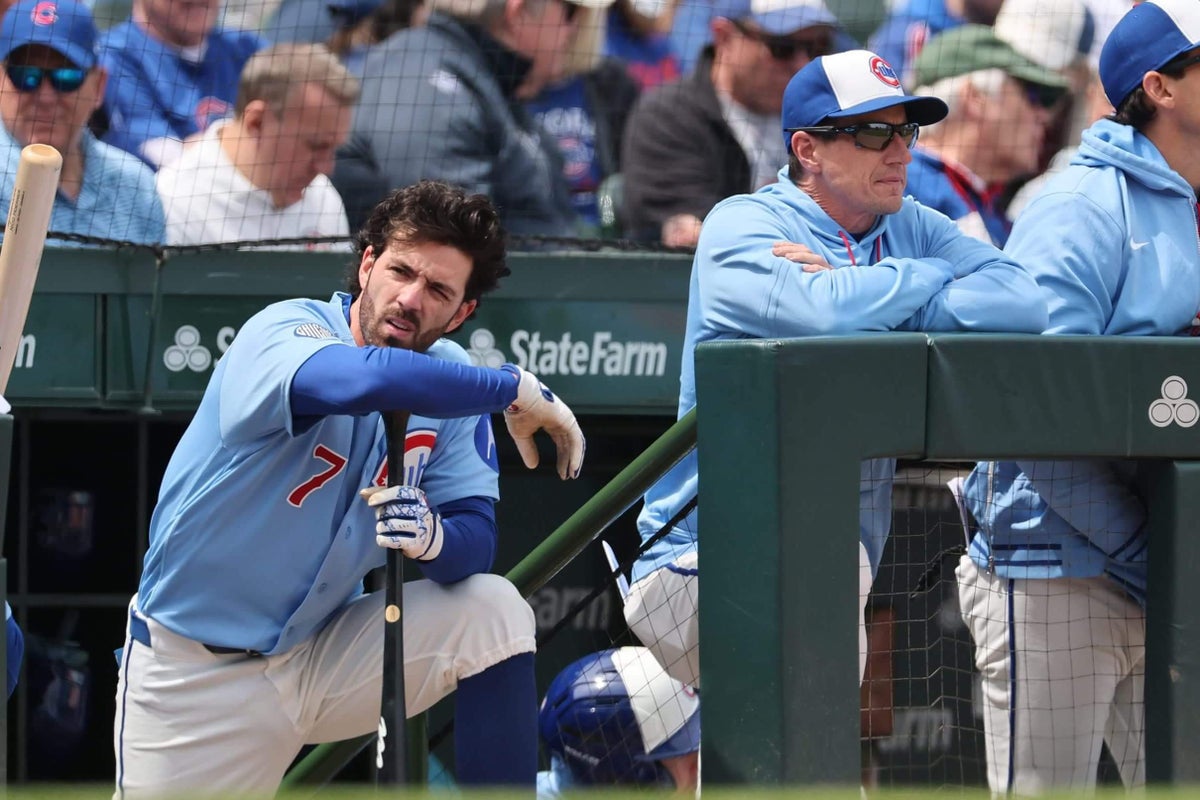
It’s a young man’s game, as Chicago Cubs president of baseball operations Jed Hoyer likes to say. The baseball industry tells us that players in their 30s inevitably begin to decline. Finding that right mix of ages will forever be an inexact science.
In the version of this season the Cubs hoped for, the club would develop that emerging talent while relying on experienced players such as Dansby Swanson and Alex Bregman to advance deeper into October. The sport, though, isn’t played on a computer screen. Stuff always happens.
With a little more than half of the 162-game schedule remaining, the club’s playoff probabilities are less than 50 percent, according to the projection systems run by FanGraphs and Baseball Reference, even after banking two 10-game winning streaks.
The Cubs don’t know how good young players such as Matt Shaw and Pedro Ramírez will be in the future, or if they will even have long careers in the majors. Moisés Ballesteros looks like he needs more consistent at-bats, if not a reset at Triple-A Iowa. Kevin Alcántara did not make a great impression during his limited run.
Still, a 10-game losing streak in May, combined with the Milwaukee Brewers again running away in the National League Central race, will lead to calls for a shake-up. Pete Crow-Armstrong’s stretches of MVP-level production before his 25th birthday are a reminder that rapid growth and big leaps usually come from players at a certain stage in their development.
Cubs manager Craig Counsell recently acknowledged that he needs to create more opportunities for Shaw, 24, a first-round pick who posted an .839 OPS as a rookie after last year’s All-Star break and then got moved off third base to accommodate Bregman. Already this season, Ramírez, 22, has turned himself into a top-100 prospect, made his major-league debut and stayed on the active 26-man roster longer than anticipated.
Yet when Hoyer sat down in Wrigley Field’s home dugout this week for a media briefing, he seemed surprised by the amount of time spent on an underperforming offense, the possibility of benching Swanson and Bregman’s lack of impact. From Hoyer’s perspective, the overall health of a battered pitching staff is a much larger concern.
“We have a lot of really talented position players,” Hoyer said. “There have been questions about our pitching depth that are fair. That’s something the injuries this year have certainly exposed. On the position-player side, we have a lot of good athletes, a lot of good bats. Having that depth is really valuable. If there are times we can use those young players, that’s fantastic.
“But I would also say the sample is still pretty small, and even within this year, those guys have had positive times. So let’s hope those guys kind of work through this. The best-case scenario, the best version of our team, is those guys are hitting and we still play really good defense.”
Mike Shildt saw that game-changing ability up close during last year’s playoffs at Wrigley Field. Shildt, who managed the San Diego Padres at that time, said this after the Cubs won their wild-card series: “I don’t think they give an MVP for this round, (but) I’d give it to Swanson. I mean, Dansby played his tail off, man. He almost single-handedly beat us with his glove.”
The Cubs then doubled down on their pitching-and-defense strategy after the Brewers beat them in the next round. Besides acquiring pitching in bulk, the Cubs circled back to Bregman, an All-Star third baseman who had turned down their offer in spring training and used the opt-out clause in his deal with the Boston Red Sox to become a free agent again.
Between Swanson and Bregman, who are each 32 years old and were the first two picks in the 2015 draft, the Cubs have invested more than $350 million in the left side of their infield.
Swanson’s production as a Cub, midway through the fourth season of a seven-year, $177 million contract, has already been worth nearly $109 million, according to the dollars metric on FanGraphs, largely due to the shortstop’s Gold Glove defense and occasional power surges.
That streakiness goes both ways.
Among hitters who entered Thursday on track to qualify for a batting title, Swanson ranked tied for last in average (.176) and placed in the bottom 5 percent in OPS (.598). A No. 9 hitter isn’t supposed to carry the offense, but that lack of production is magnified when so many of Chicago’s other hitters are also in a funk.
Perhaps this would become a different internal debate if the Cubs didn’t have so much time left on the calendar. Or if Swanson’s contract was much closer to the expiration date. Or if the backup shortstop, Gold Glove second baseman Nico Hoerner, also wasn’t mired in a months-long slump.
As it stands, Counsell and Hoyer have separately given votes of confidence that didn’t leave much room for interpretation. The Cubs will keep running Swanson out there, hoping something clicks with his swing, knowing that their fragile pitching staff needs all the help it can get defensively.
Swanson recognizes that he and his teammates have been pressing.
“There’s no sugarcoating it — not playing good stinks,” Swanson said. “We care so much. We want to do good, so badly. At times in this game, that can almost be harmful.”
Bregman is wired the same way. As a Gold Glove defender who’s getting on base 34 percent of the time, he provides a baseline level of value, but the Cubs expected more offensive thump on the front end of his five-year, $175 million contract.
Long targeted as the missing piece to this lineup, Bregman is batting .169 (14-for-83) with runners in scoring position, producing only one double and one home run in those situations. A clutch hit here or there could take the pressure off everyone else.
“He’s got an amazing track record,” Hoyer said. “I don’t think he’s happy with his first two-and-a-half months as a Cub. I think he would be open (about how) it’s been frustrating. That’s also part of baseball. I promise you, no one’s taken more swings. No one’s watched more video to figure out why he’s struggling. (But) the isolated power, the slug, the hitting with runners in scoring position hasn’t been there.”
If the answers were obvious, the Cubs would have made those changes by now. There’s a reason why solid everyday players get paid so much money — they’re hard to find. A big-market franchise identified these two particular players for their two-way skills, leadership components and World Series experience. It’s hard to envision this team functioning at a high level if they don’t turn it around soon.
“I believe in this group,” Bregman said. “Guys have been through ups and downs and know how this game works. At the end of 162, the cream always rises to the top.”