
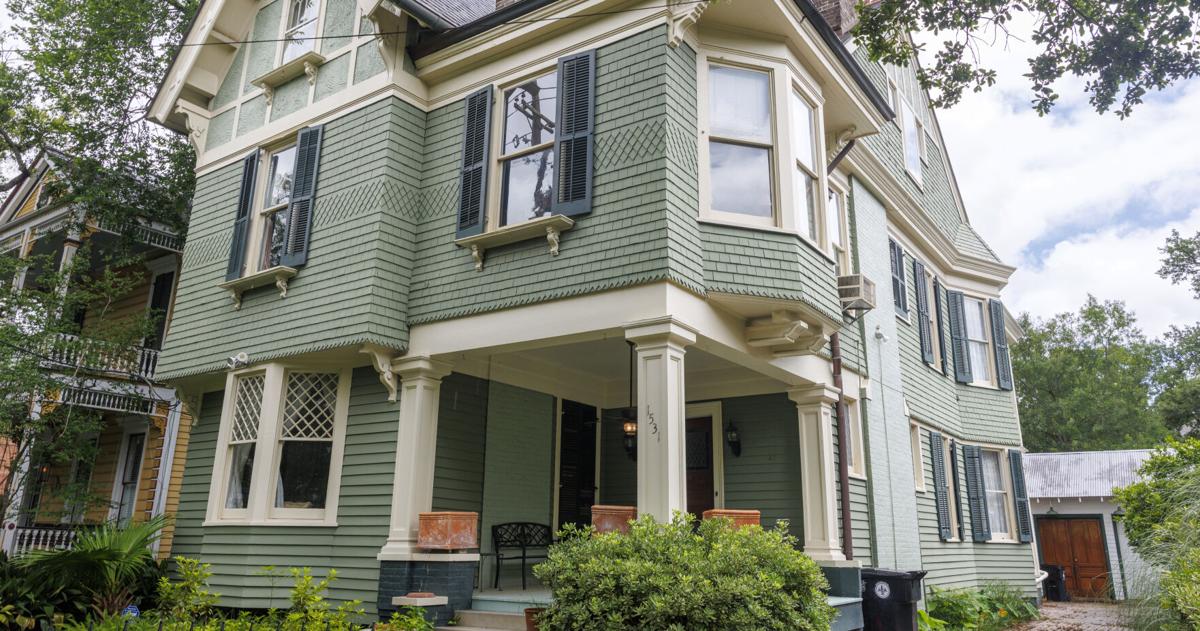
Have you ever noticed the use of wood shingles around New Orleans? Instead of clapboard, older homes sometimes have wooden patterns as siding and decorative accents.
Unlike Colonial New England, which has a history of shingle-clad houses, the use of wood shingles as a wall cladding material arrived here in the later part of the 19th century.
Replacing clapboard and drop siding, the shingles were something new that added both texture and pattern to homes. It caught the eye of architects across the nation who enthusiastically jumped on board.
Shingle Style in Rhode Island
While the Gilded Age wealthy were busy building massive summer homes referred to as “cottages,” there was a growing desire for something more American. The William Watts Sherman House in Newport, Rhode Island, designed by Louisiana native H.H. Richardson, is considered the prototype of what has been dubbed Shingle Style.
With the excitement of the upcoming 1876 U.S. centennial in the air came the desire for an architectural expression more homegrown than European. The William Watts Sherman House delivered with a more open and less formal room arrangement; an exterior of stone, brick and, of course, wood shingles; and bands of leaded glass windows.
By 1879, his family desired more space, and young architect Stanford White, of the noteworthy New York firm of McKim, Mead & White, obliged, having recently completed the nearby Newport Casino.
Not a gambling den, the casino was a tennis clubhouse with storefronts facing the street and club activities above and behind the building. The casino appeared in HBO’s “The Gilded Age” as itself when the characters assembled to play lawn tennis.

The Isaac Bell House, a historic landmark in Newport, Rhode Island.
Photo by George Gray, Provided by The Preservation Society of Newport County
The Isaac Bell House, near the casino, was designed by White in 1881. It is considered one of the most important examples of Shingle Style as it incorporates elements of English Arts and Crafts and Colonial American homes with the Japanese influence of a more open floor plan. It also included unusual details, such as the bamboo-style posts along the porches.
How did Shingle Style surface in the South?
It’s important to note that “creatives” (architects, designers, fine artists, etc.) do not create in a vacuum. They are influenced by what came before. The William Watts Sherman House, the Newport Casino and the Isaac Bell House appeared in many architectural publications of the time, inspiring architects across the country.
One such architect was the very talented Thomas Sully. Considered one of the most important architects of the late 19th century in New Orleans, Sully designed many fine homes and commercial buildings that continue to grace our city. For example, he designed 4010 St. Charles Ave., which exhibits several of the same features as the William Watts Sherman House — a fully shingle-clad second floor rests on a brick ground floor, all accompanied by small paned upper window sashes.
Sully later designed 1305 S. Carrollton Ave., and again, clad the entire upper floor with shingles in various patterns. There, the English influence is seen again in a diamond-paned upper window sash.
The shingle legacy in New Orleans
There are grand homes around town that display wood shingles in many shapes: scallop, fish scale, square, diamond and wave-patterned. There are even squared shingles applied in a crazed, though rhythmic, pattern.
In New Orleans, wood shingles were adopted by the builders of more modest shotguns and cottages, filling the front gable with texture and pattern. After 1900, bungalows became all the rage and were built in great numbers in the Carrollton, Broadmoor and Gentilly Terrace neighborhoods.
Many of these homes are partially or completely shingle-clad. There is also a smattering of shingled houses in the Lakeview, Algiers and Old Metairie neighborhoods.
The next time you are out and about, look around, and you will see the use of wood shingles in a historic neighborhood near you.