
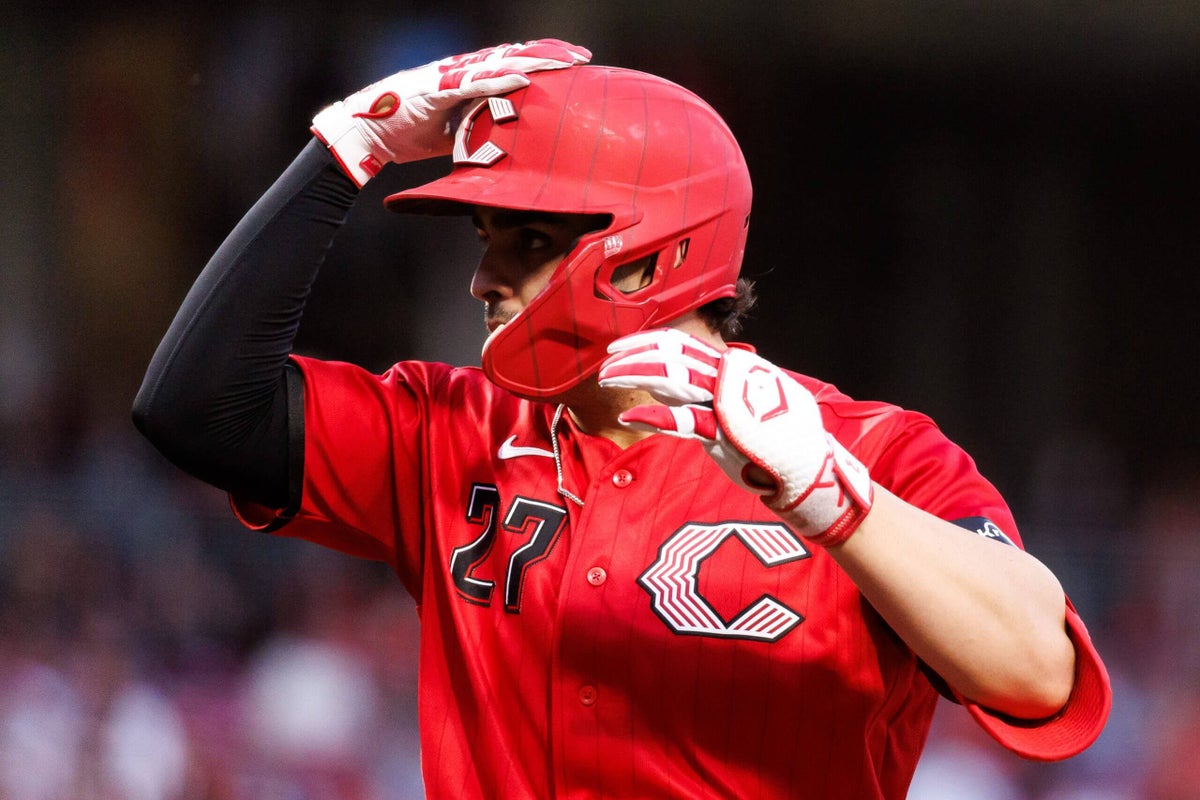
Cincinnati Reds rookie Sal Stewart enters this week’s series with the Milwaukee Brewers with 20 successful ABS challenges — just two fewer than the entire first-place Brewers’ roster.
In the first year of the Automated Ball Strike Challenge System, no player has challenged more pitches than Stewart (30), or won more challenges.
The Brewers’ Gary Sanchez has challenged 22 pitches — two more than Stewart has had overturned (20).
For those who know Stewart well, like San Diego Padres third baseman Manny Machado, the fact that the 22-year-old is the game’s most prolific helmet tapper isn’t surprising.
When asked whether he was surprised by Stewart’s willingness to challenge balls and strikes, Machado, Stewart’s childhood hero-turned-mentor, chuckled before the question was even finished.
“No,” Machado said, chuckling again before finishing his thought. “I know his eye — he’s always had it.”
Machado cites three reasons Stewart is the poster child for using ABS challenges:
Supreme confidence: Any player who reaches the big leagues must be confident in their abilities. However, even among the ultra-confident, some stand out. The fact that a 15-year-old Stewart walked into a South Florida training facility expecting to hit with Machado and former big-leaguer Yonder Alonso perfectly exemplifies Stewart’s exceptional confidence. If anything, that confidence has only grown since his high school days, when he thought he belonged with big leaguers, to now, when he has proven he belongs with the game’s best.
Strike zone awareness: Maybe the most impressive part of Stewart’s rise from the 32nd pick in the 2022 draft to the big leagues was his immediate mastery of the strike zone. In his first full season in the minors, the 19-year-old Stewart had more walks (84) than strikeouts (77) in 499 plate appearances — with just 18 of those plate appearances coming against a pitcher younger than him.
Experience: It’s counterintuitive that rookies are more experienced, but with ABS, rookies have an advantage — or at least that’s what Machado and other veterans believe.
That theory is bolstered by Detroit Tigers rookie Kevin McGonigle, whose 12 overturns are tied for second among all players with Houston Astros three-time batting champion Jose Altuve. Both have been successful on 71 percent of their challenges, while Stewart has won two-thirds.
“You’re talking perhaps both Rookies of the Year,” Machado said. “It’s still new to us. It’s not new for them. They’ve got an advantage — I’m a little jealous.”
For his part, Machado has more failed challenges (six) than successful ones (five).
Nathaniel Lowe, Stewart’s fellow first baseman with the Reds, has a World Series ring, a Silver Slugger and a Gold Glove. Lowe has more hardware than challenge wins, having won just one of his four challenges. Like Machado, the 30-year-old is in awe of Stewart’s fearlessness at tapping his helmet to challenge umpires.
“I wish I had more blind optimism to (challenge) a ball,” Lowe said. “Especially in a situation where if you lose it, I would feel like I am doing the team a disservice. So if we have players that are confident in doing it, then I would say you go ahead and keep doing your thing. But in my situation, I haven’t gotten a lot right yet, and I am not totally comfortable with ripping off challenges.”
Reds manager Terry Francona has given pretty much free rein to all of his players (except pitchers) to challenge when they feel it’s necessary. Part of that freedom comes with the responsibility of using those challenges at the right time, a fact he said he’s reiterated a time or two to Stewart, less as an admonishment than as a reminder.
“We’ve talked to Sal a few times about not letting emotion drive early challenges,” Francona said. “But again, he’s one of our best hitters, and there have been times when he’s had a pretty good feel for it.”
Stewart didn’t get much time with ABS last season, playing 38 games at Triple A before being promoted to the big leagues, winning two of three challenges he made with the Louisville Bats. McGonigle’s first challenge came at the big-league level — he hasn’t played a game at Triple A.
Stewart said he wasn’t sure if having used it for the limited time in Triple A necessarily helped him, but it certainly didn’t hurt.
It’s not just the less established batters who have an advantage, but also the catchers. Reds catcher Jose Trevino has as many Platinum Glove awards on his resume as successful ABS challenges — the 2023 winner as the top defensive player at any position in the American League has challenged four pitches behind the plate this year and won just one.
Bats catcher P.J. Higgins, who has spent 81 innings behind the plate at the big-league level this season, said he’s not sure there’s enough sample size in the minors for batters to get comfortable with ABS, but there’s plenty for catchers.
Only Triple A used ABS last season, and Higgins stood out for his success. He was successful on 77 percent of his challenges in the first year of the ABS system, the best mark of any catcher who challenged more than 20 pitches. Overall, last season at Triple A, he won 48 of 62 challenges. This year, he’s 10-for-16 (63 percent) in Triple A and 9-for-11 (82 percent) in the big leagues.
“I think just like anything else, it’s more repetition, more experience with it,” Higgins said. “You have more confidence going into it because you are familiar with it. I think it’s no different than when they implemented the pitch clock.”