
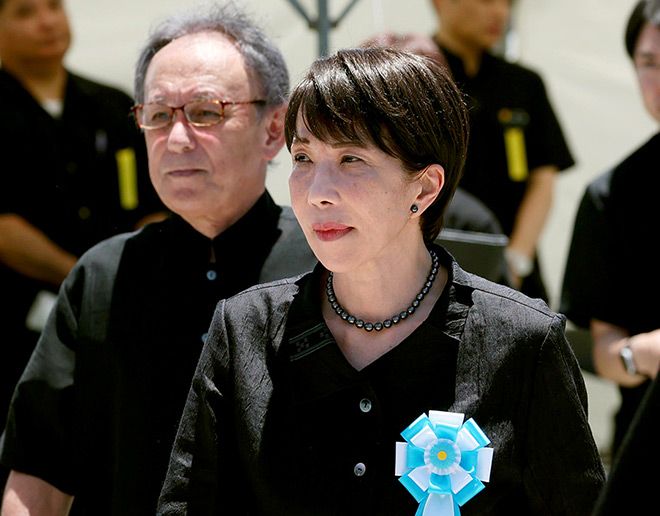
Prime Minister Sanae Takaichi’s visit to Okinawa and five‑minute private meeting with Governor Denny Tamaki on June 23 highlighted the continuing strains between Tokyo and the prefecture, according to officials and campaign strategists.
Those tensions have long shaped Okinawan politics and could heavily influence the Sept. 13 gubernatorial election.
Tamaki, who is seeking a third term and has long opposed relocating U.S. Marine Corps Air Station Futenma from Ginowan to Henoko in Nago, said he had repeatedly sought talks with Takaichi since she took office in October.
However, a meeting never materialized until the Memorial Day ceremony at Itoman’s Peace Memorial Park to honor those who died in the 1945 Battle of Okinawa.
Tamaki told reporters the Henoko relocation and the Self‑Defense Forces’ “Southwest shift” were not raised in the brief encounter.
He said he asked to meet with her again, which Takaichi agreed to.
Local officials said the short meeting underscored how disconnected Tokyo appears from Okinawan concerns.
An Okinawa prefectural assembly member allied with Tamaki criticized the prime minister’s approach, saying she “was probably busy with elections and the Diet, but there is no visible interest in Okinawa to begin with.”
The same assembly member added, “Governor Tamaki keeps saying he wants dialogue with the central government, but there is no one to serve as a conduit, so it will probably be difficult to continue talks with the government going forward.”
CAMPAIGN CALCULUS
The visit comes as the Liberal Democratic Party tries to unseat Tamaki. The prefectural LDP is backing former Naha Deputy Mayor Genta Koja in the Sept. 13 race.
Kosaburo Nishime, chair of the LDP’s Okinawa chapter and a Lower House member, has called the contest a “decisive battle.”
But party managers on the ground are uneasy about tying the local campaign too closely to Takaichi.
Prefectural LDP officials dropped plans for Takaichi to campaign for Koja, with one official saying, “It would be better if the prime minister did not come,” worried that her presence could negatively impact swing votes rather than help them.
Party strategists are particularly focused on retaining Komeito‑aligned votes; the lay Buddhist organization Soka Gakkai, Komeito’s main support base, includes members who oppose Takaichi’s more hawkish security agenda.
A local Komeito official said, “In Okinawa, where the memory of the Battle of Okinawa has been passed down, our commitment to peace is strong. If Takaichi takes the forefront, a certain number of people will drift away.”
The political calculations follow a strong showing for the LDP in February’s Lower House election, when LDP candidates won every single‑seat district in the prefecture for the first time under the current electoral system.
The LDP’s Masahisa Miyazaki, who serves as deputy minister for defense, unseated a long‑time Social Democratic Party incumbent in District No. 2 by stressing his closeness to Takaichi, a result that both energized local LDP operatives and sharpened concerns about voter reaction to central government policies.
SECURITY MOVES STIR UNEASE
Security moves out of Tokyo have heightened those tensions.
In 2023, the central government carried out a government‑ordered enforcement action that effectively removed the prefecture’s ability to block the Henoko construction.
Tokyo’s push to realign SDF units to the southwest and to step up Japan‑U.S. joint drills have stoked unease among residents for whom memories of the bloody Battle of Okinawa remain vivid.
For example, multiple SDF Ospreys flew to Marine Corps Air Station Futenma for the first time on June 22.
Those moves helped prompt vocal protests when Takaichi spoke at the June 23 memorial service; some attendees shouted “No to war” and “Protect the Constitution.”
Against that backdrop, Komeito’s stance is seen as pivotal: the party supported rivals to Tamaki in the last two gubernatorial contests, and local LDP officials hope distancing themselves from Takaichi will retain Komeito‑leaning voters.
Takaichi first dealt with Okinawan affairs as a Cabinet minister in 2006 and has repeatedly pushed for the contentious Henoko relocation plan including placing it in LDP policy documents in 2013.
Her stance sometimes led to clashes with prefectural LDP members; some said they could not “feel Takaichi’s attachment to Okinawa.”
SPEECH FOCUSES ON SACRIFICE
In her June 23 memorial remarks, Takaichi mentioned the great sacrifices made in the Battle of Okinawa.
“When I think of the regret felt by all those who lost their lives in the war and the grief of their bereaved families, my heart truly aches,” she said.
Takaichi added that Japan, “under the resolute vow to never again repeat the horrors of war, has advanced as a nation that esteems peace,” and pledged that “we will continue our unceasing efforts so that every Japanese person can live in a peaceful and fulfilling society.”
She also said, “Even now, 80 years after the end of the war, the people of Okinawa continue to bear a heavy burden due to the concentration of U.S. bases. We will work on the reorganization, consolidation and reduction of U.S. military facilities and areas in Japan, and, in cooperation with the people of Okinawa, promote the effective use of former military base sites.”
After the ceremony, asked by reporters about reducing the U.S. base burden in the prefecture, Takaichi called the U.S. forces in Japan “indispensable” as the security environment grows increasingly severe.
“For their smooth stationing, the understanding and cooperation of the public, including local communities, are essential,” she said. “However, we must steadily proceed with reducing the base burdens.”
(This article was compiled from reports by Kazufumi Kaneko and Ryo Aibara.)