
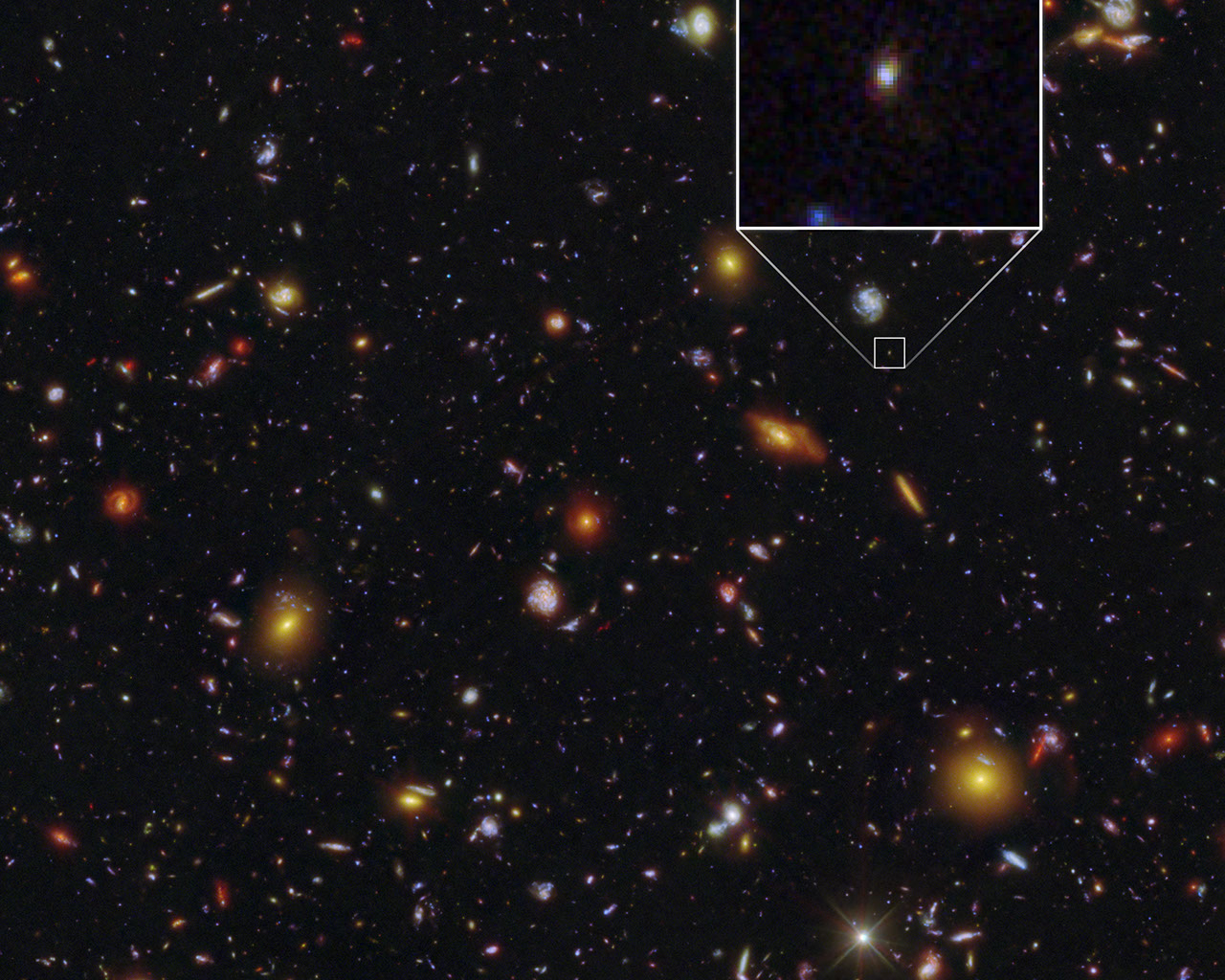
Oddball galaxy MXDFz4.4 existed only 1.4 billion years after the big bang, when the universe was still a “swirl” of opaque and clear gas as the Era of Reionization was ending.
Detailed visible-light images from NASA’s Hubble Space Telescope revealed that several bursts of younger stars cleared the space in and around the galaxy. The team sifted through extensive Hubble observations that produced deep exposures of the field where this galaxy is located.
The color assignments in the image, which combines data from the Hubble and James Webb space telescopes, emphasize the specific wavelengths of light Hubble observed where ionizing photons from MXDFz4.4 were detected, which transformed the gas around them from opaque to clear.
Researchers have long sought evidence to explain how the universe transitioned from foggy to transparent — and Hubble has provided the first example this close to the Era of Reionization of how that might have happened within an individual galaxy. “Hubble returned the only view that shows the galaxy’s ionizing photons — light capable of clearing the ‘fog’ in and around the galaxy,” said lead author Ilias Goovaerts, a postdoctoral fellow at the Space Telescope Science Institute in Baltimore.
About the ObjectR.A. Position
R.A. PositionRight ascension – analogous to longitude – is one component of an object’s position.
03:32:39.64
Dec. Position
Dec. PositionDeclination – analogous to latitude – is one component of an object’s position.
-27:47:16.30
Constellation
ConstellationOne of 88 recognized regions of the celestial sphere in which the object appears.
Fornax
Distance
DistanceThe physical distance from Earth to the astronomical object. Distances within our solar system are usually measured in Astronomical Units (AU). Distances between stars are usually measured in light-years. Interstellar distances can also be measured in parsecs.
12.4 billion light-years away to MXDFz4.4
Dimensions
DimensionsThe physical size of the object or the apparent angle it subtends on the sky.
This image is about 1.6 arcminutes across.
About the DataData Description
Data DescriptionProposal: A description of the observations, their scientific justification, and the links to the data available in the science archive.
Science Team: The astronomers who planned the observations and analyzed the data. “PI” refers to the Principal Investigator.
This image was created from Hubble data from the following proposals: 9978 (HUDF; S. V. W. Beckwith et al. 2006), 9425 (GOODS; M. Giavalisco et al. 2004), 12060, 12061, 12062 (CANDELS; S. Faber, A. Grogin et al. 2011, A. M. Koekemoer et al. 2011), 12177, 12328 (3D-HST; P. Van Dokkum, G. B. Brammer et al. 2012), 15647 (UVCANDELS; H.Teplitz, X. Wang et al. 2025), 12534 (H. I. Teplitz et al. 2013), 13872 (HDUV; P. A. Oesch et al. 2018) and JWST data from the following proposal: 1180 (JADES; D. J. Eisenstein et al. 2023)
Instrument
InstrumentThe science instrument used to produce the data.
Hubble> ACS/WFC Webb> NIRCam
Filters
FiltersThe camera filters that were used in the science observations.
Hubble> F435W, F606W, F775W, F814W, F850L, Webb> F090W, F115W, F150W, F182M, F200W, F210M, F277W, F335M, F356W, F410M, 430M, F444W