
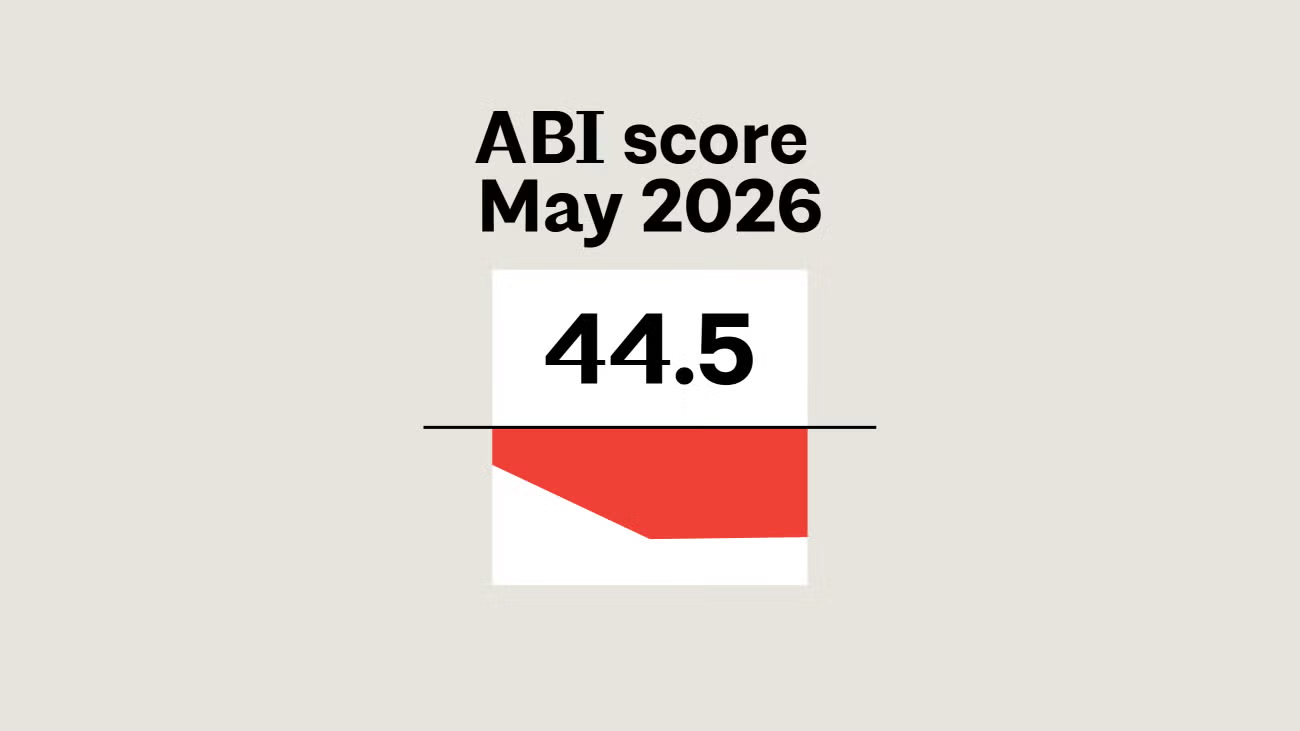
Business conditions worsened at architecture firms in May
Following a score approaching growth earlier this year, the AIA/Deltek Architecture Billings Index® (ABI) score for May declined to its lowest level since January, with a score of 44.5. This is likely a reflection of the softness in the economy due to the ongoing Iran conflict, as higher gas prices and inflation have led some clients to pause new projects. This is also reflected in the inquiries index, which slipped below 50 for the first time in four months. The value of newly signed design contracts also weakened to its lowest level since January.
In addition, architect sentiment about future work also declined this quarter. At the end of the first quarter of 2026, 21% of responding firm leaders reported that they expected their firm’s billings to decline by 5% or more in the second quarter; now, one quarter of firm leaders expect their billings to decline in the third quarter. Nearly half (46%) expect their billings to remain about the same, while 30% expect their billings to increase by 5% or more.
Business conditions were soft across the country in May as well. Billings remained closest to growth at firms located in the South, as has been the case for most of the year so far. However, billings weakened significantly at firms located in the West, which had also been close to growth earlier this year. Firms of all specializations also reported declining billings this month, after firms with a multifamily residential specialization saw flat to modestly increasing billings in March and April. Business conditions continued to weaken at firms with an institutional specialization, even though they also reported growth in March.
High inflation persists
In the broader economy, inflation remained stubbornly high in May, as the Consumer Price Index (CPI) increased by 0.5% from April. While this was lower than the monthly increases in March and April, it was more than double the monthly increases at the start of the year before the conflict in Iran began. The CPI was also up by 4.2% from one year ago, which is the highest annual increase in more than three years. Rising energy prices remained the primary contributor to this month’s increase, although shelter and food prices were also up. As a result, the Federal Reserve held interest rates steady at their meeting on June 17. Although the current interest rate range of 3.5% to 3.75% remains well above the target rate of 2.0%, new Federal Reserve chairman Kevin Warsh indicated a willingness to raise rates later this year.
Despite inflation remaining high, total nonfarm payroll employment increased by an additional 172,000 new positions in May, in line with April’s increase. Health care was one of the primary contributors this month, adding 35,000 new positions. Architectural services employment added 100 new positions in April, the most recent data available, but has been generally flat so far this year.
Nearly 4 in 10 firms report that they are not currently appropriately staffed with architecture staff
This month, we asked architecture firm leaders about staffing needs at their firms. Overall, more than 6 in 10 responding firm leaders (62%) reported that their firm is currently appropriately staffed with architecture staff. Just 15% reported that they are currently overstaffed, while 23% reported that they are currently understaffed. Firms located in the South (29%) and West (28%) were most likely to report being understaffed, while large firms with annual billings of $5 million or more (20%) and firms with an institutional specialization (19%) were most likely to report being overstaffed. Firms that are understaffed reported being understaffed by an average of four full-time architecture staff positions, while those that are overstaffed reported being overstaffed by an average of five full-time architecture staff positions.
Despite most firms reporting being appropriately staffed at this time, nearly two-thirds of responding firm leaders (63%) indicated that recruiting architectural staff at their firm is presently a problem, with 16% indicating that it is a serious problem. Fortunately, retaining existing architectural staff is less of an issue, with 63% of responding firm leaders indicating that it’s not a problem, and just 7% reporting that it’s a serious problem. Given today’s architectural staffing conditions, nearly one-third of firms (31%) reported that they are increasing salaries above typical levels to retain current staff, while 29% are offering additional employee perks (e.g., 4-day work week; ability to work remotely), 25% are offering additional employee benefits, 23% are increasing salary offerings above typical levels to attract qualified candidates, and 23% are hiring contract workers.
Finally, we asked whether the use of AI has had any effect on staffing at their firms over the past year. Overall, it has not, with 88% of responding firm leaders reporting that the use of AI has had no impact on staffing. However, 3% of responding firms reported that they have reduced their staff (e.g., had layoffs) due to the use of AI. On the other hand, 2% of firms reported that they have added to their staff (new hires) due to the use of AI, which was higher at large firms with annual billings of $5 million or more (4%) and at firms with an institutional specialization (3%). (The remaining 7% of firms indicated an “other” response.)