
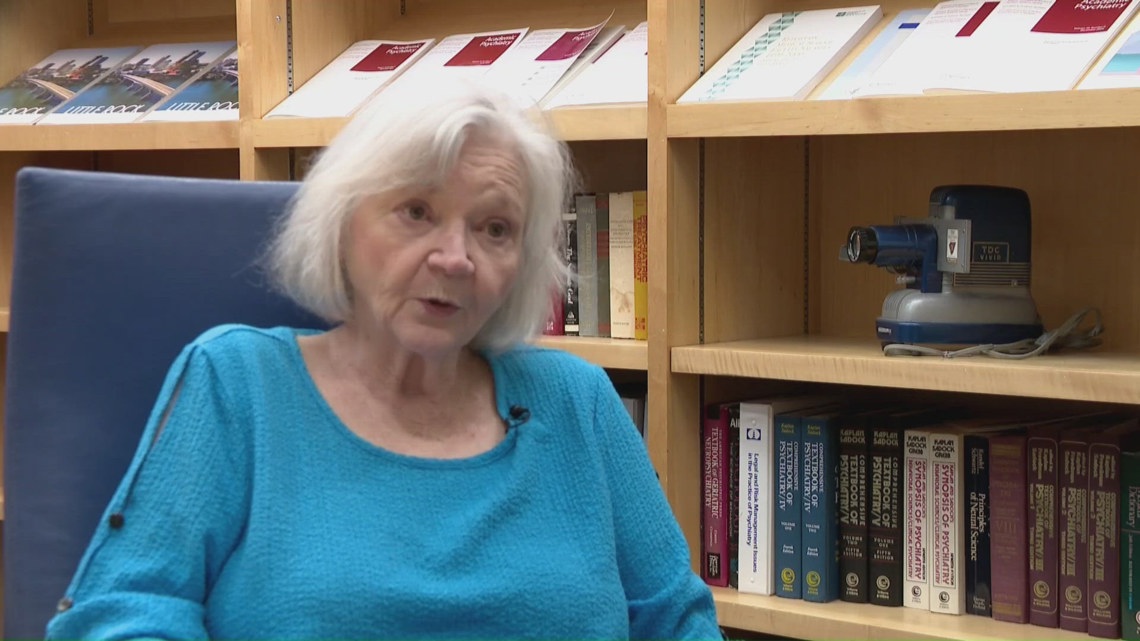
An Arkansas woman is now sharing how she has been able to conquer and overcome a lifelong battle with depression thanks to a revolutionary treatment at UAMS.
LITTLE ROCK, Ark. — An Arkansas woman is finally free from depression through a landmark treatment at UAMS.
As we celebrate our nation’s anniversary, we also celebrate the innovation and ingenuity of the people who call it home. Some of the most important stories are the incredible strides made in the medical field.

This story continues below.
More in Local
Arkansas heart transplant patient competes in ‘Transplant Games of America’
Arkansas State Board of Nursing warns of ongoing scam calls
Here’s how one of those discoveries finally brought relief to an Arkansas woman who’d been suffering from depression for most of her life. As far back as she can remember, Sandy Rasmussen has only known life through the lens of depression.
“I was always very sensitive as a child,” she described. “I was depressed from an early, early age.”
Sandy is the oldest child in her family and said that her parents had their own issues, giving her little to no support. She eventually learned to keep her struggles to herself.
“I didn’t have friends when I was young. It was like everybody knew there was something odd about me, so I never really had a close friend. I was never included in anything,” she said. “My first suicide attempt was when I was 12 years old.”
Other attempts would follow, with the last one, an overdose of medication, leaving her in a coma for days.
“Just to get out of the pain. That’s the reason I wanted to die. It was too painful to live,” she explained.
The early days of modern psychiatry in the U.S. offered few effective options for people with treatment-resistant depression. Patients like Sandy would try the newest drugs, different methods of in-office therapy, even electroconvulsive therapy, where controlled electrical currents travel through the brain to reset mood-regulating neurons. Each time, she would begin a new treatment with optimism, only to see it fail.
Then, in January of 1988, a new type of brain chemistry drug hit the American market. Psychiatry began buzzing about the breakthrough medication called Prozac.
“When Prozac first came out, I thought, ‘Oh my God! A drug. Finally,’” she recalled.
Sandy was optimistic, but, just as before, her sadness eventually returned. By then, she and her psychiatrist agreed that they had truly tried everything.
“I went in there, and I said, ‘ This is not working.’ And she said, ‘Sandy, we’ve come to the end of the road. I don’t have anything else for you,'” she said.
Years passed before Sandy’s husband Richard finally stepped in, taking her to UAMS in Little Rock for a fresh start. There, the couple learned of a revolutionary, non-invasive, newly-approved treatment, offered only at UAMS in Arkansas at that time, called Stanford Neuromodulation or “SAINT”, from Magnus Medical.
SAINT uses brain mapping and magnetic stimulation to directly target the area of the brain where emotional activity is located. Unlike other transcranial magnetic therapies, where treatment is spaced out over a period of weeks or months, SAINT therapy is completed in five days.
Sandy said she noticed that something was different on about the third day. That was 14 months ago, and now, she finally feels free of the crippling depression that had consumed most of her life. Sandy says she sometimes still can’t believe how good she feels.
“If you would have told me I would have 14 months of peace, I would have never believed you,” she said.
Her message to others like her, who are still suffering, is to not be afraid to seek help.
“There’s help. And just don’t give up on your life, because I know there’s a lot of young people out there who suffer, and there is help. You don’t have to live your life like this”, she added.
For more information on the UAMS SAINT treatment, click here.