
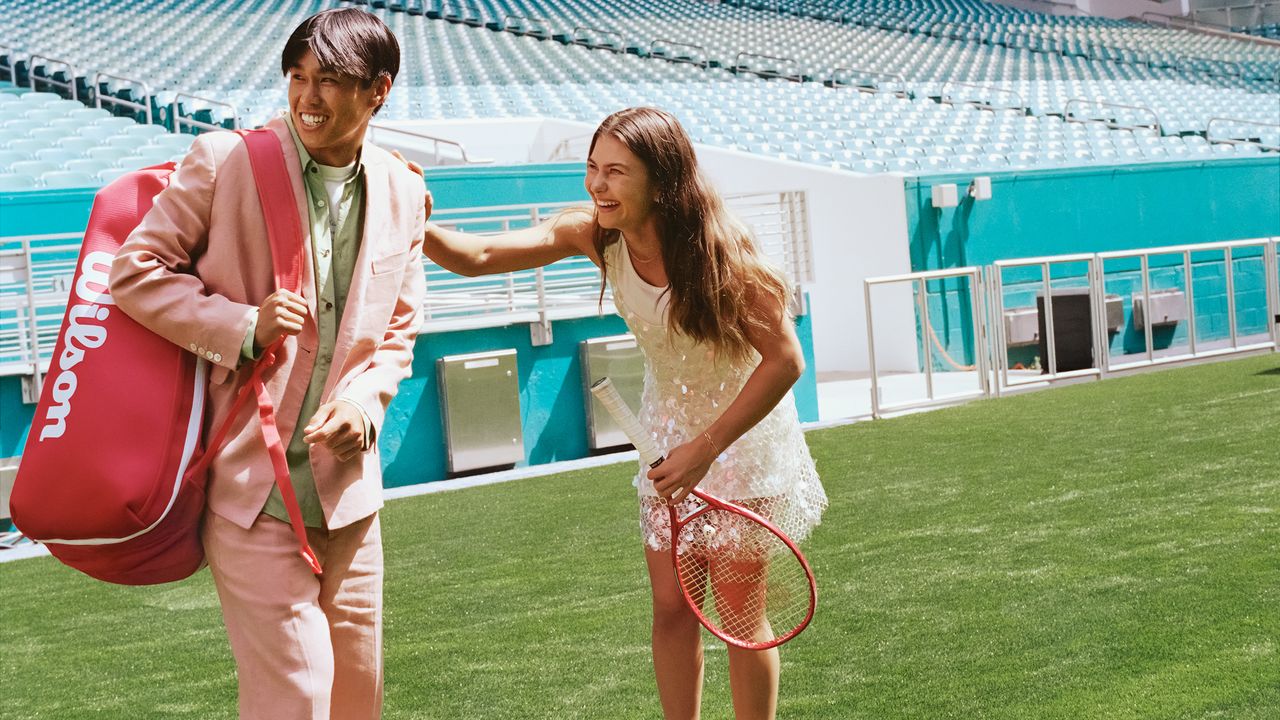
Our current moment has been an especially prosperous one for American tennis, with four men and five women in the world’s top 20—and Jovic and Tien are the youngest players to crack this elite group. Spend any time around the tennis commentariat, and you’ll hear both of them cited frequently as among the sport’s most promising upstarts. At Indian Wells in March, where Tien made a run to the quarterfinals before losing to Jannik Sinner, the world number one admitted to being impressed by how quickly Tien has established himself over just a single season on the circuit. At the Australian Open a month earlier, world number three Alexander Zverev (who’s among the five top-10 players Tien has beaten) made note of Tien’s enormous potential, questioning why the mainstream hadn’t yet caught on. “People talk a lot about other players his age, but much less about him,” Zverev said, “when in reality, he’s the one performing at a higher level.”
Tien, though, maintains a healthy distance from the hype machine. “It’s incredible to hear,” he says of the praise and high expectations that have come his way. “But, in my mind, potential doesn’t really mean anything until you fulfill it.” In his first season on tour, Tien tells me, ambition too often came at the expense of his well-being. “I was in Rome, I was in Geneva, I was in Madrid, playing all these incredible tournaments in these great cities,” he says, “and I wasn’t really able to enjoy it, because the losses just felt like life or death to me.” He’s since made a conscious decision to try to take the pressures of the tour in stride—though he admits that most of those cities remain unexplored. “I just feel like if I’m not playing tennis,” he continues, “I’m wasting part of my life—but I’m going to try to go out and see more of the world.”
Jovic, the youngest player in the WTA’s top 100, has caught the attention of no less than Novak Djokovic, the player she grew up idolizing. “It was a family thing,” she tells me, pointing out that her parents, like Djokovic, grew up in the fog of war-torn Serbia. “We’d all sit down and root for him, watch all his matches.” Bojan and Jelena, both pharmacists, were tight-lipped about the precarious conditions that led them to immigrate to the United States. “But going into my teens,” Jovic says, “I would ask more questions. Where did you guys come from? How was it? And they just spoke in normal terms, like, ‘Yeah, we were at home, maybe a bomb’s going to fall, maybe it’s not.’ ” Jovic pauses, glancing over at her parents mingling in the hotel lobby with her agents. “They didn’t have a lot, but they worked really hard,” she adds. “So I think that perspective makes me more inclined to not waste this opportunity.”
Djokovic, to whom Jovic was introduced at Wimbledon last summer, has emerged as a sort of big brother figure, offering suggestions for navigating the demands of the circuit and encouraging her to journal, meditate, and develop her mind in parallel with her tennis. “They text,” says Bojan, smiling. Later, when I ask Jovic about their friendship, her cheeks go red. “Friendship, that’s a crazy word,” she says, wary of overstating her connection to the 24-time Grand Slam champion. “But I reach out to him if I need some advice.”
Jovic, it has to be said, appears uniquely unburdened by both her success and by the pressures of pro tennis. She pays little mind to social media harassment; she dreams of buying a speedboat and one day going to law school; and, now that she’s become a genuine threat to win big titles, she speaks with refreshing candor about the occasionally cutthroat nature of the sport’s top ranks. “There is one hundred percent a hierarchy in tennis,” she says. “When you walk into the locker room the first couple times, a lot of people won’t speak to you—Who is she? What is she doing here? The first six months were not easy for me.” As she’s established herself, though, locker-room dynamics seem to have softened.