
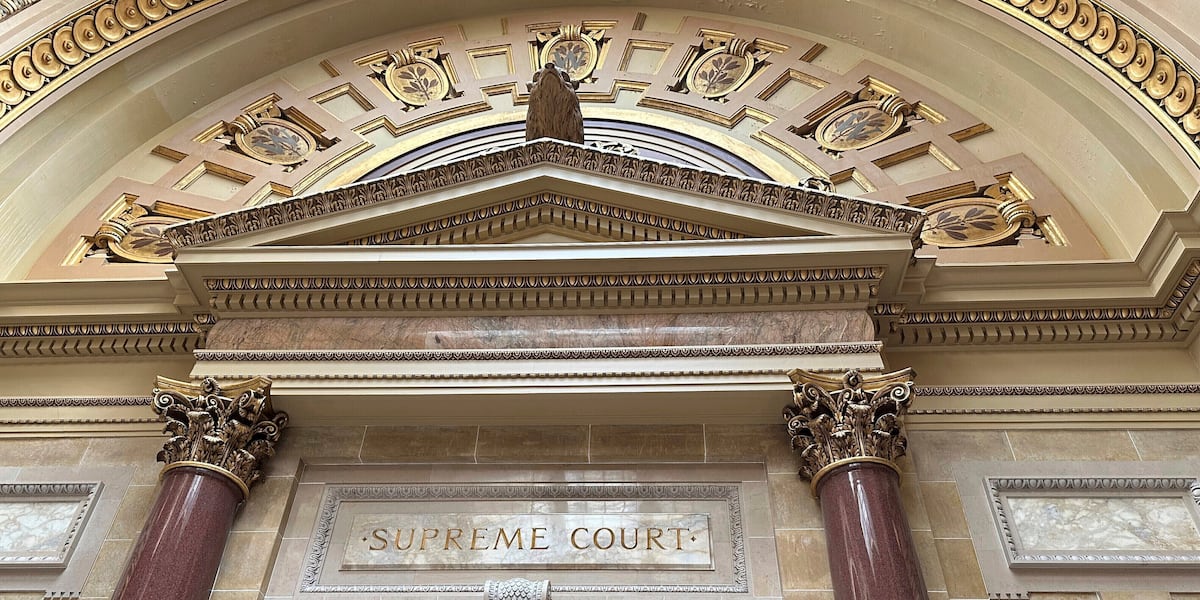
MADISON, Wis. — The Wisconsin Supreme Court issued rulings Friday in two cases involving defendants found mentally incompetent.
Involuntary medication case
In the first case, a woman charged with slapping a nurse at the Milwaukee County Jail challenged a circuit court order requiring her to be involuntarily medicated.
Her attorney argued the circuit court lacked authority to issue that order. The Supreme Court agreed, 6-1.
The court said the law does not give a circuit court judge authority to order involuntary medication solely because the court finds a defendant is dangerous. Separate laws govern court-ordered involuntary medication to restore a defendant’s competency for trial — and those require a report by a licensed physician and a hearing in which prosecutors must provide clear and convincing evidence.
“After all, there would be no reason to enact a separate process for individuals committed … subject to additional procedural and substantive requirements,” the justices wrote, if the less rigorous law could be used in those cases.
The ruling said medical professionals working with a defendant on a competency hold may still involuntarily medicate that defendant if the person poses a danger to themselves or others because of a mental illness.
Outagamie County case
In a separate decision, the court ruled unanimously in favor of the State in an Outagamie County case involving a man involuntarily committed for six months.
The man, identified in the ruling by the pseudonym Mark, argued a judge should not have proceeded with his hearing because his attorneys did not receive two psychiatrists’ reports until less than two days before the hearing. He said the late disclosure affected his right to present a defense.
The justices rejected that argument, noting that Mark’s attorneys did not ask the court to postpone the hearing, neither side intended to call one of the psychiatrists as a witness, and the reports did not call into question Mark’s mental illness.
“Moreover, Mark was not deprived of his right to a contested hearing, his right to demand a jury trial, his right to cross-examine witnesses, or his right to testify on his own behalf,” the justices wrote. “He received a timely final hearing and was not detained beyond the statutory limit.”
The court said the failure to meet the 48-hour deadline did not affect Mark’s substantial rights and was harmless to his defense.
Copyright 2026 WBAY. All rights reserved.