
Getting your audio player ready…
A handprint on a cave wall has fingers spread wide. The pigment is made from powdered red ochre mixed with water or animal fat. The hand was placed against the rock while someone blew pigment through a hollow bone. When the small hand was removed, it left behind a negative image with uneven edges. Generations of Ice Age people came to this wall, leaving other faded marks, dots, waves, and animal shapes. People of the distant past left a message for visitors: “I was here.”
Now, scientists have shown for the first time that ancient human DNA can survive for thousands of years on cave walls. This remarkable finding presents promising research options for examining prehistoric human activity. The interdisciplinary study was conducted in collaboration with the First Art Project, led by researchers from Spain and Portugal in direct coordination with institutions in the UK, China, and Germany.
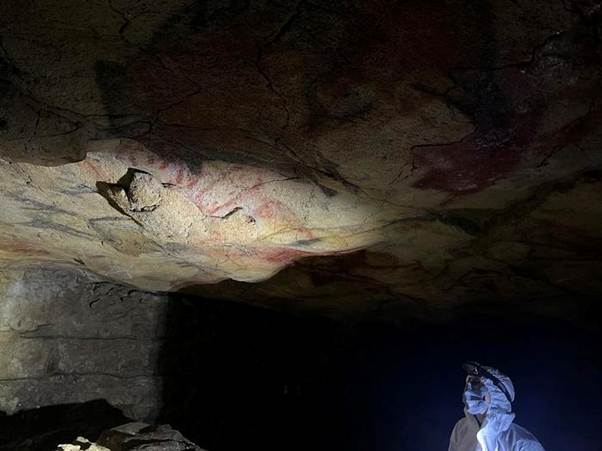
Polychrome ceiling of Altamira from which pigment samples were analyzed. (© Matthias Meyer/Nature)
Scientists Extracted Ancient DNA Directly From Cave Walls
The First Arts Project has set out to date the earliest cave art and characterize its chemical composition. This principal study aims to collaborate with institutions such as the Max Planck Institute for Evolutionary Anthropology. Due to this effective collaboration, the team has now extended its examinations to include DNA analysis.
These findings explore the possibility of recovering specific ancient DNA from cave art. The process will go beyond bones, sediments, and bone artifacts. The research focused on these four categories: 24 rock panels from eleven separate caves, simple marks, hand stencils, and pigment naturally falling from figurative paintings in the famous cave of Altamira in Spain. Using the latest technology in DNA extraction and sequencing methods, the team analyzed both pigmented and unpigmented cave wall fragments. They also analyzed sediments, bones, and a rare ancient airbrush tool used for applying paint.
Researchers found traces of human DNA in one pigmented calcite crust sampled in Escoural Cave in Portugal. Surprisingly, the researchers also found ancient human DNA in several non-pigmented parts of another cave wall in Escoural. Additional ancient human DNA was found in the Covarrón cave in northern Spain.
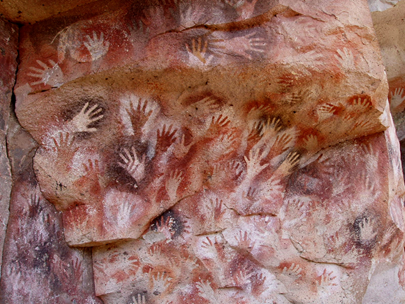
Hands at the Cuevas de las Manos upon Río Pinturas, near the town of Perito Moreno in Santa Cruz Province, Argentina. (Mariano/Public Domain)
DNA Revealed — Sex, Population, and More
Of the 54 samples collected, only five yielded authentic ancient human mitochondrial DNA. Part of that authentic human DNA was collected from a calcite crust with pigment underneath Escoural Cave, and two unpigmented cave wall samples from nearby rock art in Covarrón. Critically, two of the samples were found not to have detectable faunal mitochondrial DNA. This research suggests that human beings deposited the DNA through saliva or other fluids. In contrast, three other unpigmented wall samples contained faunal and human DNA, indicating indirect deposits most likely via sediment or water.
Hipolito Collado Giraldo, a rock art specialist and archaeologist in collaboration with the Extremadura Government in Spain, says:
“We know that some of the cave art was applied to the walls by blowing or rubbing pigment onto the surface. Given the enormous sensitivity of current ancient human DNA analysis, we were eager to see whether this type of contact could potentially leave traces of DNA in the rock art, potentially allowing the team to obtain genetic profiles from the makers of the art.”
The ancient human DNA provided sex information. Three of the samples come from women, and one is mainly from a man. One remains unidentified. Further analysis of the two unpigmented cave wall samples from the Covarrón revealed that the DNA taken traces all the way to modern humans, while nuclear DNA places these individuals within the Western Hunter-Gatherer genetic cluster. This data is broadly consistent with findings from similar ancient Iberian populations.
The researchers also tested a prehistoric bird bone airbrush from Altamira Cave that was used to spread red ochre pigment across the walls of the cave. Despite the team initially wishing to find saliva-derived DNA, no uncontaminated ancient human DNA was recovered. This find highlights the fragility of DNA preservation, especially in relation to material that has been studied over the decades.
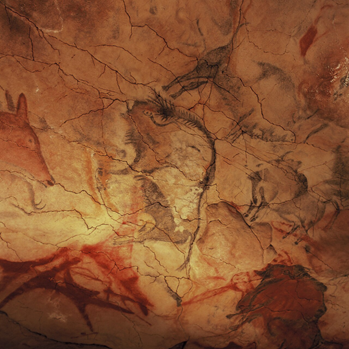
Prehistoric cave art in northern Spain. Animals and red symbols. (Yvon Fruneau/CC BY-SA 3.0 IGO)
Identifying Ice Age Artists for the First Time
Senior author and paleontologist Matthias Meyer, working with the Max Planck Institute for Evolutionary Anthropology, co-led the work with Hipolito Collado Giraldo. Meyer says, “We were very surprised to find out that ancient DNA can be recovered not only from pigmented samples, but also from cave walls that show no visible evidence of past human activity. We can now ask new questions, such as: Who touched this wall? Was it a man or a woman? Which population did they come from? How far did ancient humans venture into the deep cave systems?
This discovery opens up incredible possibilities in studying prehistoric human behavior without disturbing archaeological sites. By analyzing the DNA found on these myriad cave walls, researchers can at last further expand our knowledge into the occupants of the cave and even their biological sexes. “This isn’t just about rock art”, says Hipolito Collado Geraldo. “It’s fundamentally about how people used caves and where they left their imprint.”
Conclusion
Despite certain favorable conditions for the collection of ancient DNA, many sites were contaminated. Ancient DNA was detected in only one out of the twenty-four rock art panels examined. This particular rarity suggests that pigment surfaces rarely hold enough DNA to last for thousands of years, particularly if they aren’t protected by mineral crusts or sealed environments.
This is just the beginning, according to Meyer:
“We know far better now how these cave walls are archives of our collective human past. The next step is to engage in testing more sites, art styles, and techniques, especially hand stencils and figurative art in caves with good molecular preservation.”
With further work, it may even be possible to reveal the makers of specific pieces of cave art and to finally identify the faces of these artists by the genetic identities they left behind tens of thousands of years ago.
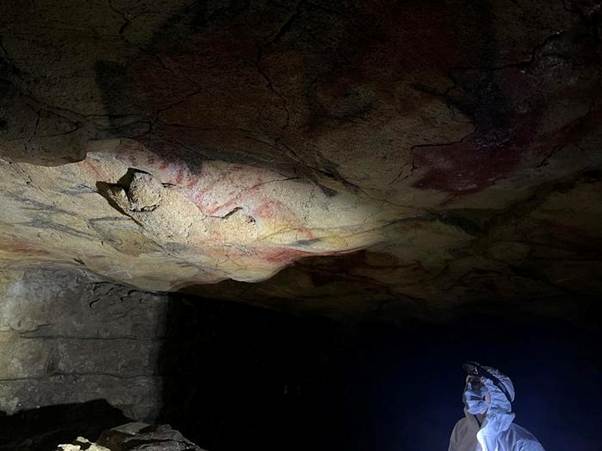
Top Image: Pigment sampling at a claviform rock art figure in Tebellín, Spain. Source: © Alberto Martínez Villa/Nature
By Ramsey Hardin
References
“Ancient Human DNA Found Preserved on Cave Walls for Thousands of Years, Study Finds.” Archaeology Magazine. Published June 26, 2026. Accessed June 26, 2026. https://archaeologymag.com/2026/06/ancient-human-dna-preserved-on-cave-walls/.
Max Planck Institute for Evolutionary Anthropology. “DNA in Archaeological Sediments.” Published December 27, 2021. Accessed June 26, 2026. https://www.mpg.de/18092942/dna-in-archaeological-sediments.
Max Planck Society. “Human DNA Can Survive on Cave Walls for Thousands of Years, Opening New Window into Prehistory.” Phys.org. Published June 24, 2026. Accessed June 26, 2026. https://phys.org/news/2026-06-human-dna-survive-cave-walls.html.
National Geographic. “Solving One of Humanity’s Oldest ‘Missing Person’ Cases.” Accessed June 26, 2026. https://www.nationalgeographic.com/newsletters/article/cave-painting-spain-stones-and-bones
“Scientists Find Human DNA over 2,000 Years Old in Caves in Spain and Portugal.” Euronews. Published June 24, 2026. Accessed June 26, 2026. https://www.euronews.com/culture/2026/06/24/scientists-find-human-dna-over-2000-years-old-in-caves-in-spain-and-portugal
Scott, Anastasia. “Ancient Human DNA on Cave Walls Could Reveal Who Touched These Sites—and Their Art.” Discover Magazine. Published June 25, 2026. Accessed June 26, 2026. https://www.discovermagazine.com/ancient-human-dna-on-cave-walls-could-reveal-who-touched-these-sites-and-their-art-49289.