
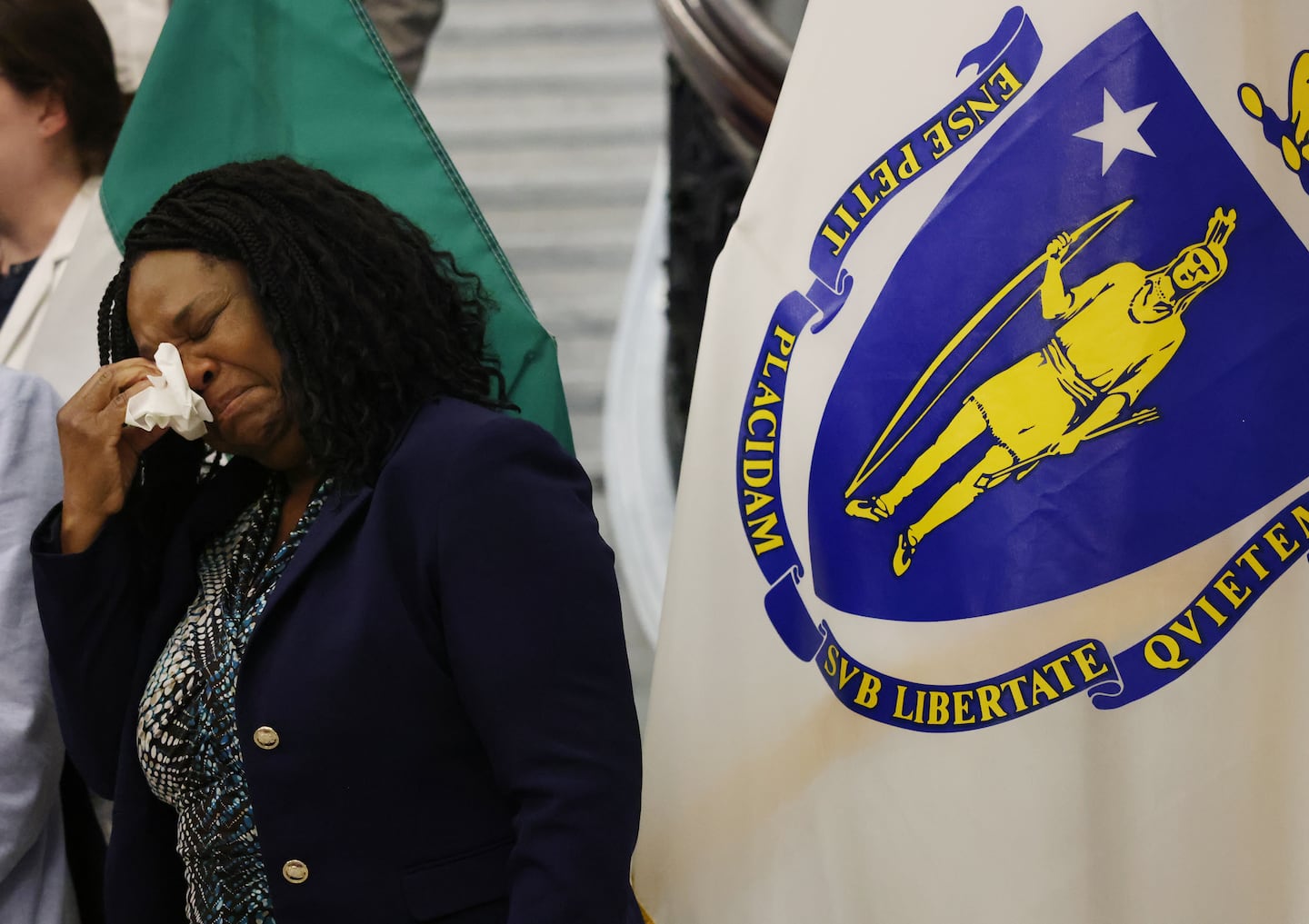
More than 10,000 Haitians in the Massachusetts workforce, many filling crucial jobs in long-term care, construction, and transportation, will lose their Temporary Protected Status. The Trump administration is expected to implement the court ruling any day. And unless they have other legal protections, those with Haitian or Syrian TPS will not be allowed to stay in the country.
Get Starting Point
A guide through the most important stories of the morning, delivered Monday through Friday.
“This is going to decimate certain industries here in Massachusetts,” said Amy Nishman, senior vice president of strategy at the workforce development agency JVS Boston. “In September, we won’t be able to get children to school because there won’t be enough bus drivers.”
Christina, a 39-year-old pharmacy tech west of Boston, was kidnapped by gangs as a teenager in Haiti and has lived in the United States since 2007. The rest of her family is now in the Dominican Republic, which has troubles of its own. Her employer doesn’t seem to be aware she’s a TPS holder, she said, so she’s going to keep working as long as she can. If she’s deported, her 14-year-old son, who was born in the United States, can stay here with his guardian.
“As a Haitian, we know struggle,” said Christina, who asked to be identified by one of her middle names to protect her safety. “It’s not new to us.”
But she finds it ironic knowing she’s no longer allowed to work, and could get snatched off the street, in the country she fled to.
“I always have to look over my shoulder: Am I really safe here?” she said. “It’s not as brutal [in the US], but there is a similarity in treatment.”
The Trump administration has attempted to strip TPS — which gives legal protection to immigrants from countries experiencing environmental disasters, armed conflict, and other extraordinary conditions — from 13 of 17 countries that had the status, most of which are tied up in court. The Supreme Court ruling opens the door to even more deportations.
The AFL-CIO, the national labor umbrella organization, condemned the decision, stressing in a statement that working people will pay the price: “It is a recipe for economic disaster that will create chaos in workplaces, disrupt key industries, and make it easier for bad bosses to exploit fear and drive down workplace standards and conditions for everyone.”
The number of new immigrants coming to the United States has dropped sharply since President Trump was elected, making it harder for employers who depend on immigrants to fill jobs. Removing immigrants who are already in the workforce will only add to the labor shortage.
In all, roughly 45,000 TPS holders live in Massachusetts, the majority of them Haitians. About 1,500 of whom work in nursing care facilities, according to the state.
The rate of new immigrants coming to Massachusetts fell by more than half during the first six months of Trump’s second term, according to a new report by MassINC Policy Center and Boston Indicators. The state has the second-highest rate of international in-migration in the country, which has been critical to offsetting the low birth rate.
Massachusetts needs at least 60,000 net new immigrants a year by 2030 to maintain the size of its working-age population, according to the report. But by the end of this year, net international migration to the state could fall to 29,000.
“Without immigration at something close to this scale,” the report states, “Massachusetts risks economic contraction.”
Hebrew SeniorLife, which provides long-term care and residential services for 4,500 seniors a day in Greater Boston, expects to lose 37 Haitian employees in housekeeping, culinary and nursing when their TPS is terminated. That’s in addition to nearly 60 of the organization’s employees who have already had to be let go during Trump‘s immigration crackdown.
A number of Haitian staffers have been at the nonprofit since the catastrophic earthquake in Haiti 16 years ago, said CEO Adam Scott. They have been incredibly loyal, he noted, even staying through the pandemic when many burned-out health-care workers left the field.
The shrinking field of caregivers — roughly half of nursing assistants and personal care attendants in Greater Boston are immigrants, according to Boston Indicators — is much more than an employment problem, Scott noted.
“At some point many people will be rehab patients,” he said. “At some point many people will be long-term care patients. And this impacts all of them.”
As the population ages, wait lists will grow for nursing homes and human services providers, which are already short staffed. Hospital patients ready to be discharged waiting weeks or months for space to open up at a care facility, causing emergency room patients to wait longer for a bed.
Many employers don’t know the status of their immigrant workers beyond the fact that they have valid work authorization cards. And some may have protections beyond TPS, such as pending asylum claims.
“My big concern is: Employers trying to make sure they’re not running afoul of the law are going to terminate people because they’re Haitian or Syrian,” said Leslie Ditrani, a Cambridge immigration attorney who runs the legal nonprofit Pathway for Immigrant Workers. “You can’t commit country of origin discrimination.”
Immigrants with work permits are also well known to Immigration and Customs Enforcement.
“ICE knows where people are,” said Keith Pabian, an immigration lawyer in Framingham. “They have their fingerprints, they have their addresses.”
Legislators from Massachusetts have been trying to extend protections for Haitians. Representative Ayanna Pressley led the charge to pass legislation in the House to extend TPS, and Senator Ed Markey introduced a similar bill in the Senate.
But following the Supreme Court ruling, the revocation of TPS for Haitians and Syrians is imminent. And more will likely follow. TPS for migrants from El Salvador is set to expire Sept. 9, and many expect they will be kicked out of the country then, too.
Sofia Isabel, a TPS holder from El Salvador who has been cleaning office and lab space in Cambridge for more than 20 years, said she felt a chill sweep over her when she heard the news about the Supreme Court decision Thursday.
“It’s been like a plunge into icy water,” she said in Spanish, through an interpreter. “We knew that if the Haitians and Syrians were to lose TPS, that really closed the door for any opportunity for us.”
This story was produced by the Globe’s Money, Power, Inequality team, which covers the racial wealth gap in Greater Boston. You can sign up for the newsletter here.
Katie Johnston can be reached at katie.johnston@globe.com. Follow her @ktkjohnston.