
BREAKING: Pendleton rejects settlement with homeless residents
Published 10:24 pm Monday, June 29, 2026
PENDLETON — The Pendleton City Council voted Monday night, June 29, to reject the settlement offer for the lawsuit against it brought by homeless residents of the city.
The decision, which was 5-3 against approving the settlement, came after a special meeting and public hearing held in the Pendleton Convention Center. The city had space for 1,000 seated attendees, and more than half of the seats were filled at the start of the meeting.
Residents spoke overwhelmingly against the proposed settlement, with some in favor or neutral. Each person had three minutes to speak.
The main arguments against settlement involved concerns about the city’s approach to mitigating homelessness more broadly. Additionally, residents said they thought the long term impacts of the lawsuit have hidden fees.
“This is going to be a multimillion dollar settlement over the course of its time,” said Patrick Gregg, representing Neighbors for a Better Pendleton.
Many said they didn’t think the settlement addressed criminal activity among people living on the streets of the city, such as taking drugs or defecating in public. Pendleton Police Department Chief Tony Nelson said people who witness illegal activity in public should call the police.
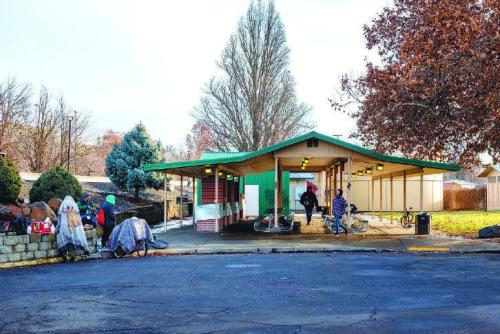
The lawsuit, which was brought last year against the city by five homeless residents, centers on the city’s resting ordinance, which the plaintiffs claim is not in compliance with Oregon law. The state requires resting ordinances to be “objectively reasonable,” and the plaintiffs argue the city’s current rules are not.
The settlement that council rejected Monday night would have expanded its current resting hours from 8 hours to 24 hours. It would have kept the current 72-hour vacate notice after the first day. Pendleton also would have paid $125,000 to expand its housing services in town.
“I feel there is greater value in putting the lawsuit behind us and removing the future costs of this litigation,” wrote City Manager Robb Corbett in his staff recommendation to the city. “I believe a court battle would be very risky and expensive, estimated at the low end to be $250,000.”
Corbett also told council that the costs would not be covered by insurance.
Chad Jacobs, partner at Beery, Elsner and Hammond, was the city’s lawyer. He told the attendees that the state law is convoluted and laid out the details of the settlement as well as the reasons he recommended the council settle.
“Fiscal costs, (and) uncertainty are two big issues when you think about settlement and whether or not it makes sense to move forward with a settlement agreement,” he said at the start of the hearing.
After hearing public concerns, he reiterated that he believed the settlement offered “the best path forward to resolve (the city’s) current vulnerabilities.”
Before voting, councilor Brett Mulvihill said, “I feel that as a community, we need to make a stand. I cannot support this settlement.”
Other councilors who voted against the settlement echoed his feelings, including John Thomas and Steve Campbell. Councilor Ellie McBride said she would prefer to have more time to renegotiate terms and give the public more time to understand details of the settlement and ask questions.
Sean Butler said he was voting in line with what the councilor elected to replace him, Joseph Hull, would want.
“(Hull) would vote for Neighbors for a Better Pendleton so that’s where I’ll go,” Butler said.
Councilors Linda Neuman, Carole Innes and Addison Schulberg voted to approve the proposed settlement, generally citing a desire to listen to legal council, move forward and address other ongoing issues.
Mayor McKennon McDonald said after the meeting she was happy to see how many people in the community attended the event. Jacobs, the city’s attorney, will give the plaintiffs the council’s answer to the proposed settlement. The likely next step will be a hearing in front of a judge.
More to come.