
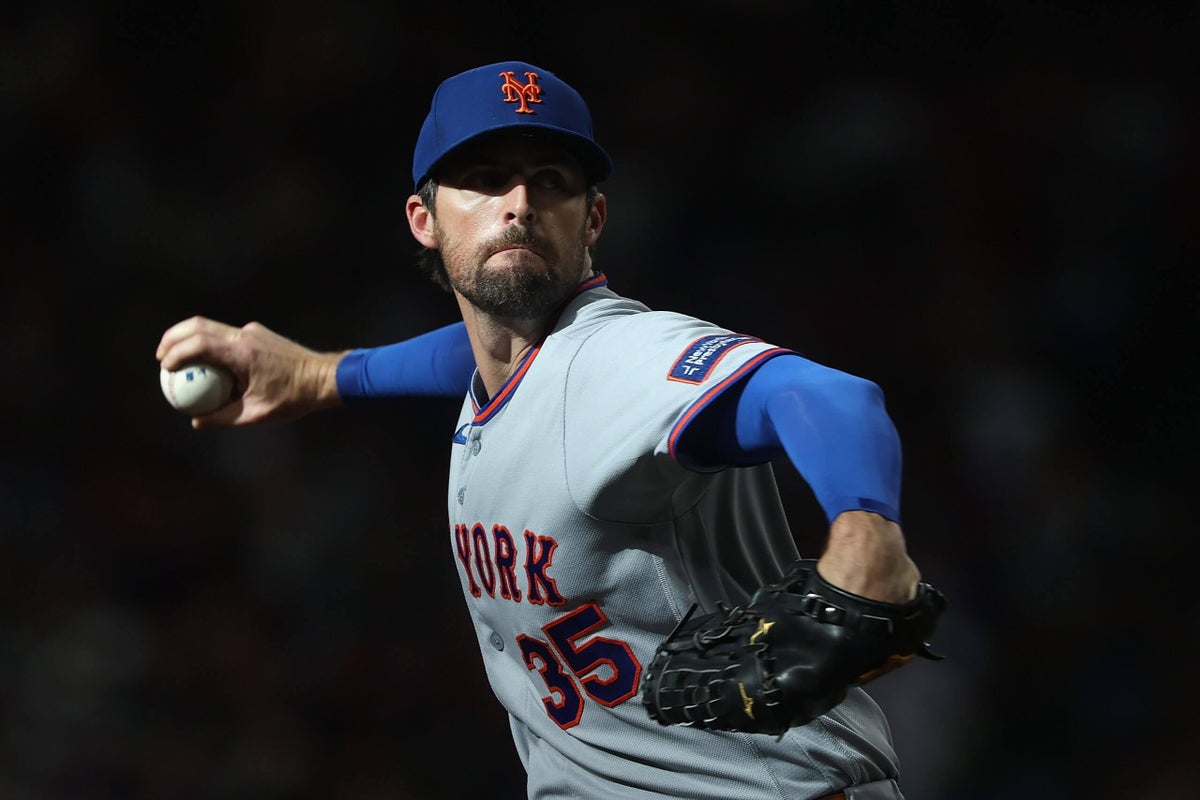
TORONTO — With Monday’s 2-1 loss to the Toronto Blue Jays, the New York Mets have lost at least 50 of their first 85 games for just the second time this century. Since 2000, only the 2018 Mets have fallen this far this fast, making it clear more than a month ahead of the trade deadline the Mets will be sellers.
What do they have to sell?
This week, we’ll look at the Mets’ various trade assets and their potential returns. There are the obvious pieces to move in their walk years and the potential bigger moves with longer-term ramifications. Today, we’ll start with the rotation, where the Mets have already traded away 2025 All-Star David Peterson.
Freddy Peralta
When the Mets traded for Peralta from the Milwaukee Brewers in January, it looked like the start of a long relationship. The right-hander was unabashedly excited to be in New York, and the Mets had dealt a pair of top-100 prospects, Brandon Sproat and Jett Williams, to bring him here.
Instead, extension conversations went nowhere in the spring, and the Mets’ season is going nowhere in the summer — which means Peralta might go somewhere else by Aug. 3.
Contract status
Peralta will be owed about $2.4 million after Aug. 3 and then hit free agency this winter. If he is traded, he cannot receive a qualifying offer this winter.
Why the union should reject MLB’s latest offer
Keith Law
2026 performance
Peralta was acquired to be an ace, but his limitations have been more evident this season than his attributes. His first year in New York went from underwhelming to explicitly disappointing in that brutal start against the Philadelphia Phillies 10 days ago —what may go down as the last pivot point of a lost season. His ERA had been straddling 4.00 before that, with decent peripherals. (The strikeout rate is at a career low, however.) He enters Wednesday’s start against Toronto with a 4.53 ERA (4.16 FIP) and 91 1/3 innings over 17 starts. Just four of those 17 outings have met the standard of a quality start.
The market
First, Peralta’s value on the market will depend on which other starters — Tarik Skubal — are available. (Joe Ryan, Reid Detmers and Sandy Alcantara were other starters ranked ahead of Peralta on The Athletic’s first trade deadline big board.) If the cost for Skubal is justifiably high and those other starters, all with control beyond this season, stay put, then Peralta should generate a lot of interest around the league.
Several of the contenders most in need of pitching — think of the St. Louis Cardinals, Chicago White Sox, Athletics and Washington Nationals — might not be ready to trade prospects for a rental starter such as Peralta. Teams more invested in this specific season, such as the Chicago Cubs or even a Baltimore Orioles team talking about buying, could be more aggressive.
One thing that might give acquiring teams some pause: Peralta’s team is just 1-5 in postseason games he’s started. Peralta has a 4.76 ERA in those contests while averaging fewer than five innings per start.
Projected return
It won’t be two top-100 prospects as it was in January. The best recent comp for Peralta might be the Los Angeles Angels’ 2023 trade for Lucas Giolito from the White Sox. At the time of the deal, Giolito had been worth 1.7 WAR that season and 7.6 WAR over the previous three seasons for Chicago. Right now, Peralta has been worth 1.2 WAR this season and 7.1 over the last three, with another month to catch up a bit.
The Halos sent catcher Edgar Quero, then a top-100 prospect, along with pitcher Ky Bush, a recent second-round pick, for Giolito and Reynaldo López. Given that Giolito had underperformed his peripherals in a significant way the prior season, I’d venture Peralta could generate about the same value individually as Giolito and López did together. So think a back-half top-100 prospect and a solid second prospect as the return.
Should the Mets trade him?
Yes, Peralta should still be one of the best starters available at the deadline, and trading him will allow the Mets to recoup some of the cost of acquiring him in January. They could revisit a longer-term deal in the offseason, as unlikely as that feels right now.
Clay Holmes
Perhaps no injury has damaged the Mets’ long-term chances this season as much as Holmes’ fractured leg, suffered May 15. The rotation has been unable to fill his absence, preventing the Mets from putting together series wins, let alone a longer winning streak, to get back into contention.
Holmes has begun playing catch and could throw off a mound as soon as this week. It’s unlikely but not impossible he’ll return to a big-league mound before the trade deadline.
Contract status
Holmes is owed $3.8 million after Aug. 3. He has a $12 million player option for 2027 he’ll almost certainly decline as long as he doesn’t suffer an injury setback.
2026 performance
The collapse of the rotation around him in 2025 concealed how well he made the transition from back-end reliever to starter, as he made every start and exceeded most expectations. He was taking a step forward in 2026, with a 2.39 ERA (3.19 FIP) over nine starts before the injury. Only one qualified starter (Cristopher Sánchez) has a lower ground-ball rate this season. Holmes has thus positioned himself as a guy you acquire to start a postseason game for you.
The market
Holmes’ ground-ball rate would make him a tantalizing prize for a team with excellent infield defense, such as the Cubs, Cardinals, Arizona Diamondbacks or Atlanta Braves. The Mets hope Holmes’ injury timeline is relatively clear (if not over entirely) by the deadline, removing some of the uncertainty for an acquiring team.
Projected return
The injury is the issue. Had Holmes been starting these last six weeks and posting the same numbers he has so far this season, he could bring back the same type of return Merrill Kelly did last summer from the Texas Rangers (three intriguing pitching prospects). Holmes’ injury puts a question mark next to how many starts he could make for an acquiring team, how he’ll actually perform in those starts, and whether any kind of setback would make him want to exercise his option for 2027.
In that sense, the closest analogue would be the Blue Jays’ trade for Shane Bieber last summer, when Bieber hadn’t started all season for the Cleveland Guardians. The Guardians received Khal Stephen, a recent second-round pick, back for Bieber. Now Bieber had missed more than 12 months from Tommy John surgery, compared with Holmes’ two to three months with a leg injury. But he did have a longer track record as a starter (and a Cy Young on his mantel).
Further, getting back a second-round pick approximated the return Cleveland would have gotten had it held on to Bieber and given him a qualifying offer in the offseason. For the Mets, that threshold with Holmes would be a fourth-round pick.
Should the Mets trade him?
Even if Peralta doesn’t land the projected return mentioned above, he’ll bring back something more valuable than the compensation pick the Mets would get if he leaves in free agency. That’s not necessarily the case with Holmes, and so the Mets shouldn’t simply trade him to the highest bidder if the return falls beneath that threshold. Provided he’s ready to return by the deadline, or shortly after, though, Holmes should net the Mets something better than a draft pick.