
The Athletic has live coverage of the 2026 Wimbledon Championships.
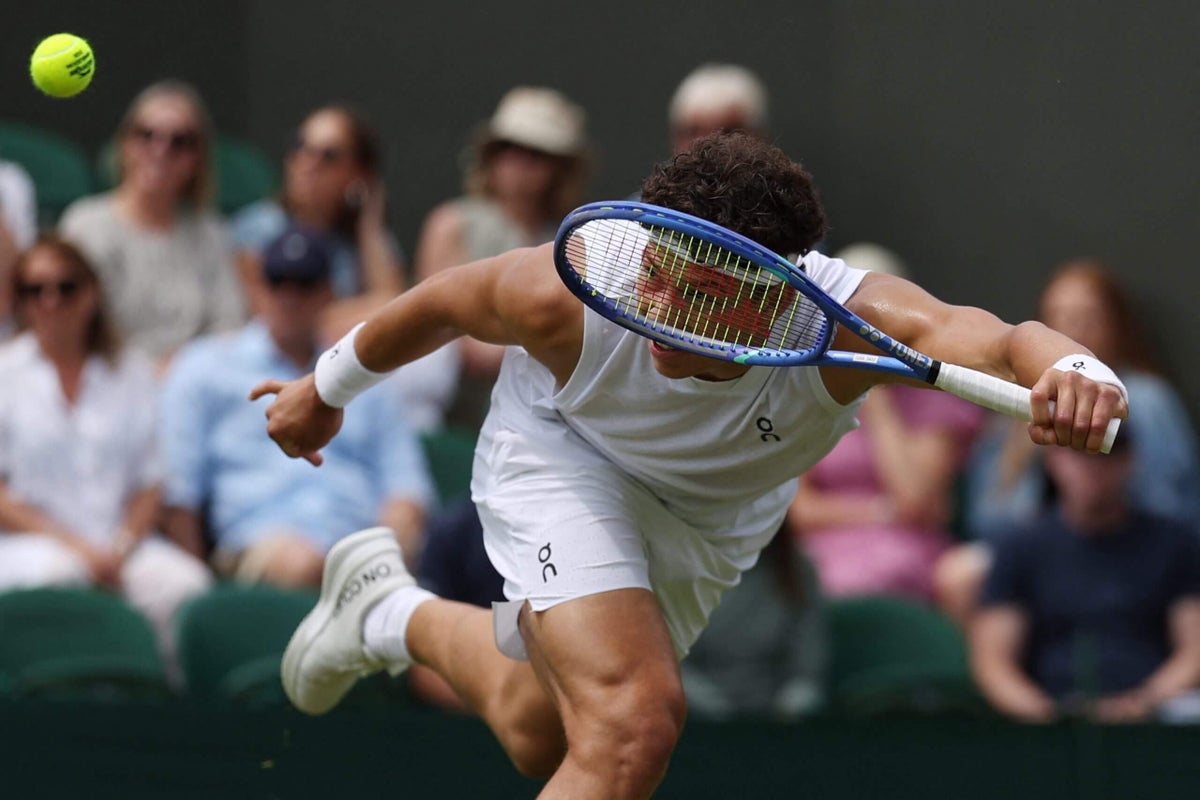
THE ALL ENGLAND CLUB, London — This was always going to happen to Ben Shelton. The numbers said it would.
He was going to get into a tight match on grass, perhaps at Wimbledon, against a less accomplished player. The sets and the match were going to go long, coming down to a few points. And with little margin for error, Shelton, the No. 4 seed at this year’s tournament, was going to have to find a way to break his opponent’s serve to give himself a cushion.
The grass gives him great advantages on his serve. On return, it shrinks the previous few chances he can create for himself.
And with that, what looked on paper like a golden opportunity for Shelton to journey deep into the most important tournament in the sport got yanked out of his grasp by Otto Virtanen of Finland, who came back from two sets to one down to beat Shelton in five, 6-4, 3-6, 6-7(8) 6-2, 7-6(11-9) on No. 2 Court at the All England Club.
“I’m here, I played to the last point. … A big win on a big court in my favorite place,” Virtanen, 25, said in his on-court interview.
Why do players wear white at Wimbledon?
Ava Wallace and Madison Eades
It may be a while before Shelton, 23, gets another opportunity like the one that presented itself at Wimbledon this year. With Carlos Alcaraz sidelined with an injured wrist, Shelton, the world No. 5, became the fourth seed, with his own quarter of the draw to conquer. He landed on the opposite half of the draw from Jannik Sinner and Novak Djokovic, the only two players in the men’s draw who have won the title here.
And then he lost in the first round of a Grand Slam for the first time since the 2023 French Open, during his first full year on the tour. This loss, against the Finnish world No. 140, marked the second consecutive Grand Slam when Shelton has won a warm-up tournament before going out to a player he needs to handle if he is going to achieve his goals in the sport.
Last month at Roland Garros, Shelton was the highest seed left in his quarter of the draw when Raphaël Collignon of Belgium swept him away in straight sets.
In this match, Virtanen did what players often do when they get the better of Shelton on faster surfaces, staying close enough to have a chance to win on the tennis equivalent of a coin flip, but the American had his chances Tuesday afternoon. Virtanen saved 11 of 12 break points, the two biggest ones at *3-4 in the fifth set. On the first, Shelton sent a meaty backhand long. On the second, Shelton scrambled from the grass twice to keep the ball alive, but Virtanen worked the point around to a backhand overhead.
Come the match tiebreak, Shelton had mini-break leads of 5-3, 6-4 and then 7-5, after he cut a backhand volley hard across the court. He stretched it to 8-5 when Virtanen went long with a short backhand. But then Virtanen caught the back of the line on a ball Shelton was sure was floating long, and the Finnish player was alive.
Virtanen won the next two points, and missed the chance to set up a match point on his serve with a forehand pass that was wide open. But then Shelton sent two balls into the net to give the Finn his first match point, and a forehand Hail Mary wide — just wide — sent Shelton out of the tournament.
In an news conference, Shelton called the loss “one of the toughest I’ve taken, for sure.”
He said he knew he was safe from Sinner and Djokovic, but hadn’t looked past his first-round match or tried to figure out what his path to a semifinal or final might be.
“I was pretty off on my serve spot, so I wasn’t getting many free points,” he said of the match against Virtanen. “I was having to grind through a lot of the games.”
He may have some nightmares about the third set, when he had the score in his favor at 15-40 three times on Virtanen’s serve, but couldn’t get the decisive point to take control.
“The guy came up with some ridiculous stuff in those moments,” he said. “Sometimes it happens like that.”
The loss continues something of a feast-or-famine year for Shelton. He made the quarterfinals at the Australian Open and won the Dallas Open in February. And after losing early at the BNP Paribas Open at Indian Wells and the Miami Open, as he recovered from an illness, he won the Munich Open on clay. Then came the French Open loss, which followed similar exits at the Madrid and Italian Opens.
“I’ve had a lot of really tight matches, deciding set tiebreakers, deciding sets that I’ve lost,” he said.
“Sometimes these things can happen. I think this year it’s happened a lot more for me than I would like.”
He’s had plenty of wins that way, too. Coin flips work like that.