
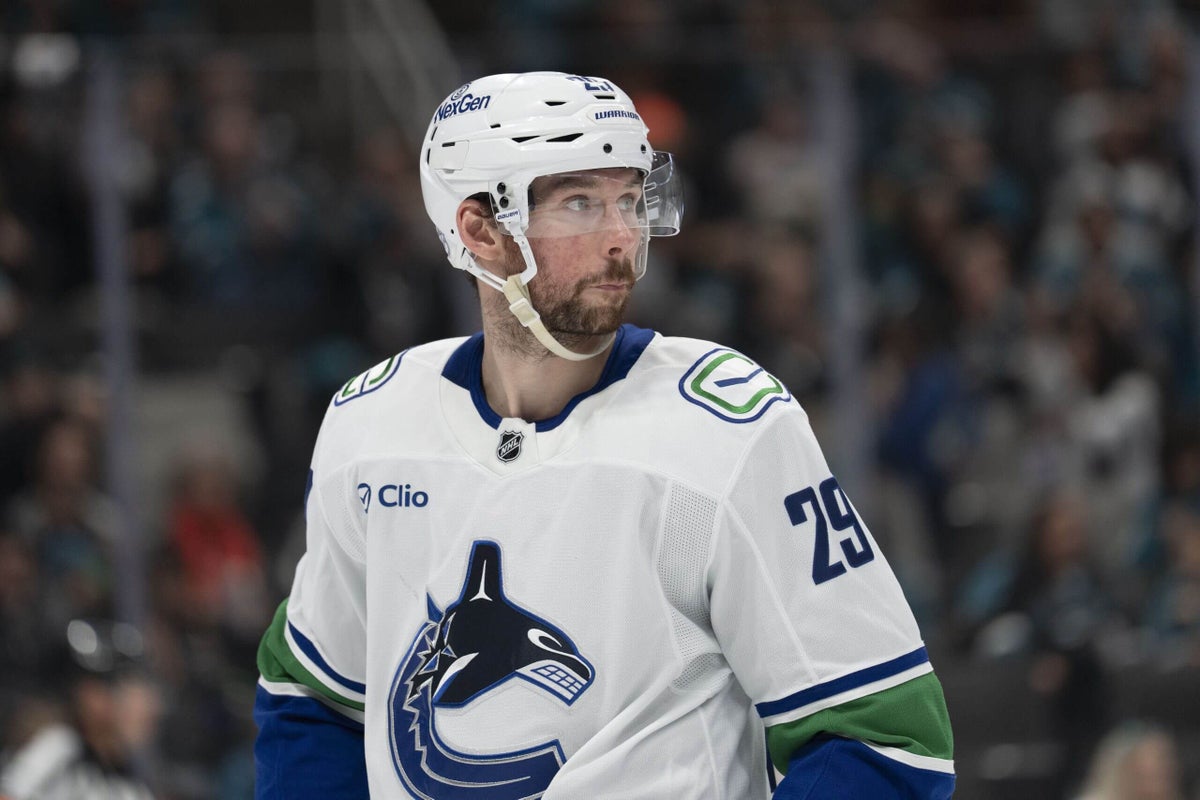
New York Rangers get: Marcus Pettersson
Vancouver Canucks get: 2030 first-round pick (top-10 protected)
In a vacuum, the idea of a win-now team trading a first-round pick that’s way into the future for a sturdy but unspectacular No. 3/4 defenseman sounds perfectly reasonable. Pettersson, who has a long history with Rangers head coach Mike Sullivan, will likely bounce back from a tough year in Vancouver and be a rock-solid second-pair defenseman.
However, the bigger concern from the Rangers’ perspective has to be what the team is actually building toward with these win-now moves. New York has the sixth-worst record in the NHL over the last two years. This team looked old, slow and not even remotely close to being in a realistic contention window this past season. Is adding Pettersson, Sean Durzi (as part of the Vincent Trocheck trade), Pavel Dorofeyev and Oliver Bjorkstrand, coupled with a healthier Adam Fox, enough to propel the team back to the playoffs? It’s possible because the Metro Division looks weak. However, it’s naive to think this team can actually win in the playoffs, especially considering the age-related risk involved with Mika Zibanejad and J.T. Miller as the team’s top two centers.
There isn’t a realistic path for the Rangers to become Cup contenders in the next few years — it just feels like they’ve locked themselves into being a “mid” team. There’s a real chance that New York’s attempt to stay relevant blows up in its face before 2030, especially with Adam Fox being eligible for unrestricted free agency in 2029. And if that scenario unfolds, that 2030 first-round pick could suddenly become a whole lot more valuable. Yes, it’s top-10 protected, but then it would presumably roll over as an unprotected 2031 first-rounder, and when you look at how old and uninspiring their core could be by then, that could become an extremely valuable pick for the Canucks. But that risk probably doesn’t matter to GM Chris Drury, who won’t be around anyway if his aggressive retool fails to work.
Pettersson is a positionally sound defensive defenseman with a long reach. He was a stud second-pair shutdown defender for a long time in Pittsburgh, but his results since joining Vancouver have been more mixed. Pettersson excelled down the stretch in 2024-25, but his play fell off considerably this past season: He drove just 43.7 percent of scoring chances, and the team had a minus-28 goal differential during his five-on-five shifts.
However, it’s worth noting that every defenseman besides Filip Hronek struggled in Adam Foote’s system last year. There’s a good bet he’ll rebound with a change of scenery, though it’s not guaranteed because the Rangers haven’t exactly had the best track record of maximizing defensemen. Vladislav Gavrikov fit well last year, but K’Andre Miller and Jacob Trouba both looked significantly better after leaving New York.
For a Cup contender, adding Pettersson for a 2030 first-round pick would have been a logical swing, but it’s much dicier for a mediocre team in the Rangers’ position.
For the Canucks, trading Pettersson off a down year and collecting a first-round pick is a strong move for the rebuild. There’s certainly a chance that he could have bounced back under Manny Malhotra next season and increased his trade value, but there’s also a risk that he would have declined further to the point where netting a first-round pick may not have been possible.
Waiting four years for a first-round pick isn’t ideal, but in this case it’s worth it, given the uncertainty about how competitive the Rangers will be at that point and the potential upside of that selection.
Rangers grade: C
Canucks grade: A-