
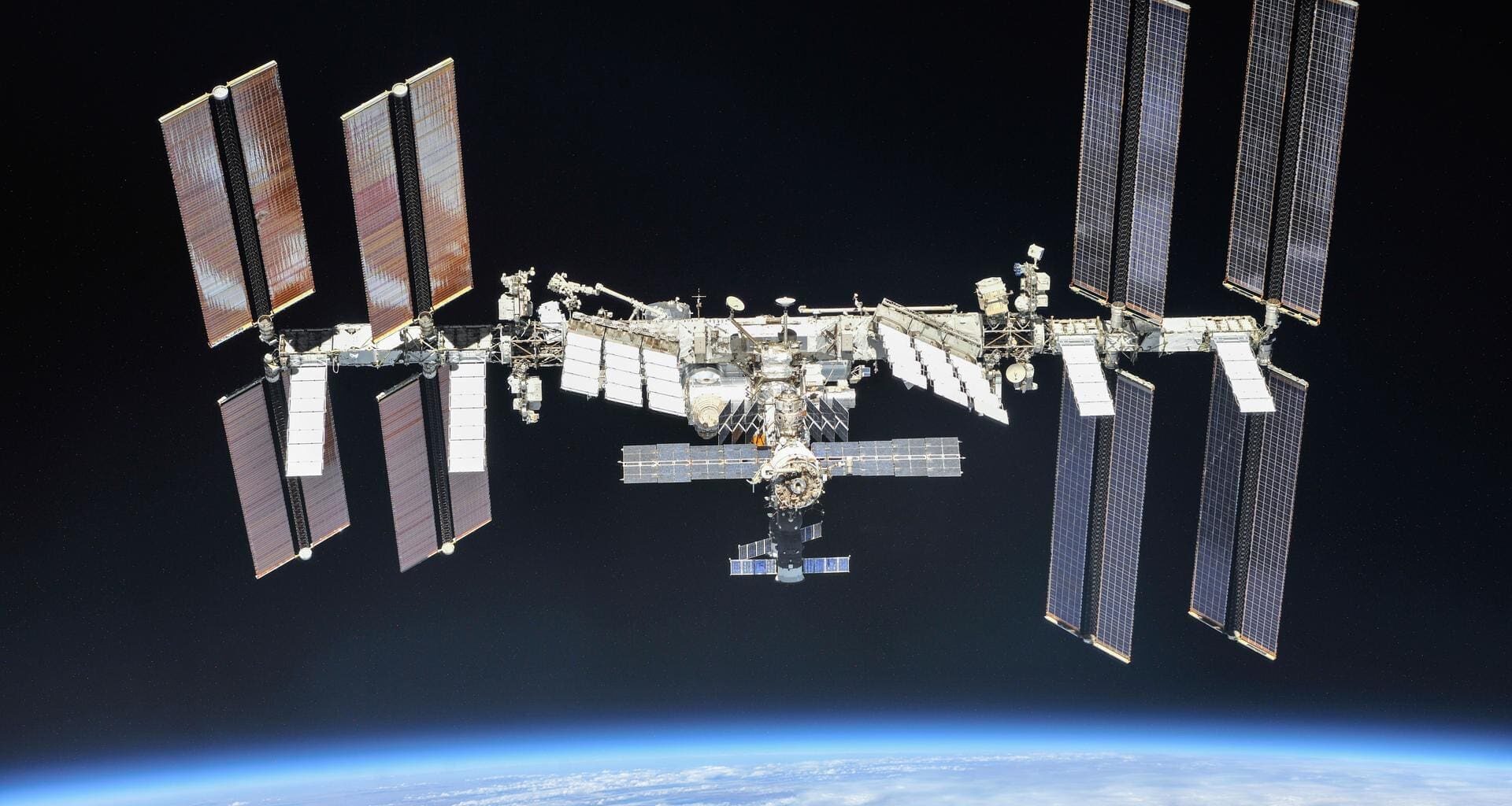
Weather permitting, the International Space Station will be making lots of visible passes in Santa Barbara’s evening skies throughout July. Its orbit may change, and I’ve only listed the best evening events. To get the latest and most complete predictions, visit Heavens Above.
On Saturday, July 4, after the fireworks, the ISS appears at 11:13 PM PDT in the N below Polaris, and briefly scoots to below Cassiopeia in the NNE, setting at 11:15 PM.
We’ll get two passes on Sunday. The first very low ocean horizon pass will begin at 8:46 PM in the SSE in Centaurus, through Lupus, Scorpius, and Sagittarius, then below bright Altair and dim little Delphinus, ending in the E at 8:50 PM. On its next orbit, it will rise at 10:21 PM in the WSW in Corvus, climb northward to the junction of the handle with the bowl of the Big Dipper asterism, above Polaris, and into Cepheus and Cassiopeia in the NE, setting at 10:28 PM.
There are also several bright early morning passes during early July, if you’re an early riser. Early early early.
Monday’s pass will be the brightest of July’s evening appearances, rising at 9:33 PM in Corvus in the SW, and sailing overhead through Virgo, by Arcturus, the head of Draco, and behind Deneb, the tail of Cygnus, setting at 9:40 PM in the NE.
On Tuesday, nearly as bright, the station will start in the SSW in the tail of Hydra at 8:45 PM, go between Libra and Scorpius, along Ophiuchus, and vanish in our shadow in the middle of the Summer Triangle asterism at 8:52 PM in the ENE.
On Wednesday, it will rise at 9:34 PM in the W, in the belly of Leo above bright Venus near the horizon, go through the shoulder of Ursa Major, below Polaris, and set in Cassiopeia in the NNE at 9:40 PM.
Thursday’s pass will start in the middle of Hydra in the WSW at 8:46 PM, go through the hindquarters of Leo, across the bowl of the Big Dipper, above Polaris, and end in the NE in Cepheus at 8:52 PM.
There will be a series of dim and low evening passes for the next nine days.
On Sunday, July 19, the ISS will make a low skim over our mountain horizon, starting in the N at 10:31 PM, from the nose of Ursa Major through Camelopardalis to below Cassiopeia, where it will fade out at 10:33 PM in the NNE.
On Tuesday, it will pop up in the NNW in the front paw of Ursa Major at 10:31 PM, and disappear into the Earth’s shadow just below Polaris in the N at 10:33 PM.
Wednesday’s pass will be low, beginning at 9:43 PM in the NNW in Lynx, through Camelopardalis and above Cassiopeia, then through Lacerta, fading out at 9:47 PM near Pegasus in the ENE.
Thursday’s first pass will start in the N at 8:55 PM and be a lower version of Wednesday’s pass, ending at 8:59 in the ENE in the neck of Pegasus. At 10:31 PM it will reappear in the NW for a pop up from Leo Minor to Canes Venatici, disappearing in the WNW at 10:33 PM near Cor Caroli, a beautiful double star through a telescope.
On Friday there will be a very bright pass from 9:43 PM in the NW in the shoulder of Ursa Major, through the bowl of the Little Dipper asterism, the neck of Draco and the neck of Cygnus, and ending in Vulpecula in the middle of the Summer Triangle at 9:47 in the E.
Saturday will have two passes, with the first at 8:55 PM in the NNW in the nose of Ursa Major, below Polaris, through Cepheus and below Cygnus and Delphinus, and vanishing in the E near Equuleus at 9:01 PM. It will return at 10:32 PM in the W in the hindquarters of Leo and fade out in the middle of Virgo at 10:33 PM in the WSW.
On Sunday, July 27, the station will have a very bright pass starting at 8:55 PM in the NW below the legs of Ursa Major, by Cor Caroli, across Boötes and Ophiuchus, disappearing as it nears the Moon in the SE at9:01 PM.
Monday’s pass will take place between 9:46 PM and 9:48 PM, very low from the WSW in Leo, above setting Venus, below Virgo, and into Lupus in the SW.
The last good evening pass of July will be a higher version, rising at 8:56 PM in the W, and ending at 9:01 PM in the S below the Fish Hook of Maui (for fans of Moana).
The ISS will return to our evening skies in early September, if the current orbit doesn’t change.