
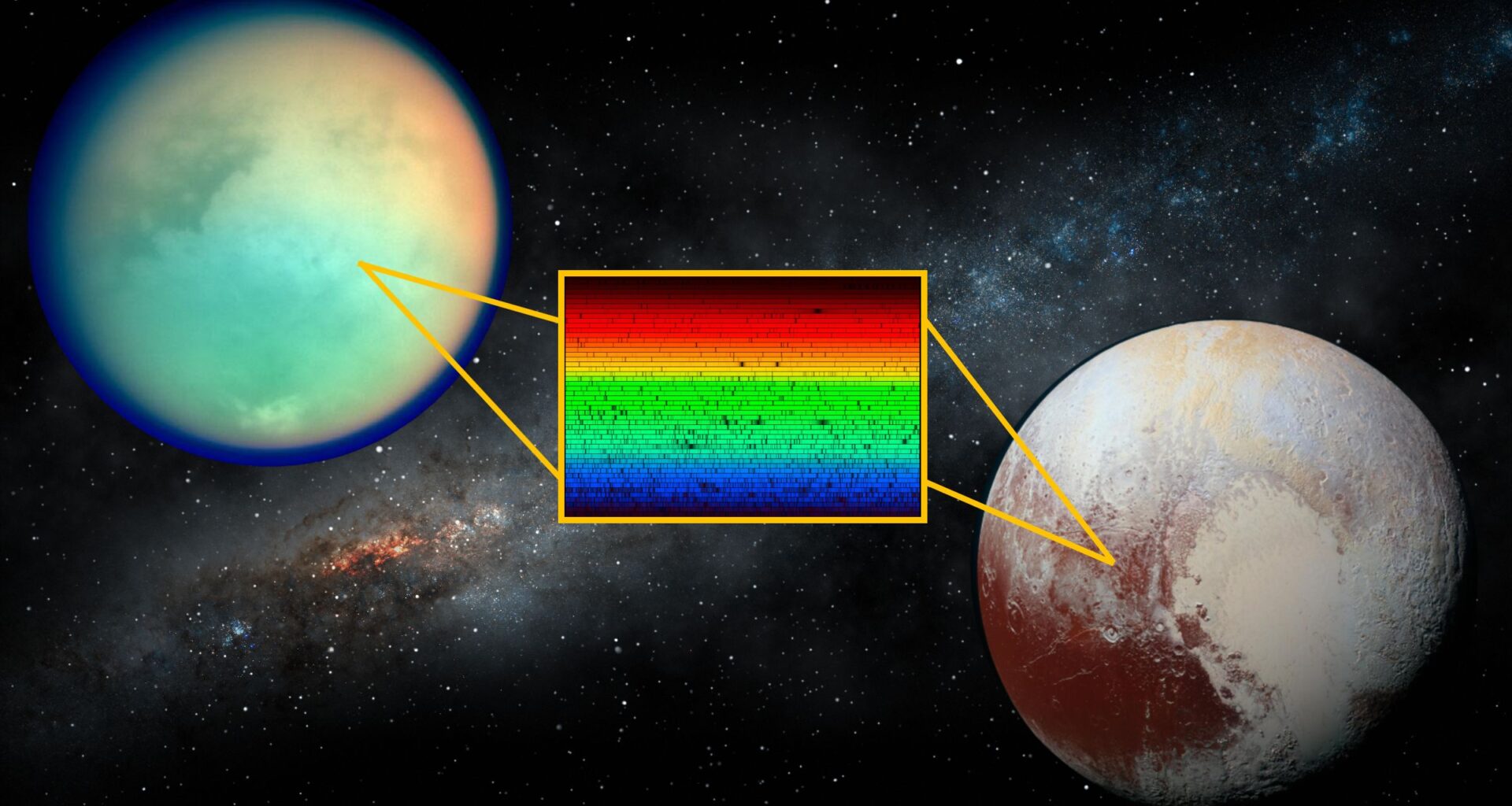
A mysterious wavelength of light is missing from the dwarf planet Pluto and Saturn’s supersized moon Titan, new James Webb Space Telescope (JWST) observations show. The surprising discovery hints that these worlds harbor an unknown molecule that has not been seen in any other solar system world or exoplanet so far.
Every element or molecule in the universe absorbs unique wavelengths of electromagnetic radiation. Therefore, one of the main ways astronomers study distant worlds — both inside and outside the solar system — is by closely examining the light that reflects off them and searching for dark “absorption lines” that correspond to the wavelengths of known chemical compounds.
You may like

The James Webb Space Telescope is specially designed to be able to detect subtle absorption signals from distant worlds.
(Image credit: Getty Images)
A molecular mystery

Titan and Pluto are very different worlds. Saturn’s largest moon has liquid on its surface and is around four times closer to the sun than the dwarf planet.
(Image credit: Getty Images)