
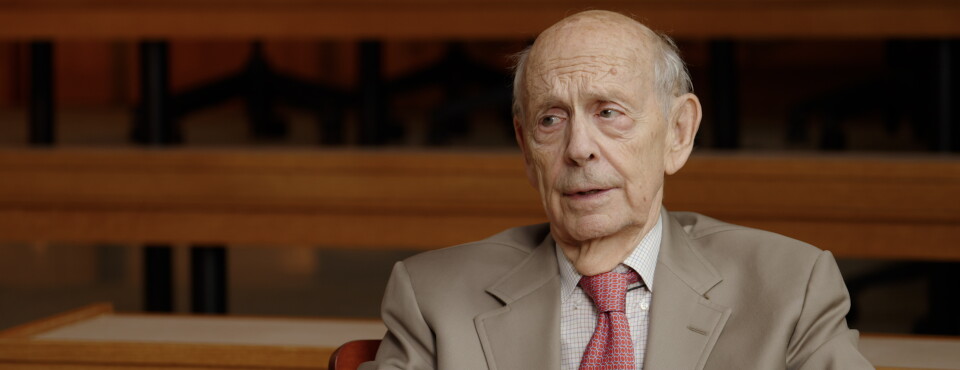
Retired Justice Stephen Breyer said “it’s possible, of course,” that who occupies the White House plays a role in when justices opt to leave the US Supreme Court.
“It’s a personal decision when you retire,” Breyer said in an exclusive June 29 podcast interview with Matthew Schwartz for Bloomberg Law at Harvard Law School.
WATCH: Our full interview with retired Justice Stephen Breyer.
The interview came as the Supreme Court prepared to wrap up its term and speculation built about a potential retirement by Samuel Alito in the run up to the midterm elections that could cost Republicans control of the Senate.
The justices left the bench for the final time without any retirement announcement by Alito, a George W. Bush appointee who has served on the court since 2006.
Breyer, who noted he was close to 83 when he opted to retire in 2022, said, “There are lots of things involved. There’s your family, your children, your grandchildren, what are you going to do? There are all kinds of things involved.”
When asked if the occupant of the White House was a consideration in his decision, Breyer, appointed to the court by Democratic President Bill Clinton in 1994, said, “that could be in my mind.”
Asked if it was likely, Breyer said, “I don’t know” and noting his wife is a psychologist, added, “She’s the one to ask.”
Breyer retired under President Joe Biden, a Democrat who chose his former clerk, Ketanji Brown Jackson as his successor. Breyer had faced progressive pressure to make way for a Democratic-appointed successor, including a billboard truck hired by Demand Justice to circle the Supreme Court in 2021.
Thurgood Marshall, an appointee of Lyndon Johnson who retired from the court in 1991, was the last justice to step down during the tenure of a president with whom they were not ideologically aligned. Republican President George H. W. Bush picked Clarence Thomas to replace him.
Declining Trust in the Court
Public trust in the judiciary has fallen to near its lowest level in the half-century Gallup has measured it, and a majority of Americans now tell pollsters they believe the justices are guided more by politics than by law — a share that has roughly doubled in six years.
Breyer conceded the decline was cause for concern, but he rejected the idea that the erosion reflects a Court actually driven by politics, arguing the perception confuses the appointment of a justice with the work of one.
“It’s politics when you’re appointing a new justice; every political group in the world” campaigns for their preferred nominee, he said. “But once the judge is appointed, it’s different. The judge is thinking, what is the correct decision according to the law?”
Whether a loss of public trust is itself a threat, he said, depends on the time horizon. “Yes and no,” Breyer answered, when asked if the Court’s power ultimately rests on the perception of the public. “Yes, if you’re talking very long run.”
A single unpopular decision, he said, would not move the country away from the rule of law; that takes time. The greater danger, Breyer said, is disengagement — that if Americans conclude the Court is nothing but politics and they stop paying attention, “what you will do is you will divorce the court from the life of the average person.”
Bench Dissents
At the end of a term which ended with two dissents from the bench by liberal justice Sonia Sotomayor — one of which prompted a sharp reply from Alito — Breyer reflected on his own such experience in a landmark affirmative action decision.
“I was thinking, well, if we’re going to decide this case by bumper stickers, I have some too,” Breyer said. “And so I said, well, rarely in the law have so few, so quickly, changed so much. And I went on for about 20 minutes. So it was obvious I was pretty unhappy about that. And afterwards I thought, well, maybe I shouldn’t have showed so much emotion.”
Breyer said he wished the public — and the press — paid more attention to the cases where the justices are unanimous than the more closely divided cases that dominate headlines.
Is the public “more interested in abortion than they are in Java language? Yes, I do. I do think they’re more interested,” Breyer said. “And so of course you’ll print that and of course, but that’s not the most, well, maybe that one is, I think that one’s pretty important. But a lot of these five or six three, a lot of those cases are less important than a lot of the ones you don’t write about.”
As the US prepares to celebrate its 250th birthday, Breyer said he remains optimistic about the country’s future based on his talks with middle school students.
“What’s the look in their eye? I interpret that look as something I like. I interpret that look as well,” Breyer said. “They are interested. And therefore there is a reason for being optimistic, even though people in this country do not always agree with each other.”
