
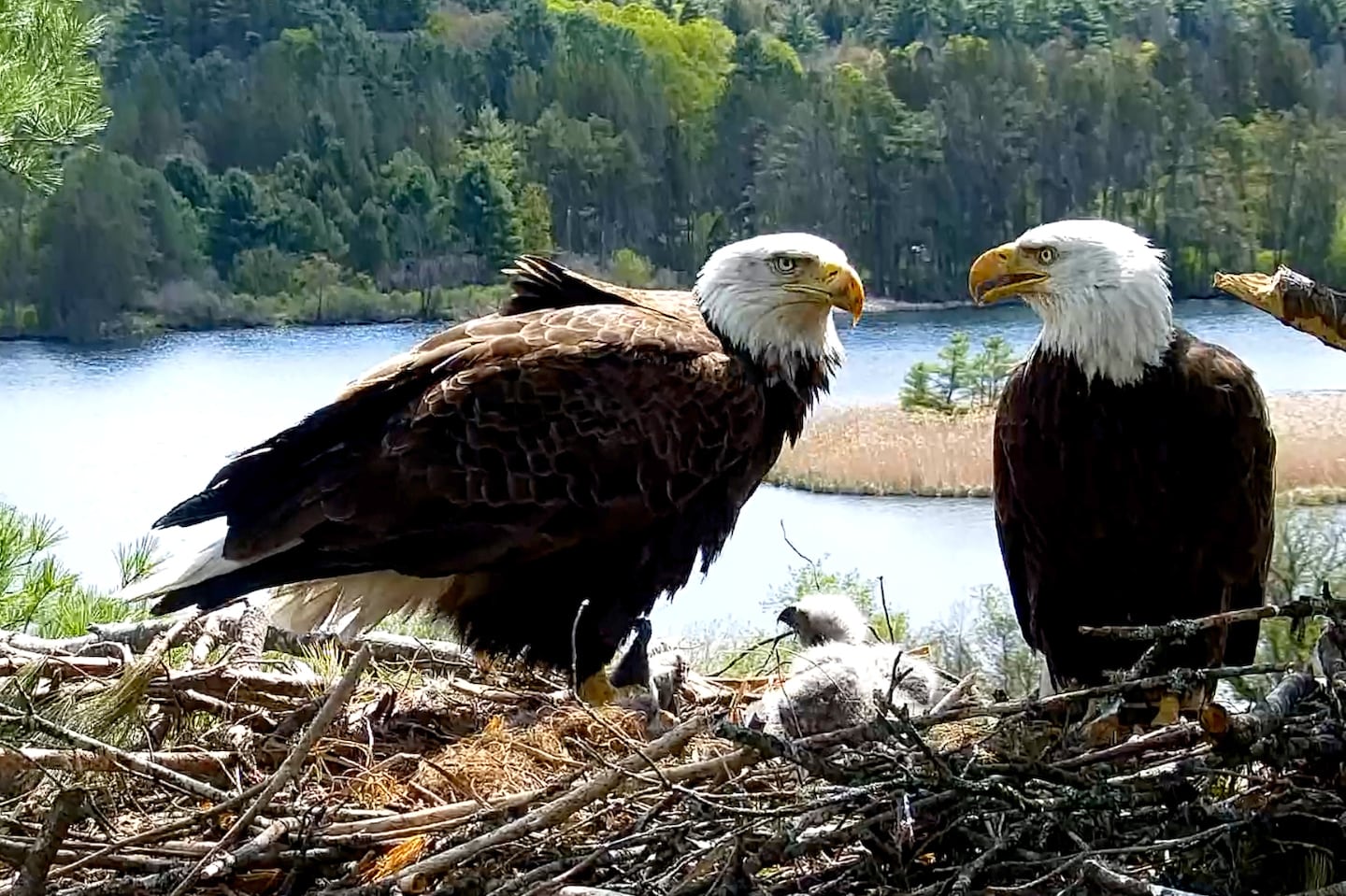
“He must be so bored,” one wrote on Facebook. Another suggested V-2 could really use some takeout. Still more emailed the Vermont Institute of Natural Science, which installed the camera near the nest, expressing alarm that the eaglet looked malnourished.
Early the next morning, as fog lifted over the pond below, Windsor, the mother, swooped in with one fish, and then another. Overcome with hunger, V-2 stepped on its breakfast and tore at it with its beak.
“It turns out, eagles know what they’re doing,” said Alden Smith, VINS’ executive director.
Since March, when the Quechee-based institute launched the live stream, it’s become a surprise hit, drawing hundreds of viewers at a time and raising the profile of the small nonprofit that hosts it.
What they see is surprisingly captivating: The nest sways hypnotically in the breeze as V-2 flaps its wings or naps. Every so often, there’s a moment of excitement, such as a delivery of fish or a hot-air balloon drifting by in the background. But for the most part, it’s simply a serene summer setting, with a placid pond below, a natural soundtrack of birdsongs and the majestic sight of the country’s official national bird.
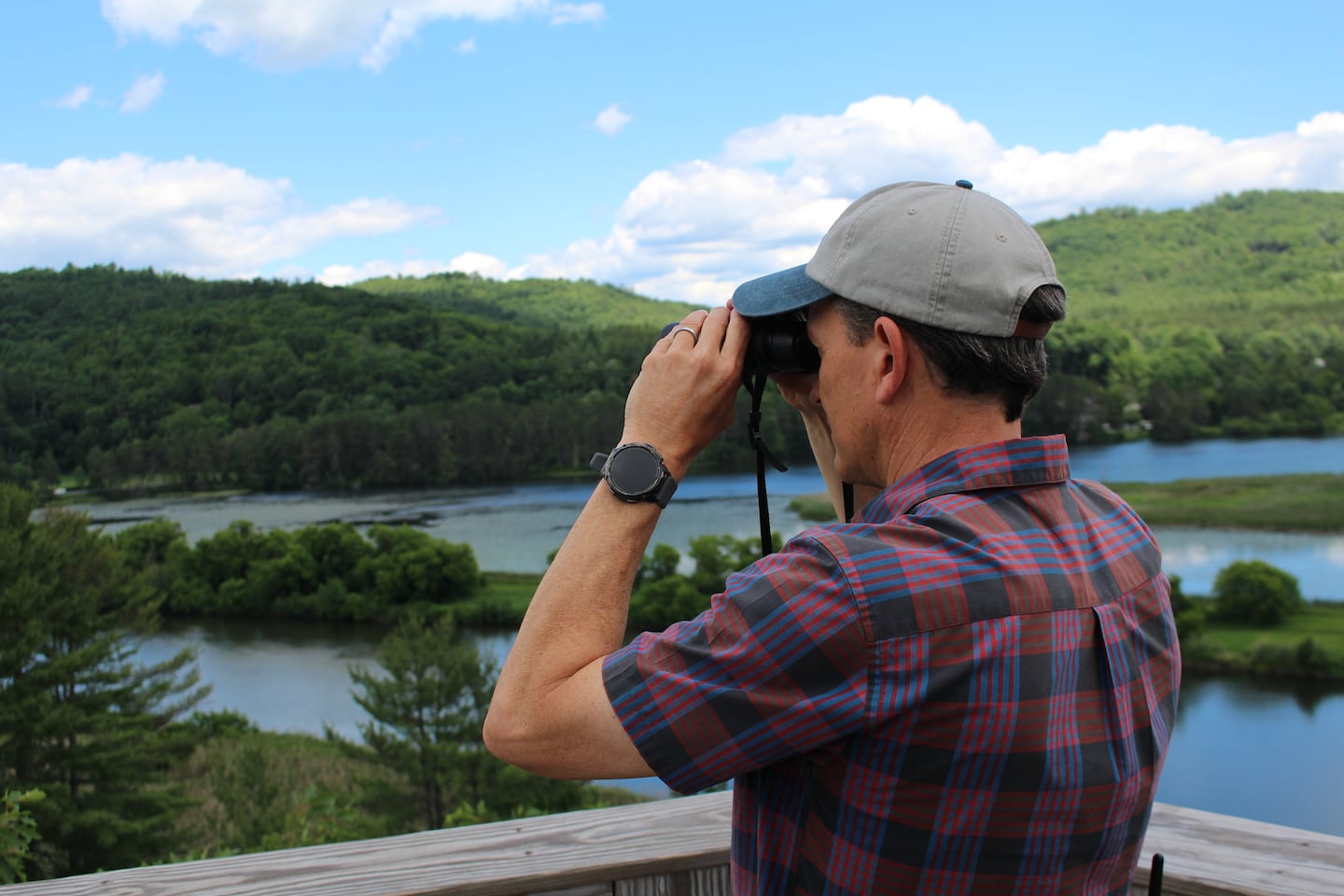 Alden Smith, executive director of the Vermont Institute of Natural Science, viewed the live-streamed eagle’s nest from an observation tower on the organization’s Quechee campus on Jun. 24.Paul Heintz/Globe Staff
“Mostly nothing happens in the life of an eagle on a nest,” Smith said.
He expected the experiment would educate viewers about avian wildlife, a key component of the institute’s mission, along with rehabilitating injured, sick, and orphaned birds. What surprised him was the number of eagle cam aficionados who have credited the stream with improving their mental health and making nature more accessible.
“It’s become so hard for people to tune into healthy signals because there’s just so much in our media landscape,” Smith said. “To have something that makes people feel calm and curious at the same time, and to feel some sense of peace, has really been meaningful.”
Fans of the live stream say they’ve played it in classrooms, assisted living facilities, dentists’ offices, and state parks. Not long after V-2 hatched in April, teachers at a nearby elementary school sent VINS a packet of drawings and letters from students welcoming the eaglet to the nest.
Hillary Walz, a surgery coordinator at Dartmouth Health, grew up in the area and fondly recalled field trips to VINS’ campus to visit its captive owls, hawks, and eagles. She began playing the stream at work in March, generating excitement among staff in the vascular surgery department.
After Windsor hatched an egg, a surgeon suggested the department throw an eaglet shower in her honor. Staff gathered in a conference room and helped themselves to “squawk snacks” (Swedish Fish), “nesting material” (pretzel sticks), and cupcakes with eagle toppers. There were red and pink balloons and, of course, a screen playing the live stream.
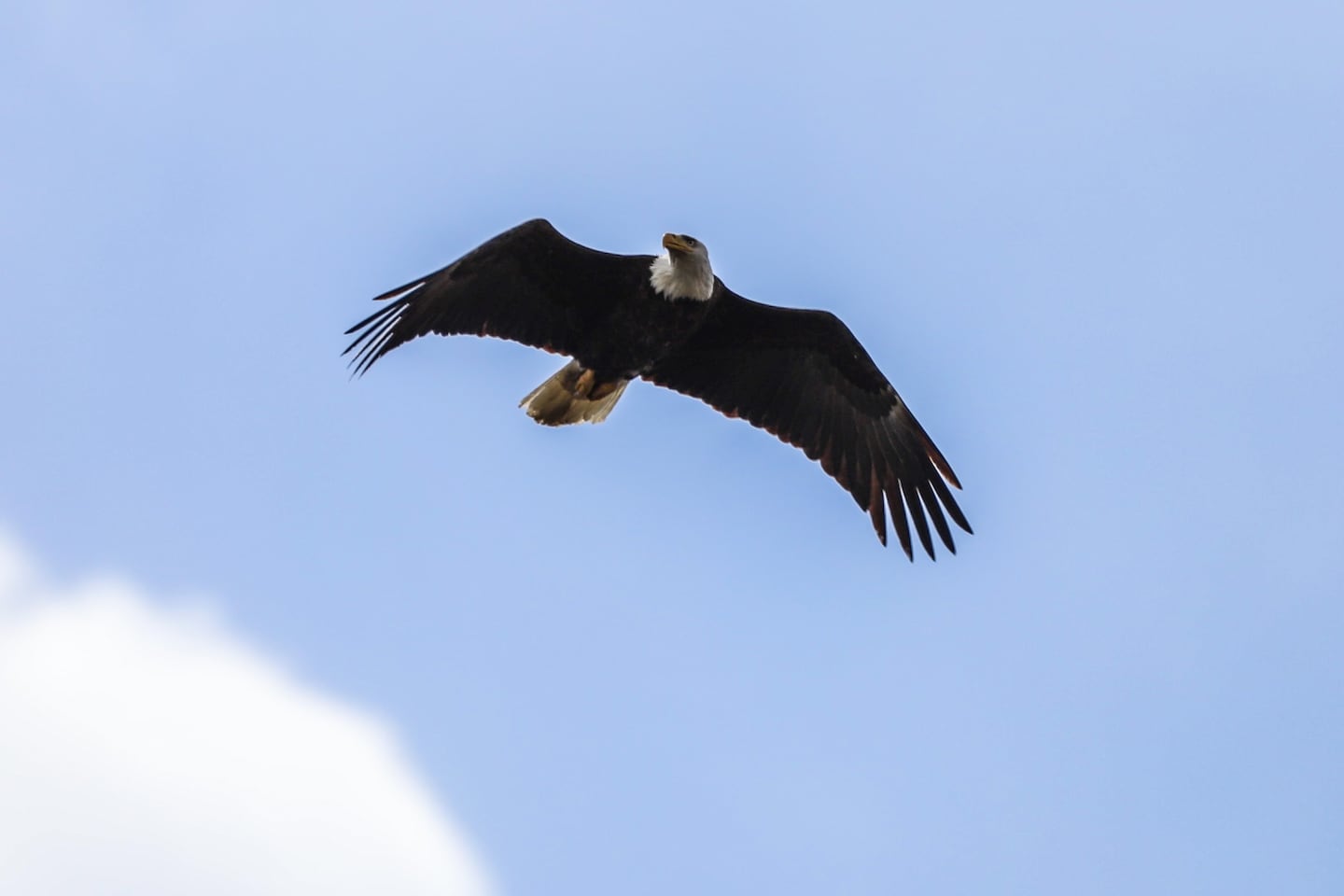 An adult bald eagle soared above the Vermont Institute of Natural Science in Quechee.VINS
“We’re working in health care. It’s a lot of stress. It’s a lot of anxiousness for patients and providers,” Walz said. “So I think for us it just gave us some therapy, some peace of mind — just a way to disconnect and watch nature … It’s a nice little escape from the chaos in here.”
Some eagle-watchers keep an unusually close eye on the nest. Lisa Levesque, who lives in Connecticut, created a Facebook page for fellow fans and posts screenshots and videos of the birds daily .
“If I’m honest, I probably spend 14 hours a day with it on,” she said of the live-stream.
Even when she goes out to dinner with her family, Levesque, 54, places her phone on the table in front of her, keeping an eye on the nest.
“I know that sounds really obsessive, doesn’t it?” she said. “I’m really enveloped in it.”
The Vermont institute is hardly the first entity to host an eagle cam. They’ve been around for at least two decades, and some, such as the Southwest Florida Eagle Cam and the Decorah Eagles in Iowa, have drawn hundreds of millions of views. Levesque previously ran a fan page for a Colorado eagle cam.
But the phenomenon has been slow to catch on in Northern New England, perhaps because the comeback of bald eagles has taken longer here than elsewhere. The species was nearly eradicated in the 1960s due to the widespread use of the pesticide DDT. Reintroduction efforts began in the late 1970s but didn’t reach Vermont until the early 2000s. The first successful nest was identified in 2008.
Now, according to Margaret Fowle, a conservation biologist for Audubon Vermont, there are around 60 identified territories in the state hosting a pair of breeding bald eagles, largely in the Connecticut River and Champlain valleys, Fowle said. The bird is no longer on the federal or state endangered species lists.
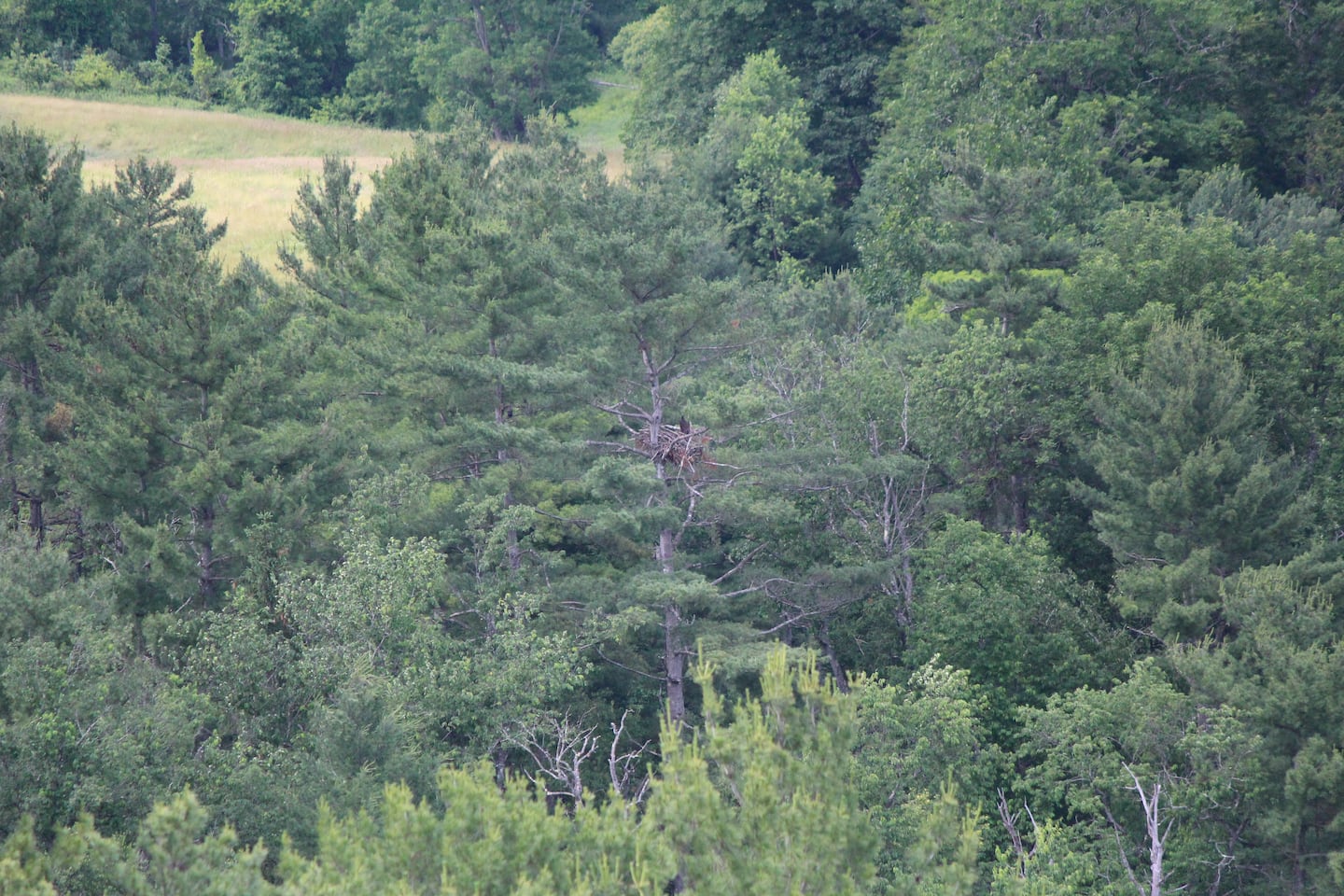 A live-streamed eagle’s nest, as seen from an observation tower, on Jun. 24.Paul Heintz/Globe Staff
“The story of eagles is a success story,” said Jillian Kilborn, a nongame bird biologist for the Vermont Fish & Wildlife Department. “And it’s one of the great success stories we’ve had in the Northeast.”
VINS has long hosted captive birds on its 47-acre campus, just upstream from the Quechee Gorge, but it wasn’t until February 2025 that a researcher noticed a pair of wild eagles carrying nesting material to a perch above a bend in the Ottauquechee. That spring, staff spotted an eaglet from a tower VINS had erected as part of its forest canopy walk — a boardwalk network suspended between trees.
“We started asking the question: How can we bring people closer without disturbing the eagles?” Smith said.
The following winter, when Dewey and Windsor were away from the nest, VINS staff worked with arborists to mount two cameras nearby. The pair returned on Valentine’s Day and Windsor laid an egg on St. Patrick’s Day. V-2 hatched April 24.
VINS staff have at times been uneasy about the project, Smith said, worried about leaning too far into technology or anthropomorphizing the animals. Some even questioned the wisdom of giving the eagles names.
“I was not a fan of doing so, for the reason that they are wild animals. They’re not part of our lives,” said Anna Morris, the institute’s director of wildlife ambassador programs.
In the end, they reached a compromise: to follow the naming convention used for VINS’ captive birds, based on where the birds originated. Windsor was named for the county in which the nest is located and Dewey for the pond below. V-2 earned its name because he was the second eaglet hatched on the VINS nest.
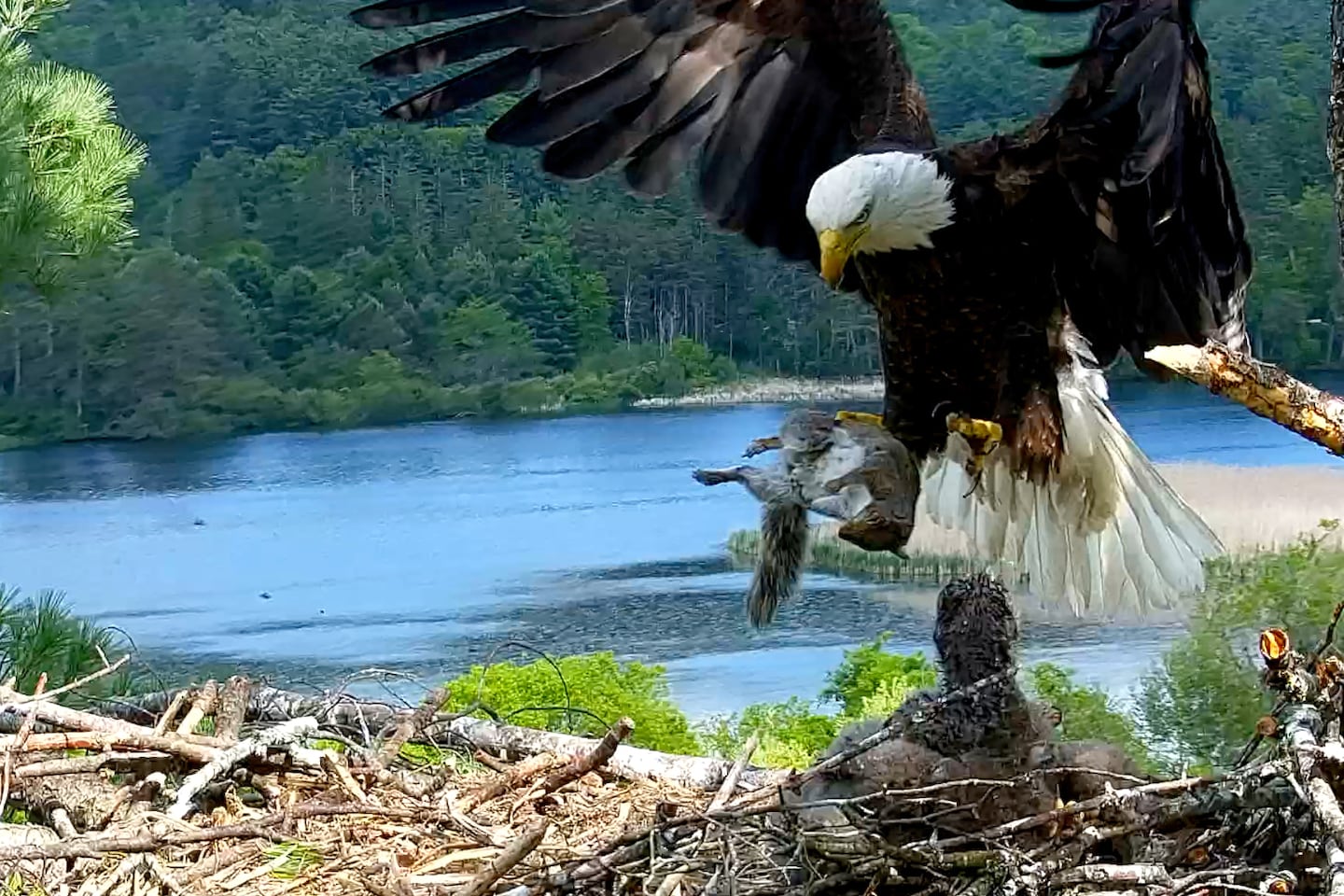 An adult bald eagle brought a squirrel to the nest on May 27.VINS
It can be hard to avoid imparting human characteristics on the birds, particularly as viewers come to think of them as friends. During a recent online forum hosted by VINS, one member of the public asked whether eagles experience loneliness, suggesting V-2 appeared forlorn as its parents spent more time away from the nest.
“Oh, this is a sweet question,” Morris responded, gently steering the viewer away from that conclusion. “I don’t tend to ascribe human emotions to these animals, which is not at all to say that they don’t experience emotions.”
The outcome VINS staff have most dreaded is some sort of live-streamed calamity — particularly one that could be ameliorated with human intervention, putting the institute in an impossible position. The survival rate of eaglets is only 50 percent in their first year of life, according to Fowle, the Audubon biologist.
“Nature is harsh,” she said. “There are a lot of other eagle cameras out there, and there have been some difficult things to watch.”
VINS has committed to letting nature take its course.
“It’d be devastating in many ways,” Morris said. “But I comfort myself with the reminder that there are dozens of other Bald Eagle nests in the state of Vermont without cameras on them, where things happen every day.”
For now, the news out of the nest is good. V-2 is growing stronger, flapping its wings and learning to eat bigger prey. Within the next month, it’s likely to take its first flight. That also means the nest will soon be empty — at least until next year.
Levesque expects she’ll be “a little emotional” when she can no longer track V-2’s every movement.
“What will I do with my whole day now?” she asked with a laugh. “My family will probably say, ‘Thank god.’”
But, Levesque said, for V-2 to take flight is “the happiest part. That’s the ultimate goal.”
Paul Heintz can be reached at paul.heintz@globe.com. Follow him on X @paulheintz.