
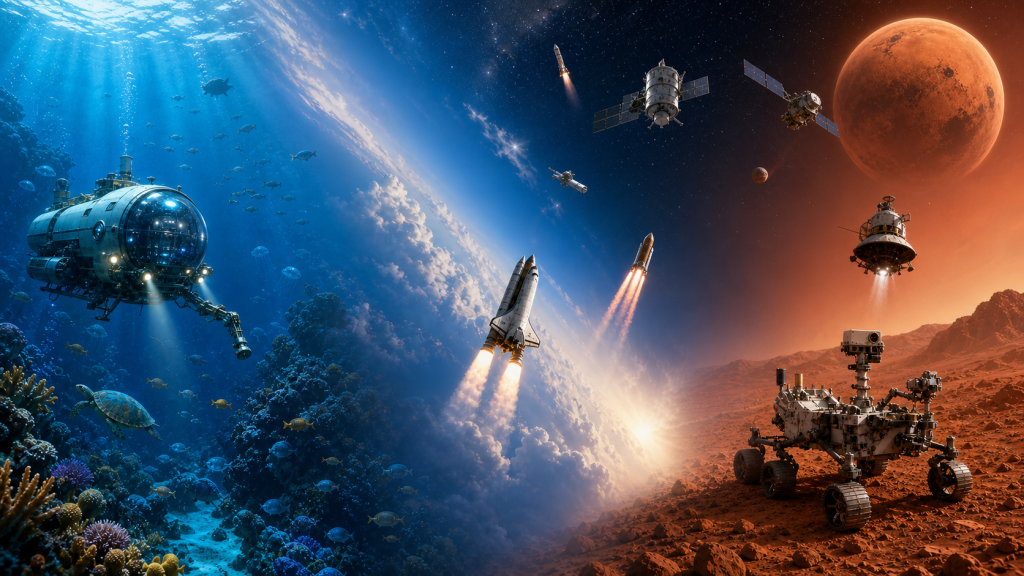
“We set sail on this new sea because there is new knowledge to be gained, and new rights to be won, and they must be won and used for the progress of all people,” President John F. Kennedy told a crowd at Rice University in 1962. In an era of Artemis missions, Mars planning and renewed fascination with space, NASA’s work continues to push the boundaries of exploration while quietly transforming life on Earth.
On Monday, the Vail Symposium presents “NASA at Work: Exploring Space from the Ocean to Mars,” an evening at 4 Eagle Ranch that reveals how missions “Off the Earth, For the Earth” are reshaping science, climate research and our understanding of the planet we call home. This program will include preshow activities, a visit from the HAATS helicopter and lawn games.
When most people think of NASA, they picture rockets, astronauts and distant planets. But the agency is also a key player in understanding our climate, advancing medical research and probing the mysteries of “inner space” beneath the ocean’s surface. This program brings together three leaders in space and exploration — NASA astronaut and artist Nicole Stott, Johnson Space Center project manager Bill Todd and space strategy expert Phil Larson — to show why NASA’s mission of “innovating for the benefit of humanity and inspiring the world through discovery” matters to every one of us, not just to scientists or engineers.
“NASA’s work reminds us that exploration isn’t just about distant planets — it’s about understanding and caring for the home we already share,” says James Kenly, executive director of the Vail Symposium. “This program brings that big picture down to earth for our community, connecting what happens in orbit and under the ocean to the everyday choices we make as ‘crewmembers of Spaceship Earth.’”
Stott, who spent more than 100 days in space aboard the International Space Station and later founded the Space for Art Foundation, will share her “Earthrise” insights: that we all live on a planet, we are all Earthlings, and the only border that matters is the thin blue line of atmosphere that protects us. Todd, project manager for exploration analogs at Johnson Space Center and former NASA Undersea Research Team project lead, joins Stott in discussing their experiences as aquanauts — living and working underwater — and how those missions have shaped both scientific understanding and personal perspectives on our interconnected world. Larson, chief of strategy and engagement for space exploration at the Johns Hopkins Applied Physics Laboratory, will add context on how NASA and other space missions are tracking climate science, driving innovation and benefiting humanity now and in the future.

Support Local JournalismDonate
Together, the panel will explore big questions:
How do space and undersea missions change the way we see our planet and each other?
What science has emerged from decades of “Off the Earth, For the Earth” exploration?
How is NASA working to monitor and address climate change?
What can we expect to see on the horizon as new missions launch and new technologies emerge —from the ocean floor to Mars?
The program will be moderated by Emmy-winning journalist Greg Dobbs. Dobbs covered the U.S. space program for HDNet television, anchoring live from Florida for the last six years of the space shuttle program. He interviewed every crew member before their missions and broadcast from Kennedy Space Center for every launch and most landings, giving him a front‑row seat to the triumphs and challenges of modern spaceflight.
This event at 4 Eagle Ranch is designed as an evening for all ages. Doors will open at 3:30 p.m. with the panelist talk scheduled from 5 to 7 p.m. Before the presentation, kids and adults are invited to participate in “Postcards to Space,” a children’s art activity; view selected pieces of Stott’s artwork, including one of the art spacesuits developed through the Space for Art Foundation; enjoy a rolling documentary; and play camp lawn games. Food will be available for purchase and a cash bar will be open.