
The Athletic has live coverage of the 2026 Wimbledon Championships.
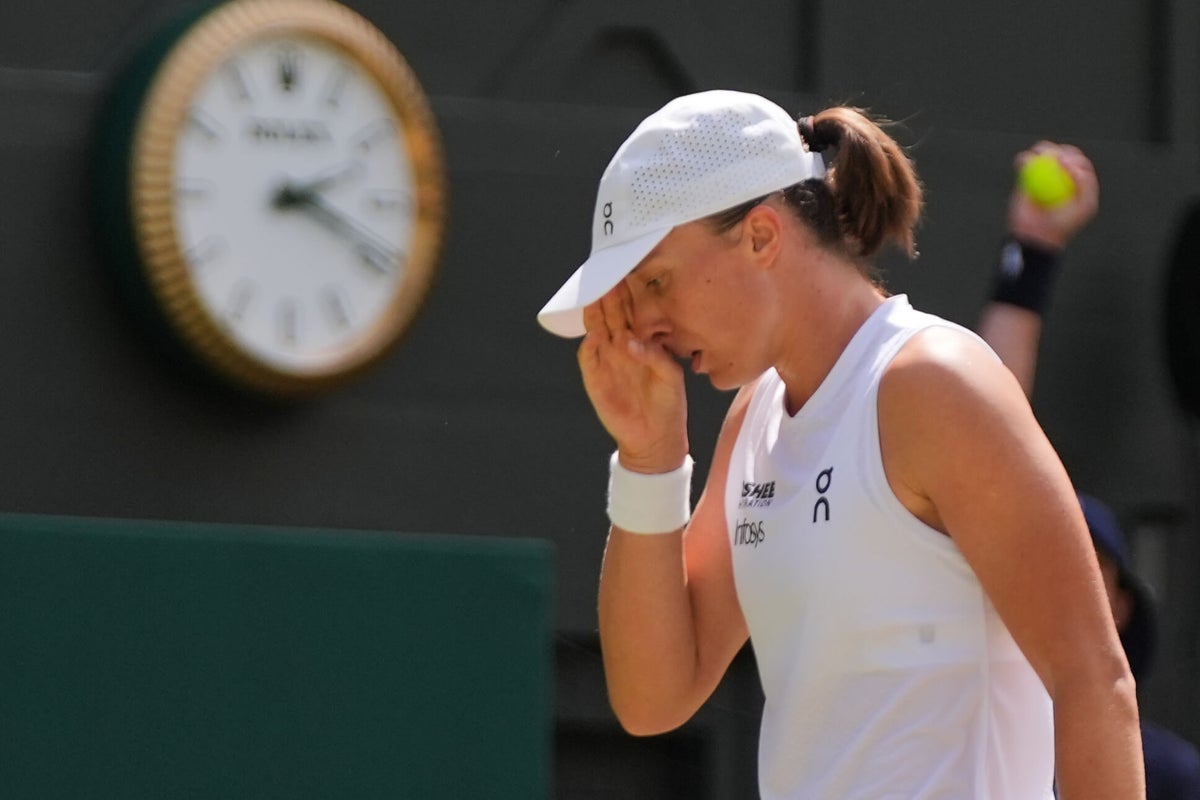
THE ALL ENGLAND CLUB, Wimbledon — Iga Świątek’s Wimbledon title defense is over, after a third-round defeat on Saturday to Alexandra Eala, the rising star from the Philippines.
In an already difficult year for Świątek, this may be the toughest loss of them all — a 7-6(9), 6-2 defeat on Centre Court to give up her crown.
When the tour rankings update a week on Monday, Świątek will be out of the world’s top 10 for the first time since May 2021. Having replaced coach Wim Fissette with Francisco Roig ahead of the clay-court season, she has mostly rediscovered the controlled aggressiveness that she wants to define her tennis, but found herself fighting to impose it with consistency against a far less powerful opponent.
For Eala, who announced herself on the WTA Tour last March with a win over Świątek to reach the Miami Open semifinals, this was an even more eye-catching result. A victory that will introduce her to a much wider audience, having never previously made it beyond the second round of a Slam. Now, aged 21, she is in the fourth round of Wimbledon, and has shown why there is so much excitement around her. In front of a crowd which gave her plenty of support, she showed off the angles and spins she can generate, in particular with her lefty forehand.
“Wimbledon has always been my favorite tournament,” Eala said in a post-match news conference. “I always loved the tradition around it, the elegance.”
She is already a megastar in the Philippines, with fans flocking to her matches wherever she plays, and on Saturday she endeared herself to Centre Court, after Świątek, a six-time Grand Slam champion, let an epic first set slide off her racket.
How does Hawkeye work in tennis?
Tifo Sports
It lasted 84 minutes, far longer than many of her matches. In the tiebreak, Świątek had two set points, but couldn’t convert. The first arrived on her forehand after she had worked the point around in the way she wants to do, but then failed to trust her finishing instinct — something she said was an issue at the French Open even after a win against compatriot Magda Linette.
“Sometimes it was like that,” Świątek said of her failure against Eala to finish points she’d set up well in a post-match news conference. “I can’t really explain the frames on the drive volleys. Usually I play them well. So yeah… S––– happens.”
Not winning the most important points in matches has also been a recurring theme this year. Going into Wimbledon, Świątek had won a greater percentage of points in her 2026 matches than any other player, and was second for percentage of games won, but she was 16th when it came to percentage of matches won — according to data from Tennis Abstract, and as discussed on social media following her loss.
Świątek said Saturday that Eala was “more brave in the important moments.”
And in a match between two players whose serves do not always offer secure platforms for their baseline games, it was Eala who was more effective on return. Świątek also missed three backhand returns in the tiebreak that would normally be regulation shots for her, and the uncertainty in her attacking game was typified by a series of drive volleys on key points, including one at deuce in the game after she had broken Eala’s serve to lead 2-1, in which she hit the ball straight back to her opponent.
Another shanked forehand drive volley the game before the tiebreak was a further indication, and Świątek continued to hit straight back to Eala with the court gaping throughout the match.
Świątek was furious with herself and seemingly her team as she left the court following the first set’s conclusion. Her main coach Francisco Roig appeared to say to her that “she is not beating you, you are losing,” and the match continued along that path. Eala scrapped and produced brilliant changes of direction out of the corners, but Świątek too often invited her to play one more ball, or made herself hit a difficult second shot after not putting away a more simple first one.
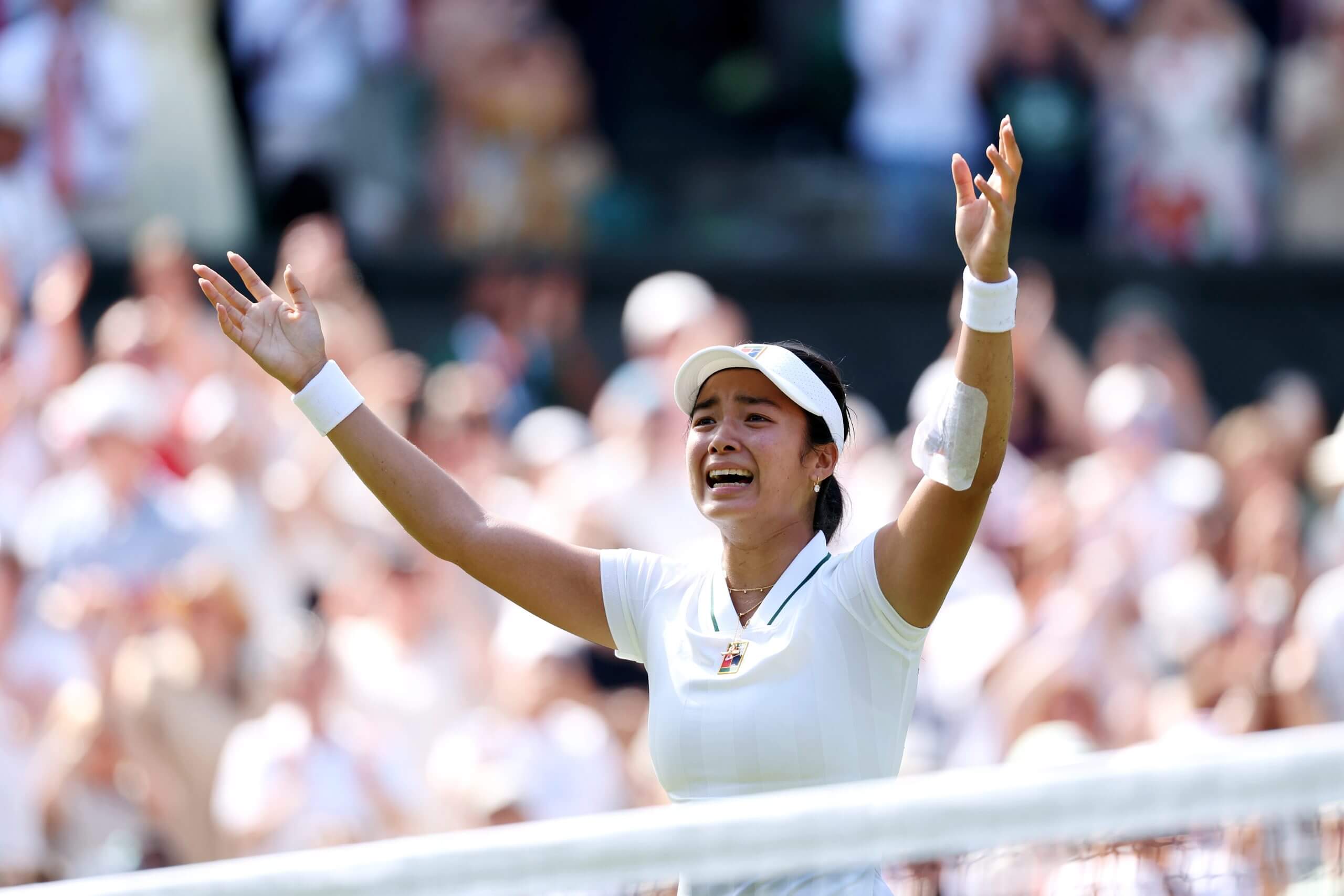
Alex Eala reached the second week of a Grand Slam for the first time with the biggest major win of her career. (Clive Brunskill / Getty Images)
The match also exposed Świątek’s continuing struggles with her serve. Eala feasted on it in the tiebreak, having time to run around her backhand and unleash inside-in forehands that Świątek couldn’t handle. Eala was also stepping well inside the baseline to return, sending out a message about her intent to go after her opponent’s second serve.
Eala’s serve is not exactly a point-ender either, but she made better use of the space she opened up by pulling Świątek wide, especially when serving to her backhand from the ad side.
And despite Eala hitting first serves in the mid-70-mph range in the tiebreak, Świątek couldn’t attack them in the same way. She ended the set with 27 unforced errors compared to 20 winners.
Świątek said in her news conference that she had struggled more with Eala’s serve the slower it got.
“I think it was tougher mentally for me to accept these missed returns from the slow serves. I got to say it’s much tougher to return a serve like that than a normal serve.
“I know it was slow. I know exactly how it’s going to come to me. It’s such a different rhythm than what I usually have a chance to return.”
She added that as the second set went on, “I felt like she was serving slower and slower, and it became tougher and tougher for me to return these serves. That, for me, was hard to accept.”
A recurring theme for Świątek this year has been spiraling when things start to go badly, and so there was concern at how she would respond to losing a set that she could easily have won. She went down 4-0, but then produced a sequence of play which typified where she is at. After a dominant break of serve to recover to 4-2 down, a hold of serve would have put a huge amount of pressure on Eala. Instead, her serve again veered off kilter, with two double faults, and as Eala held break point for 5-2, Świątek again made herself play an extra shot in attack by hesitating to come forward and planted a volley long.
In the Polish section of her news conference, Świątek said that: “It’s always a bit like you’re fighting against yourself. In many matches, I just played stupidly and made poor tactical decisions.”
In a 10-minute final game, there was still time for some donations from Świątek — another volley that went long to hand Eala a match point, and a missed backhand return off a 65 mph second serve. A few points later, Eala collapsed on her back in celebration.
“Maybe for someone like Iga who has won so many Slams. … Or maybe someone like Serena or Venus (Williams) this achievement may seem small, but for someone who grew up in the Philippines …” Eala said in her on-court interview, her voice breaking as she trailed off.
“I went to train with my brother and grandfather every day after school, with my ruffled socks and my light-up shoes and chubby cheeks, so for her this is everything.”
Asked in her news conference about being an inspiration to millions back home, Eala said: “I try to be as authentic as I can. I believe in being genuine. I believe in my values. This exposure I guess or this platform that I have has really allowed me to self-reflect. It allows me to become the best version of myself, because I know that a lot of people look up to me.
“Then again, I think the main message here is that I don’t want them to look at me and say, ‘I want to be the next Alex Eala.’ I want them to look at me and say, ‘Wow, I want to be the first me. I want to make my own path.’”
Next for Eala is a fourth-round match against Jasmine Paolini on Monday, and beyond that, the sense that she is beginning to make good on the rich potential she undoubtedly has.
A star was born on Centre Court, while one of the biggest in the sport is faced with rediscovering her shine.