
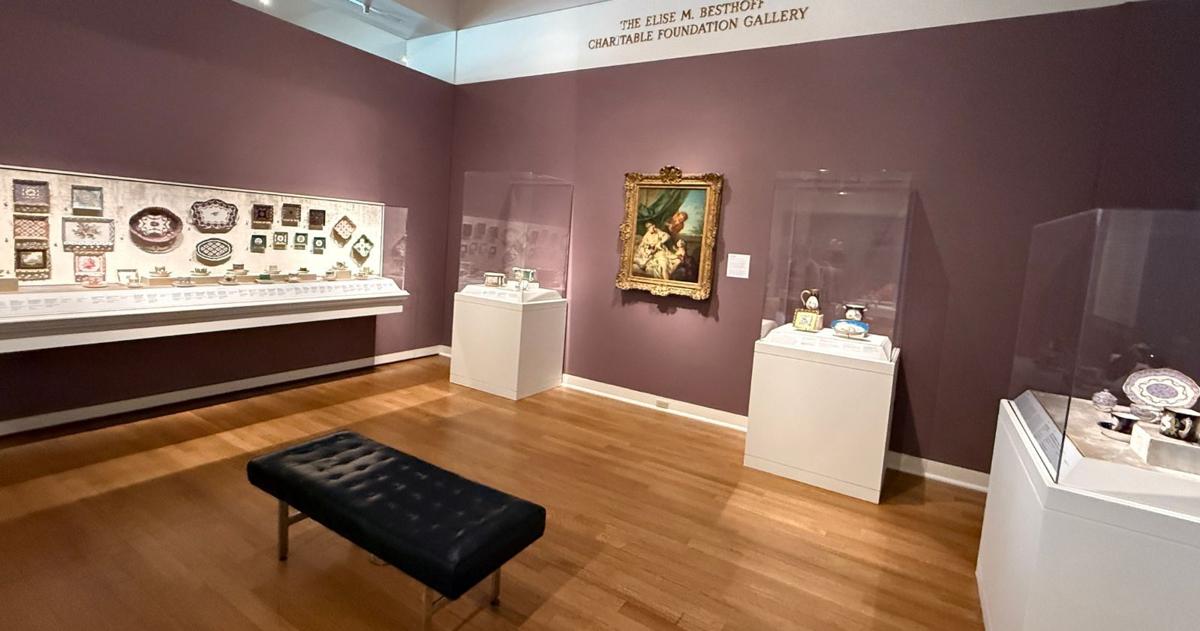
The royal porcelain factory on the outskirts of Paris has been producing beautiful works of breakable art for nearly three centuries. Because a New Orleans collector took special interest in a specific period of the factory’s output, 75 pieces made for France’s doomed royal family between 1758 and 1766 are now on view in “Sèvres Magnifique: French Porcelain from the Collection of Thomas B. Lemann” at the New Orleans Museum of Art.
Founded in 1740 in Vincennes, the factory moved in 1756 to be closer to Versailles and its fancy residents.
“This little factory, which was modest in the beginning, became such an emblem of France that it caught the attention and the patronage of the royals,” said Mel Buchanan, NOMA’s RosaMary Curator of Decorative Arts & Design. “So, it was King Louis XV who became a patron of the factory, or, well, more directly his mistress, Madame de Pompadour.”
The trays, tea sets, plates and bowls in the exhibit beloved by the pre-guillotine set somehow survived the French Revolution, as did the factory, which still operates today. Many of those who ostensibly handled the objects — including Marie Antoinette, or at least her servants — did not.
“These were used objects, but in a very rarified world of the elite in a court setting,” Buchanan said. “All of these things would have had a place and been part of that ceremony of daily life at the court.”
The answer is on the back
Some of the exhibit pieces are mounted so visitors can see their undersides, where various markings identify the factory, and sometimes the artist, that painted the piece.
“If you turn over ceramics, as I sometimes joke, the answer is on the back,” Buchanan said.
Because of these marks and the meticulous records kept by the factory, it’s possible, a few centuries later, to credit the proletariat painters and gilders in exhibit text accompanying the porcelain.
“So, each individual painter — which were some of the best artists of their generation worldwide — had the privilege of marking their piece,” Buchanan said. “In a factory setting, that’s pretty rare. Generally in a factory setting, it’s the factory that gets the credit or maybe the original designer. It’s very rare that the individual artists get to claim ownership of the piece.
“There is an archive at the Sèvres factory today that you can go visit. If you make the appointment and request the right materials, you can be looking at the pay schedules for a gilder that worked in the 1760s. It’s really extraordinary. Incredible.”
So, thank you, 18th-century cake-eating annotators of Sèvres, from curators of the present and future.
The documentation was part of the appeal to Lemann, Buchanan said.
“As a historian, I imagine he was possibly attracted to Sèvres because they were their own historians,” she said.
Important to Lemann as well was that the pieces be in pristine shape.
“Condition was very important,” Buchanan said. “Some collectors are not as concerned with something having a little ding or a little repair. Tommy Lemann wanted everything to be perfect, which is wonderful for a museum because we feel the same way, to have pristine examples.”
From Versailles to City Park
The delicate porcelain’s journey into NOMA’s permanent collection spanned several decades. It’s been on display at the museum a few times, dating back to the 1980s, but always anonymously. Lemann died in 2023 at age 97, and the collection was donated to the museum.
His story, well-known to a certain vintage of locals, is worth pondering as you enjoy his gift of the royal platters, etc., to his fellow citizens.
A New Orleans native, he served in World War II and was a Harvard Law graduate thereafter. There are YouTube videos of him reciting, late in life and in Greek, the poetry of Alcaeus and Homer.
“Often when we talk about Tommy Lemann, I always use a shortcut to describe maybe how his mind worked: He was a codebreaker during the Second World War,” Buchanan said. “He made his career as a lawyer (but) he lived a life of the mind, operating on a level that … most of us struggle just to keep up. He was a voracious reader, traveler and deeply knowledgeable about all parts of history and art.”
The exhibit will remain on view through Jan. 3, 2027.
Museum calendar for July 5The art exhibit “Festival/New/Works,” which pairs established artists with emerging talents, closes Monday at the Contemporary Arts Center of New Orleans. More: cacno.orgWednesday’s 6 p.m. Gallier Gathering, to be conducted for free on Zoom, will feature a discussion with author and historian Andrew N. Wegmann on the topic “From Cuba to Creole: The Lacroix Household and Creole Identity in 19th-Century New Orleans.” hgghh.org.At 6 p.m. Thursday, the Ogden Museum of Southern Art will host a “Culture & Cocktails” gathering to explore the musicians and music represented in the photography exhibit “Herman Leonard: Images of Jazz.” Advance registration is encouraged. ogdenmuseum.org.At 6:30 p.m. Thursday , a Dinner with a Curator event at the National WWII Museum will pursue the theme “Press Start: World War II in Video Games.” nationalww2museum.org.The Ogden Museum of Southern Art exhibits “Herman Leonard: Images of Jazz” and “Focu: Noel Rockmore” will close July 12. ogdenmuseum.org.A free opening reception for the traveling exhibit “Drawn to Combat: Bill Mauldin and the Art of War” will start at 5 p.m. July 16. A panel discussion, which will take place in-person and online, will start at 6 p.m. nationalww2museum.org.