
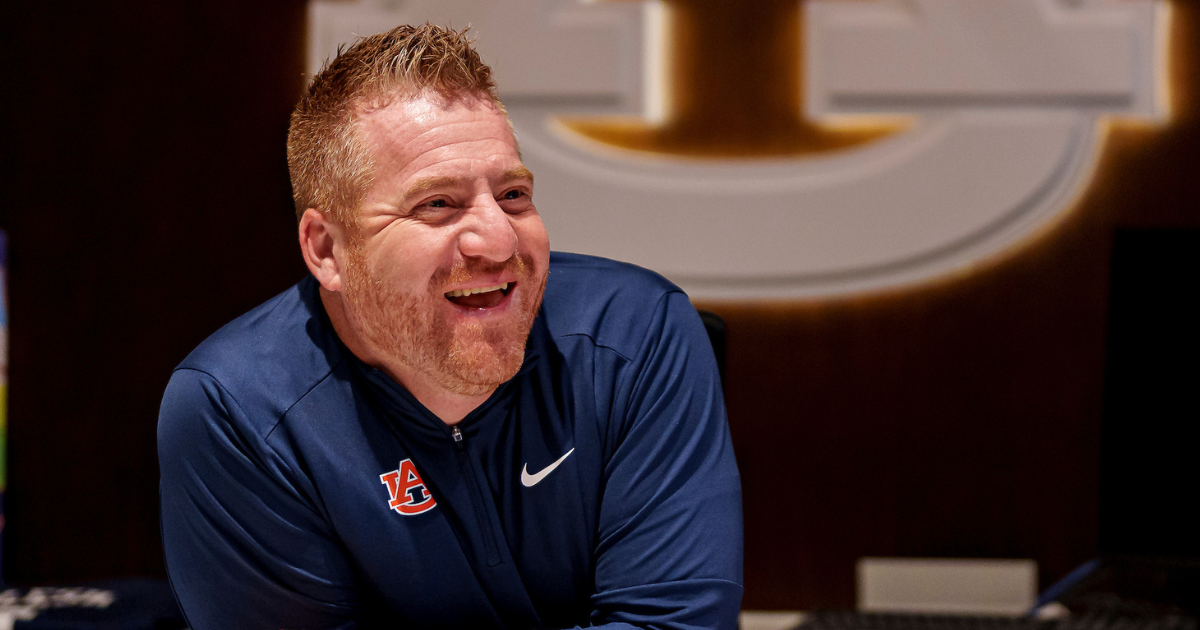
AUBURN | The price tag keeps going up for the nation’s top high school talent. In a recent story by On3’s Pete Nakos, the cost to earn a commitment from a low four-star is up to $350,000, and the higher-rated four-stars are going for as much as $750,000. Most five-stars are going to cost you at least $1 million.
Texas A&M may sign the the nation’s most expensive 2027 class at north of $10 million, which already includes six five-stars. Other SEC schools will be closer to half of the Aggies’ spending. How does the rest of the league compete? Making better evaluations, assigning more accurate values and a little bargain shopping.
Bargain shopping can come in many forms but perhaps the best way to save significant cash is to avoid the five-star and highest-rated transfer quarterbacks, and look to develop a quality starter without having to commit a lot of initial money.
Auburn has taken steps to do that in building its ’27 roster. Since Alex Golesh took over, AU has signed Tristan Ti’a from Oregon State and Locklan Hewlett from USF, who both have four years of eligibility left, and signed Rhys Brush in the ’26 class. If one or two of those three show enough potential as a future starter this fall, AU won’t have to pursue a top quarterback in the portal and be able to save more than $1 million. AU also has a commitment from three-star Gary Chatman in the 2027 class.
MORE WAYS TO SAVE
When it comes to making better evaluations and valuations, just look to the three-stars and lower four-stars. Getting a few or more bonafide stars from that group in each class can add up quickly over three, four or even five years.
Auburn, quite frankly, hasn’t done a good enough job of that lately. Of the players projected as starters or key contributors this season, only Bryce Deas, Kaleb Harris, Sylvester Smith and Omar Mabson fit the bill of being a former three-star or low four-star that AU signed out of high school.
BUILDING BLOCKS
But that brings us to another great way to bargain shop. Let’s say a few too many of those lower-rated recruits don’t pan out. Let them go, and replace them in the transfer portal with players that also have multiple years of eligibility.
Golesh has already used this approach. Of the 39 transfers they took in January, 26 have multiple years of eligibility and 18 of those have three or more years left. That’s nearly half of the class that could be around through 2028 or even ’29.
It’s unlikely Auburn will ever be able to build the most expensive roster in this era of college football. But there are multiple paths of piecing together quality teams that compete for championships, and Golesh has already taken key steps in building Auburn’s future.
NEVER DOUBT THE POWER OF JORDAN-HARE
Going into 2021, Auburn had won 12 straight night games at Jordan-Hare Stadium and had a .792 winning percentage at home.
That home-field advantage has completely collapsed over the last five years with the Tigers going 19-18 including 2-10 against ranked teams. There’s no doubt that AU’s poor showing at Jordan-Hare has greatly contributed to the record-tying five consecutive losing seasons.
But don’t let those numbers fool you. Jordan-Hare is still a magical place. One of the best college football venues in the country. A record 22-straight sellouts speaks for itself. All this football program needs is competent leadership and it can be back to competing for championships and Jordan-Hare can be back to being a graveyard for opposing teams.
Golesh is AU’s third coach since the streak of futility started. I haven’t seen him make a misstep in the seven months since he was hired. He has put Auburn on a road back to legitimacy. No shortcuts, no excuses and no wild promises.
Auburn people understand there is plenty of work to do. But they also know good coaches can get more out of their teams than even they thought was possible. And when that happens, Jordan-Hare will be ready to do its part.
TODAY’S MUSICAL JOURNEY BEGINS ON A LIGHTED DANCE FLOOR
In today’s musical journey, we go back 52 years to the first disco song to top the charts and kickoff a new era of music. On July 6, 1974, “Rock the Boat” by the Hues Corporation reached No. 1 on the Billboard 100. The single also topped the charts in Canada and was a top 10 hit in the UK, Ireland, Netherlands, Argentina, South Africa and New Zealand. The song was the third single from the debut album by Hues Corporation, Freedom for the Stallion. After the first two singles failed to reach the top 60 on the charts, “Rock the Boat” got off to a slow start before several New York DJ’s began playing it at dance clubs and it quickly caught on.
The band’s manager, Wally Holmes, wrote most of the band’s songs including “Rock the Boat.” The original opening line of the song, “Ever since our voyage of love began,” was changed to “So I’d like to know where you got the notion,” by producer John Flores. The single has been certified Gold in the U.S. with more than two million in sales. It’s appeared several T.V. shows including the Derry Girls, Family Guy and The Simpsons.
COUNT BLACULA
Hues Corporation was formed in Los Angeles in 1969 by Holmes, who hired St. Clair Lee, Fleming Williams and Hubert Ann Kelley, who is from Fairfield, Ala. The trio began as an opening act for several bands including Frank Sinatra, Glen Campbell and Milton Berle. The name was a pun on the Howard Hughes Corporation. Their appearance in the blaxploitation film Blacula in 1972, which included three songs on the soundtrack, helped launch their career.
The group stayed together for 11 years and produced six studio albums. After “Rock the Boat,” their highest-charting single was 1974’s “Rockin’ Soul,” which reached No. 18 on the Billboard 100. They didn’t have a top 60 hit over the next six years. They went through several personnel changes with Kelley eventually leaving the group to become a minister.