
Geological setting
The Phu Noi Locality is situated in Ban Din Chi village, Kham Muang District, Kalasin Province, Northeastern Thailand (Fig. 1b). The site represents one of the most prolific non-marine vertebrate fossil assemblages in Southeast Asia and occurs within the lower part of the Phu Kradung Formation, the basal unit of the Khorat Group35,36. The formation consists predominantly of fluvial sandstones, siltstones, and mudstones deposited in a continental basin system, indicating a fluvial depositional environment35,36,37,38,39,40,41,42.
Fig. 1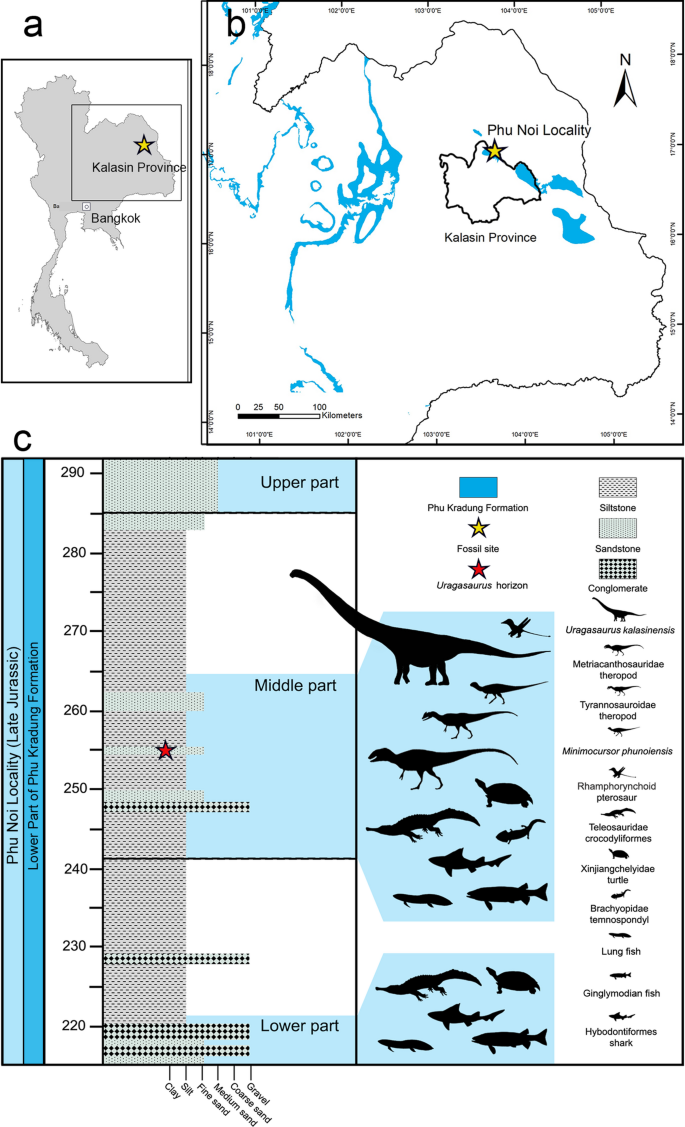
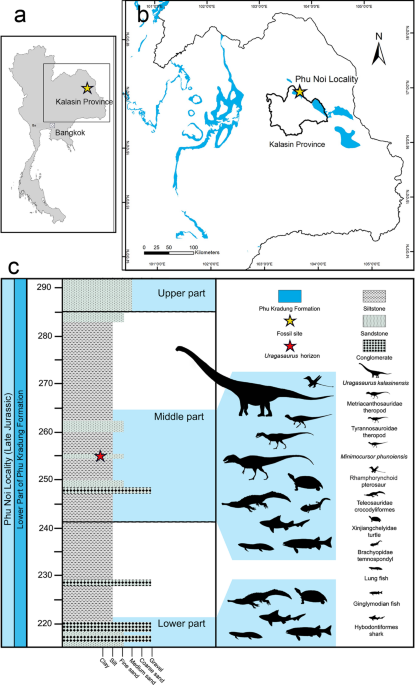
Locality map and section diagram of Phu Noi Locality. The map of Thailand (a); The location of Phu Noi Locality and the distribution of Phu Kradung Formation, the northeastern region with the outline of Kalasin Province (edit by Kantanat Trakulveerayut) (b); the diagrammatic section of Phu Noi (applied from Chowchuvech et al.31) (c).
The age of the Phu Kradung Formation remains incompletely constrained due to the absence of radiometrically datable horizons. Previous studies have suggested a Late Jurassic age based on regional stratigraphic correlations, vertebrate assemblages, and detrital zircon data36,37,38,39,40,41,42,43,44. However, the chronostratigraphic resolution remains limited, and reliance on single indicators such as the absence of particular palynomorph taxa is insufficient to tightly constrain the age. Consequently, the formation is best regarded as spanning the latest Jurassic and possibly extending into the earliest Cretaceous (Berriasian).
The Phu Noi Locality of the Phu Kradung Formation preserves a complex paleochannel sequence comprising three distinct fossiliferous horizons (Fig. 1c). The lower horizon consists of light grey conglomeratic sandstone representing the paleochannel floor. The middle horizon, situated approximately 10 m above the lower part, comprises brownish-purple and greenish-grey sandy siltstone and mudstone. The upper horizon consists of greyish siltstones within proximal floodplain deposits, located approximately 400 m west-southwest of the middle part31,36,37,38,39,40,41,42,43,44.
The mamenchisaurid specimens described herein were discovered from the middle horizon, which yields diverse vertebrate remains, including isolated and partially articulated skeletal elements. The vertebrate assemblage includes hybodontiformes sharks, ginglymodian fishes, lungfishes, basal eucryptodiran turtles, teleosaurid crocodyliformes, and neornithischian dinosaurs63,64,35,36,37,38,39,40,41,42,44. Additional taxa currently under study include brachyopid temnospondyl, rhamphorynchoidea pterosaur, basal tyrannosauroid, and metriacanthosaurid theropods, and the mamenchisaurid sauropod described herein31,42,43.
Taken together, the vertebrate assemblage from the Phu Noi locality shows strong biogeographic affinities with Jurassic–earliest Cretaceous faunas from the Junggar, Turpan, and Sichuan basins of China22,23,45, supporting placement of the Phu Kradung Formation near the Jurassic–Cretaceous transition, although precise stage-level correlation remains uncertain.
Systematic palaeontology
Dinosauria Owen46
Saurischia Seeley47
Sauropodomorpha von Huene48
Sauropoda Marsh49
Eusauropoda Upchurch4
Mamenchisauridae Young & Zhao1
Uragasaurus kalasinensis gen. et sp. nov.
LSID: urn:lsid.org:act:4AEEEE6B-156F-466D-963A-6B52F018799C.
Holotype
The isolated anterior dorsal vertebra PRC 460 has been housed at the Palaeontological Research and Education Centre (PRC), Mahasarakham University, Thailand. Following standard paleontological protocols, the vertebrae were mechanically prepared using pneumatic tools and fine brushes to remove the surrounding sediment matrix.
Associated sauropod materials
KS 34-581. Anterior dorsal neural arch. KS 34-586. Anterior dorsal neural arch. KS 34-587. Left coracoid. KS 34-588. Left fibula. KS 34-602a. Middle cervical vertebra. KS 34-602b. Right cervical rib. KS 34-692. Middle to posterior dorsal vertebra. PN 13-23. Posterior dorsal vertebra.
The holotype specimen (PRC 460) was recovered from a localized excavation area within the same stratigraphic horizon. Although several additional sauropod elements were discovered in close proximity, these remains lack diagnostic features that overlap and cannot be confidently referred to the holotype individual. These specimens are therefore treated as associated sauropod materials rather than elements of the holotype individual. Consequently, the diagnosis of Uragasaurus kalasinensis is based solely on the holotype vertebra.
Etymology
The genus name “Uraga” originates from the Sanskrit word उरग, meaning “snake” or “serpent”, referring to the distinguished long neck of the family. The term “saurus” is derived from the Greek word saûros, meaning lizard. The specific epithet refers to Kalasin Province, where the specimens are from.
Locality
Phu Noi Locality, Kalasin Province, northeastern Thailand (16.93298° N, 103.72327° E).
Horizon
Lower part of the Phu Kradung Formation, Khorat Group.
Age
Latest Jurassic, based on regional stratigraphic correlations and the composition of the vertebrate assemblage; precise chronostratigraphic constraints remain uncertain.
Diagnosis
Uragasaurus kalasinensis gen. et sp. nov. is a mamenchisaurid sauropod diagnosed by the following unique combination of characters (autapomorphy is marked by *): (1) anterior dorsal vertebra with prominent, elongated teardrop-shaped pneumatic fossae on the distal portion of the transverse processes*; (2) intraprezygapophyseal laminae (tprl) meeting ventromedially to form a Y-shaped configuration in anterior view, incorporating a single vertical intraprezygapophyseal lamina (stprl); and (3) shallow, subtriangular pleurocoel lacking an internal septum.
Description and comparisons
The specimen is completely preserved except for heavy anteroposterior compression, which obscures its lateral morphology. The centrum is opisthocoelous, the parapophysis is located on the ventrolateral margin of the neural arch that is close to the dorsolateral margin of the centrum, the dorsally curved transverse processes flare horizontally with a downward diapophysis facet, and the neural spines exhibit a U-shape bifurcation cleft in anterior view, which lacks vertically elongated sagittal prespinal (prsl) and postspinal laminae (posl). PRC 460 is equivalent to the second dorsal vertebra of M. hochuanensis and M. youngi, the third dorsal vertebra of M. anyuensis, and the fifth dorsal vertebra of Klamelisaurus1,14,18,25. Comparative measurements of anterior dorsal vertebrae in selected mamenchisaurids are provided in Table 1, supporting the interpretation of the holotype as an anterior dorsal vertebra. Moreover, the internal camellate structure revealed by CT scanning (see Internal pneumatic structure), which is typical of Mamenchisauridae and closely related East Asian forms such as Omeisaurus, is presented 1,14,16,19,24,50,51,52.
Table 1 Measurements of the anterior dorsal vertebra of Uragasaurus kalasinensis (PRC 460) with the 3rd dorsal vertebra of M. anyuensis (AL001), the 2nd dorsal vertebra of M. hochuanensis (CCG V 20401) and M. youngi (ZDM 0083), and the 5th dorsal vertebra of Klamelisaurus (IVPP V9492). Italicized measurements indicate dimensions that may be affected by post-depositional compression and should be interpreted cautiously. All measurements are in millimeters.
Several disarticulated sauropod elements were recovered within a few meters surrounding the holotype in the assemblage. Because these remains were not found articulated and include elements showing morphology that may differ from the holotype, they are regarded here as associated sauropod materials rather than confidently referred specimens.
PRC 460 anterior dorsal vertebra
The anterior dorsal vertebra PRC 460 is well-preserved in anteroposterior perspective, representing lamina and fossa architectures (Figs. 2a, b, and 3). The centrum is opisthocoelous with a wider-than-high hemispherical outline, while the neural canal opening is transversely expanded and ellipsoid in outline. The sub-rectangular parapophysis is situated on the dorsolateral margin of the centrum, consistent with anterior dorsal vertebrae of eusauropods. The ventral surface of the centrum is anteroposteriorly concave and transversely convex without a ventral midline keel. The marginal border between the lateral and ventral surfaces is absent. The shallow and indistinct sub-triangular pleurocoel (sensu Britt51), which is posteriorly tapering, is situated on the anterodorsal area of the lateral surfaces, and the dorsal margin reaches to the ventral area of the neural arch. Moreover, it lacks excavation of pneumatic foramina inside the pleurocoel, and the internal septum is absent.
Fig. 2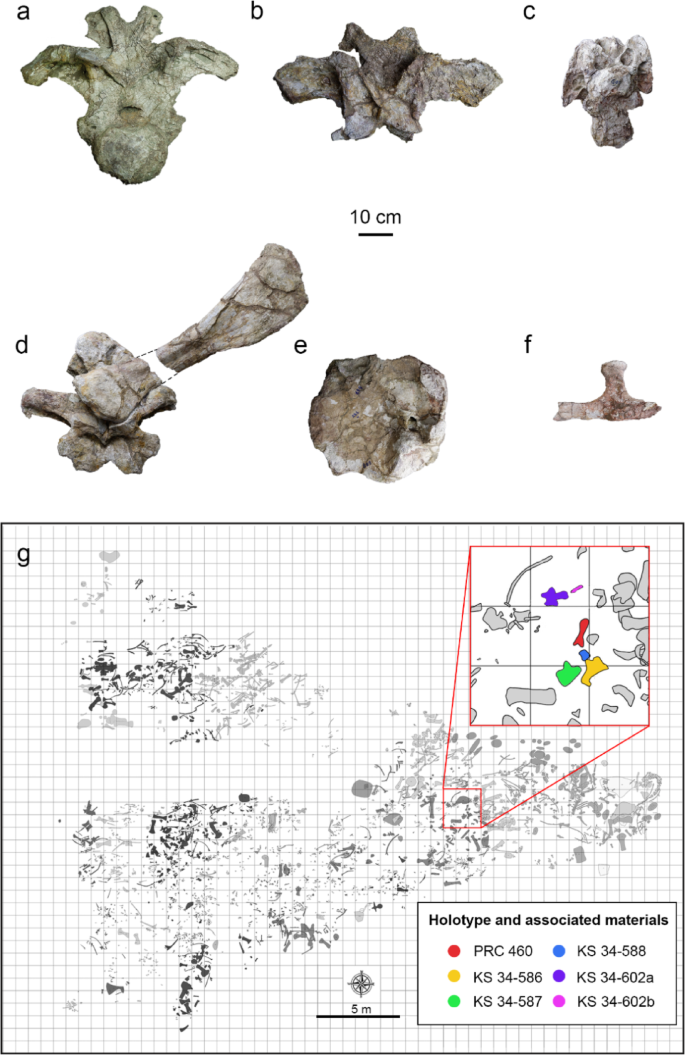
Holotype of Uragasaurus kalasinensis (PRC 460) and associated materials in the quarry map. PRC 460 Anterior dorsal vertebra in anterior view (a), KS 34-581 anterior dorsal neural arch in anterior view (b), KS 34-602a middle cervical vertebra in ventral view (c), KS 34-586 anterior dorsal neural arch in anterior view, attached by KS 34-588 fibula (d), KS 34-587 coracoid in lateral view (e), KS 34-602b right cervical rib in lateral view (f). Quarry map showing the spatial distribution of the holotype and associated materials from the Phu Noi Locality (g). PRC 460, representing the new taxon Uragasaurus kalasinensis, is indicated in red. Associated sauropod elements include KS 34-586, KS 34-587, KS 34-588, and KS 34-602a–b, highlighted in yellow, green, blue, purple, and pink, respectively. The inset shows a close-up of the excavation grid highlighting the relative positions of the holotype and nearby associated materials. Each grid square represents 0.75 × 0.75 m.
Fig. 3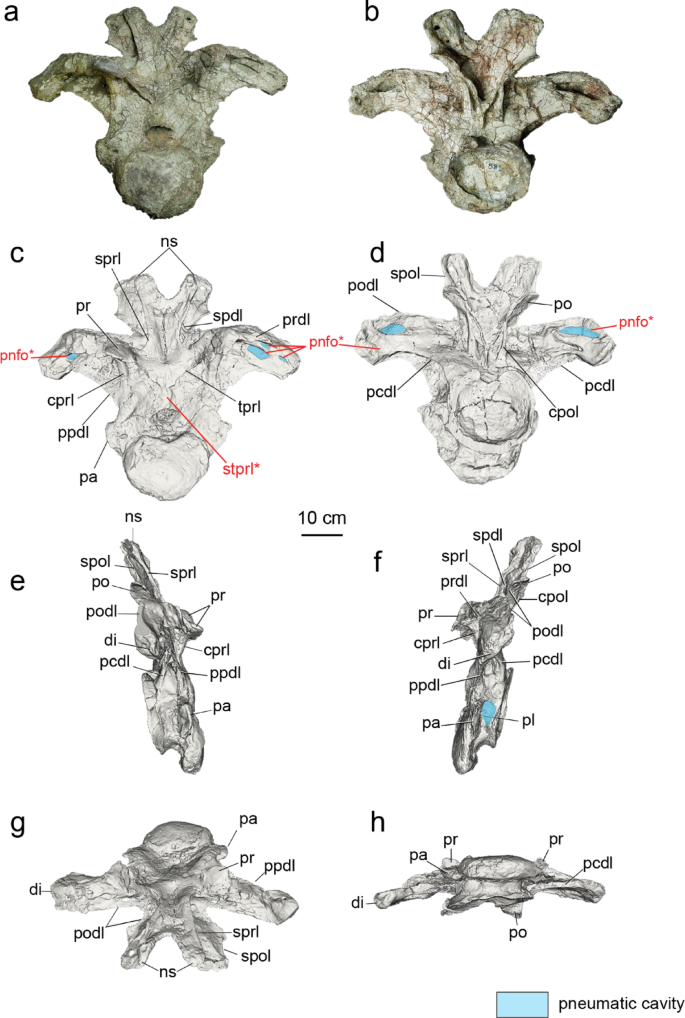
The holotype anterior dorsal vertebra of Uragasaurus kalasinensis (PRC 460) in anterior (a) and posterior (b) views. Digital rendering of the specimen in anterior (c), posterior (d), right lateral (e), left lateral (f), dorsal (g), and ventral (h) views. Asterisk refers to an autapomorphic character. The blue highlight indicates the pneumatic fossa and pleurocoel.
The prezygapophysis has large, dorsomedially oriented, transversely ellipsoid articular facets. It is ventrally supported by a pair of robust vertical buttresses of centroprezygapophyseal lamina (cprl), which are situated at two-thirds of the height of the neural arch. The tprl ventromedially connects to the counterpart at the middle of the neural arch, where the dorsal end of the stprl forms a Y-shaped configuration, which is considered the unique morphological feature of Uragasaurus kalasinensis. Furthermore, prezygapophysis laterally articulates with the prezygodiapophyseal lamina (prdl), which progressively enhances the dorsoventral thickness toward the distal end, forming the dorsolateral-facing platform of the diapophysis. The platform has a rough surface indicative of m. longissimus dorsi attachment, which is represented in the posterior cervical and anterior dorsal vertebrae of archosaurs25,51.
The ventrolaterally directed facet of the diapophysis has a smoothly curved dorsal border, and the transverse process curves upward distally. The postzygodiapophyseal lamina (podl) and dorsolateral-facing platform lines are on the dorsal edge, while the paradiapophyseal lamina (ppdl) lines are on the ventral edge. On the anterior surface of the transverse process, the ventral area beneath the platform contains three pneumatic fossae, one large horizontally elongated and two small, teardrop-shaped, located near the diapophysis. On the posterior surface, a prominent, elongated teardrop-shaped fossa, which is larger than the anterior one, is located on the upper part of the distal area of the transverse process.
The anterior dorsal neural spine is a short U-shaped, bifurcated, and absent of a median tubercle. The anterior surface of the spine is covered with a broad but shallow V-shaped spinoprezygapophyseal fossa (sprf) with many weak V-shaped streaks that line vertically, interpreted as muscle attachment scars, along the sagittal plane. The postzygapophysis and spinopostzygapophyseal lamina (spol) are convexly curved to the ventrolateral margin of the spine, as shown in the anterior view. A large postspinal fossa (posf) is located on the posterior side of the spines, bounded laterally by the spol and ventrally by the intrapostzygapophyseal lamina (tpol). The posf extends ventrally from the shallow plain on the neural spine, passing through the proximal half and ventral boundary of the tpol between the postzygapophyses.
Internal pneumatic structure
Computed tomography (CT) data reveal that the centrum of the anterior dorsal vertebra PRC 460 exhibits a camellate internal pneumatic structure composed of numerous small, irregular chambers separated by thin bony septa (Fig. 4). Quantitative measurements of chamber dimensions were not attempted because the internal cavities are partially obscured by mineral infilling and preservation artifacts. This condition differs from the procamerate internal structure seen in certain neosauropods such as Haplocanthosaurus52 and the camerate condition found in macronarians and diplodocoids, such as Camarasaurus and Apatosaurus52. This indicates a relatively advanced degree of pneumatic invasion within the vertebral centrum of the mamenchisaurids. Camellate internal pneumaticity is commonly developed on the presacral vertebrae of the derived eusauropods, including mamenchisaurids, but also occurs convergently within Neosauropoda, particularly in Somphospondyli and Titanosauria. Evidence of camellate structure in mamenchisaurids has been documented from broken or eroded vertebrae, such as the first and second dorsal vertebrae of M. youngi14, the damaged third dorsal vertebra of M. anyuensis18, the cervicodorsal of Phu Dan Ma taxon29, and the ninth dorsal vertebra of Xinjiangtitan24,50. However, in derived neosauropods such as somphospondylans and titanosaurs, the camellae are typically smaller, more numerous, and separated by thinner bony septa8,52,53. The presence of this condition in Uragasaurus kalasinensis further supports the interpretation that complex vertebral pneumatic architectures evolved repeatedly among eusauropods and derived sauropod clades.
Fig. 4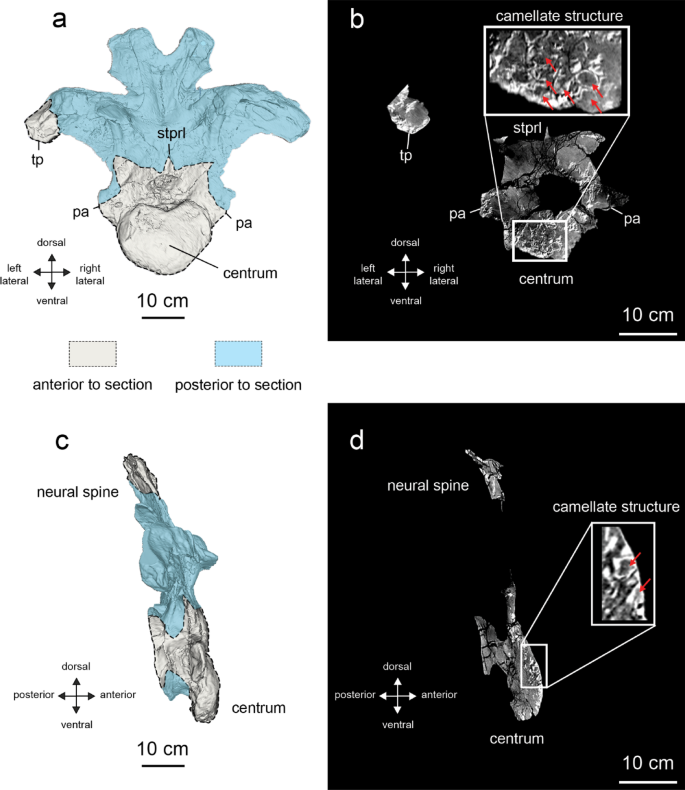
CT scan of the anterior dorsal vertebra of Uragasaurus kalasinensis (holotype PRC 460). Three-dimensional reconstructions of the vertebra in anterior view (a) and right lateral view (c). Corresponding CT sections in anterior view (b) and right lateral view (d). The section plane corresponds to the dashed line separating the grey (anterior) and blue (posterior) regions in the 3D reconstructions. White boxes highlight camellate pneumatic cavities within the centrum. Red arrows indicate polygonal camellae within the camellate internal structure of the centrum. Black-and-white arrows indicate anatomical orientation in each panel.
Comparisons
The overall laminar architecture, bifurcated neural spine morphology, and configuration of the transverse processes of PRC 460 closely resemble those of the anterior dorsal vertebrae of M. youngi and M. hochuanensis. For example, the ventral surface of the centrum is anteroposteriorly concave and transversely convex without a ventral midline keel1,54, differing from M. sanjiangensis, which possesses a ventral keel17. The pleurocoel lacks an internal septum and secondary pneumatic excavation like Jingiella, M. anyuensis, M. hochuanensis, and M. sanjiangensis1,12,17,18, in contrast to the condition observed in the Phu Dan Ma cervicodorsal (KS26-4)29. The ventrolaterally directed diapophysis facet resembles those of Klamelisaurus, O. tianfuensis, M. hochuanensis, M. youngi, and Xinjiangtitan, with a smoothly curved dorsal border and an upwardly curved transverse process1,14,16,24,25,50. Furthermore, the prezygapophysis has large, dorsomedially oriented, transversely ellipsoid articular facets, as in M. anyuensis18, M. hochuanensis1, and M. youngi14. However, several features distinguish Uragasaurus kalasinensis from these and other mamenchisaurids.
The stprl is present only in Uragasaurus among mamenchisaurids, but it is also present convergently in the macronarian neosauropod Europasaurus holgeri55. The formation of the Y-shaped lamina by stprl and tprl is not reported in other mamenchisaurids to date. This configuration differs from the V-shape condition in cervicodorsal of Phu Dan Ma taxon29, anterior dorsal vertebrae of Klamelisaurus23, and M. youngi14, and the U-shaped configuration in M. hochuanensis1. On the posterior surface, a prominent, elongated teardrop-shaped fossa, which is larger than the anterior one, is located on the upper part of the distal area of the transverse process, which is present in Uragasaurus but absent from other mamenchisaurids and Omeisaurus1,14,18,56. Finally, the anterior dorsal neural spine is a short U-shaped, bifurcated, and absent of a median tubercle, similar to Klamelisaurus21,25 but different from the V-shaped bifurcated neural spines of M. anyuensis, M. hochuanensis, and M. youngi1,14,18.
Associated sauropod materials
Several additional sauropod elements were recovered in close proximity to the holotype (PRC 460). However, these fossils cannot be confidently assigned to the same individual because of the taphonomic complexity and aggregation of the assemblage. These include: (1) a poorly preserved anterior dorsal neural arch fragment catalogued under the same field number as the holotype (KS 34-581); (2) an isolated anterior dorsal neural arch (KS 34-586) that bears an attached distal fibula fragment (KS34-588); (3) a separate fibula shaft corresponding to the piece attached to KS34-586 (KS34-588); (4) a dorsoventrally compressed cervical vertebra (KS34-602a), which is dorsally attached with the indeterminates rib shaft fragment; (5) an incomplete cervical rib fragment (KS34-602b); and (6) a fragmentary coracoid of indeterminate laterality (KS34-587). Because these specimens lack overlapping diagnostic characters with the holotype, none of them is included in the diagnosis of Uragasaurus kalasinensis.
Moreover, additional dorsal vertebra (PN 692) was recovered from the same excavation area but is located at a considerable distance from the holotype on the bone map and lacks clear articulation or size correspondence. The last specimen is a posterior dorsal vertebra (PN 13-23) recovered from an unknown grid area of the locality, and it uses the unusual Identical abbreviation and number because of the reformation of the collection ID of PRC since 2013. These specimens are therefore not considered part of the holotype and are treated as associated sauropod materials. Detailed anatomical descriptions of these associated materials are provided in the Supplementary Information.
Phylogenetic analysis
The phylogenetic analysis is based on the data matrix of Moore et al.11, which was modified from Mannion et al.30, Moore et al.25, and Upchurch et al.57. The analysis under implied weighting recovered 500,000 most parsimonious trees (MPTs) of 2152 steps (CI = 0.224, RI = 0.585). The strict consensus tree is poorly resolved due to the presence of wildcard taxa, but the reduced strict consensus and 50% majority-rule trees show largely congruent topologies (Fig. 5). Moreover, the clade Mamenchisauridae, the node including Daanosaurus zhangi to Phu Dan Ma taxon, is resolved as monophyletic and supported by several synapomorphies: (1) the lateral pneumatic foramina of the anterior dorsal centra has acute posterior margin (Ch 146:1); (2) the middle to posterior dorsal neural arches have a narrow hyposphene (Ch 150:0); (3) the presence of the dorsal platform of the sacral series by the fusion of the first or fourth sacral neural spines (Ch 174:1); (4) the middle caudal vertebrae have anteroposteriorly widen base of the neural spines (Ch 199:1); (5) scapular blade has subtriangular process at anteroventral corner (Ch 216:1); (6) the ratio of maximum mediolateral width of distal end to proximodistal length of the humerus is 3.0 or greater (Ch 370:0); and (7) prdl of the middle and posterior cervical vertebrae have convex or with distinct bulging interruption in lateral view (Ch 434:1).
Fig. 5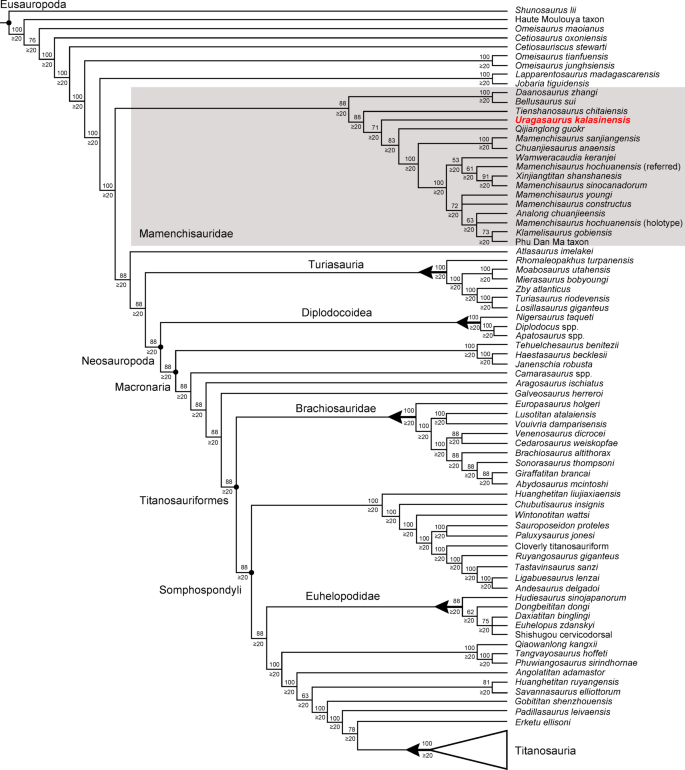
Phylogenetic result of the EIW analysis. 50% majority-rule consensus of the 500,000 MPTs (Tree length = 2084 steps) showing the phylogenetic position of Uragasaurus kalasinensis gen. et sp. nov. The number under each node indicates the the percentage frequency of clades recovered among the MPTs. The number under each node indicates the Bremer support value, which is applicable when the value is more than one. Consistency index (CI) = 0.232, retention index (RI) = 0.602.
In all optimal trees, Uragasaurus kalasinensis is recovered within Mamenchisauridae, as an early-diverging lineage, positioned basal to a clade comprising Qijianglong and more derived mamenchisaurids. The node uniting Tienchanosaurus, Uragasaurus, and the more derived members of the clade is supported by three synapomorphies: (1) maximum to minimum dorsoventral height ratio of the scapular blade is less than 2.0 (Ch 37:1); (2) parapophysis of the postaxial cervical centra are dorsally excavated (Ch 121:1); and (3) postaxial cervical and anterior dorsal neural spines are bifurcated (Ch 132:1). Bremer support values along the backbone of Mamenchisauridae are generally moderate to high (≥ 20), indicating relatively stable relationships within the clade. However, the precise placement of the new taxon remains weakly supported, likely reflecting limited anatomical overlap and the high proportion of missing data for the taxon. This phylogenetic placement is consistent with the combination of plesiomorphic and derived characters observed in the anterior dorsal vertebra of Uragasaurus.
Wildcard taxa identified during the analysis include Uragasaurus, Wamweracaudia, M. constructus, Analong, Abydosaurus, Dongbeititan, Angolatitan, and Epachthosaurus, the removal of which substantially improves resolution without altering the placement of the new taxon. The unstable behaviour of Uragasaurus likely reflects the limited anatomical overlap with many taxa in the dataset and the presence of missing data, which reduces the number of characters available to constrain its placement. In addition, the combination of plesiomorphic and derived features results in character conflict among early-diverging mamenchisaurids, further contributing to its wildcard behaviour. No unambiguous synapomorphies were recovered for Uragasaurus kalasinensis, reflecting the fragmentary nature of the material and the high degree of character conflict within early-branching eusauropods.