
Every fantasy football season, we love finding breakouts before anyone else. Why? We’re not just trying to be “the smartest person alive!”; we want to maximize the return value on our draft picks. Identifying potential breakouts is one of the most important ways to do so, as it allows fantasy players to unearth values throughout the draft and reap the rewards.
As I do every year, my fantasy football breakouts will be categorized into groups: quarterbacks and tight ends, running backs, and wide receivers — shocking, I know. Up first? A collection of throwers and plus-sized receivers, including the all-too-obvious QB Caleb Williams and TE Isaiah Likely.
In the following player write-ups, “my vote” is rooted in whether I believe the player has a good chance of becoming a top-12 QB or TE in 2026.
QuarterbacksJaxson Dart, NYG
Case for: Let’s start with the 20 fantasy points per game (FPPG) last year — for this calculation, I’m ignoring the first two games when Dart barely stepped on the field. Over the past 10 seasons, that average would have ranked as a QB6 finish. Dart’s value heavily relies on his rushing (487 yards and nine touchdowns in 12 games). Despite talk of “making him more cautious,” Dart is likely to be one of the countless quarterbacks — Cam Newton, Josh Allen, Lamar Jackson, to name a few — who fail to change their ways. Head coach John Harbaugh brought in offensive coordinator Matt Nagy and senior offensive assistant Greg Roman; the latter is often overlooked, which will allow Nagy to focus on his strength (the passing game) and Roman on his (the run game), while mitigating their deficiencies. Dart played one game with wide receiver Malik Nabers, mostly throwing to a receiving corps similar to the New England Patriots’ lackluster group. He also impressed at times in the passing game, including a 283-yard, three-touchdown game in Denver that followed an efficient win against the Eagles.
Case against: Health, obviously. Despite his occasional success without Nabers, not having the star WR for an indeterminate amount of time doesn’t help. Without Nabers, it’s Darius Slayton again, along with a collection of also-ran or past-their-prime options. However, on paper, TE Isaiah Likely looks to be a positive addition. We’ve seen Nagy fail his offense — Roman to a degree, too — and he alone could stymie the offense or a battle of wills could create issues. Also, experienced quarterbacks regularly take four to six games to hit their stride in a new offense.
My vote: Yes! Yes! Yes (with Bryan Danielson hands and all)!
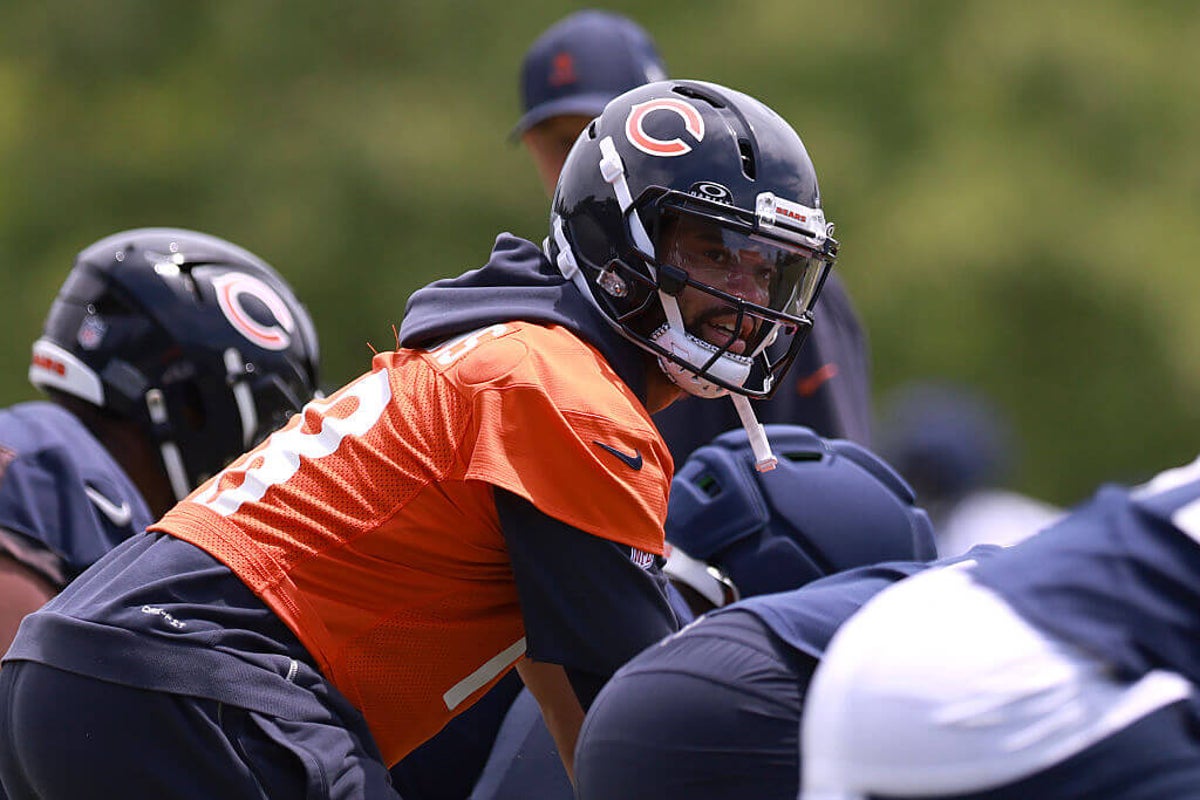
Caleb Williams, CHI
Case for: This is Williams’ second year under head coach Ben Johnson, and he’s coming off a 3.4 FPPG jump from his rookie season. In 34 games, Williams has 47 touchdown passes and just 13 interceptions. Wide receiver Rome Odunze enters Year 3 after a blazing-hot start to 2025, and reports indicate his foot is fully healed. WR Luther Burden and TE Colston Loveland are in their second years, and both looked quite good to end the season, especially Loveland. Williams had 483 and 383 rushing yards, respectively, in his two seasons, with three rushing touchdowns in 2025 after zero in his rookie year.
Case against: Williams’ completion percentage (Comp%) dropped last year (58.1%), though as a counter, you can argue that part of the blame rested with his wideouts. Watching Williams can be infuriating, as his negatives are similar to what we saw in college — hero ball, recklessness, ad-libbing when not needed, etc. When he’s “on,” Williams can look like one of the elites, but when he goes awry, he can look like Gardner Minshew. Odunze might be healthy, but he’s admitted how his foot feels now will be a “new norm,” so he might not return to his early-2025 performance. Much is being asked and assumed of Burden. If he doesn’t take a big step forward, and you couple that with Odunze not looking the same, Loveland will be Williams’ only top-notch weapon.
My vote: A strong yes
Malik Willis, MIA
Case for: Willis’ draft profile highlighted his exceptional rushing ability and a terrific arm capable of rare throws, despite the occasional hesitation to make the throw. We’ve seen flashes of these positives. Since entering the league, Willis ranks fourth in TD or first down per attempt rate (22.3%), even while facing pressure on 42.5% of his dropbacks. He also boasts a 13.3% designed rush rate, trailing only Anthony Richardson (15.6%), Justin Fields (14.1%) and Jalen Hurts (13.5%). In fact, Willis has rushed for 405 yards on 74 attempts (5.47 YPA) with four touchdowns. This rushing production is the primary argument in his favor; we’ve seen how rushing can elevate a quarterback’s fantasy value. As Daniel Jones demonstrated in 2022, finishing as a top-10 QB is easily attainable when you have 120 carries for 708 yards and seven touchdowns, despite only 3,205 passing yards and 15 touchdown passes. Oh, and job security is not a concern, as the Dolphins aggressively pursued him, hoping to find a franchise cornerstone, and will exhaust all efforts to determine if he is the answer.
Case against: His career sample size is limited, and despite his impressive arm talent, a high number of his completions have been in short areas. Until Week 16 last year, Willis had air yards of 6, -7, -3 and 1 on his touchdown throws. Willis will also be learning a new offense. While it appears quarterback-friendly with a Kyle Shanahan-style system, featuring pre-snap motion and schemes to get wideouts open over the middle, OC Bobby Slowik’s track record has been inconsistent. Surprising no one, Willis isn’t getting the true Shanahan experience. I’d be remiss if we didn’t talk about the exceptionally questionable receiving corps. WRs Jalen Tolbert and Tutu Atwell joined Malik Washington this offseason, before the Dolphins added three rookies — Chris Bell, Caleb Douglas, Kevin Coleman — one of whom (Bell) is questionable to start the year.
My vote: My mind is telling me no, but my (fantasy) body is telling me yes … alas, no, but it’s close.
Tyler Shough, NO
Case for: After his first two starts, Shough was QB12 in FPPG (18 — Weeks 10-17). During this period, he also had a 70.3% completion rate, second only to Brock Purdy (70.7%), and he passed for 260.1 yards per game, ranking seventh. Beyond the stats, Shough sparked the Saints offense with more downfield passing — an easy bar to clear when previous starter Spencer Rattler was averaging a whopping 6.2 yards per attempt. Shough developed a strong rapport with WR Chris Olave, and he delivered a respectable rookie performance despite throwing to a receiving corps that also included WRs Devaughn Vele, Mason Tipton, Kevin Austin and Dante Pettis, along with TEs Juwan Johnson and Foster Moreau. The Saints addressed their receiving situation for 2026 with the addition of WR Jordyn Tyson with the eighth pick and Bryce Lance as a high-ceiling developmental wideout. Plus, they brought in Travis Etienne to share the backfield (currently) with Alvin Kamara.
Case against: Shough only had eight passing touchdowns during the Week 10-17 stretch (T-18th). His accuracy mightily waned when throwing 15+ yards downfield — a mere 25% completion rate, which was fifth-worst among the 32 QBs who had at least 250 attempts. While some of these incompletions were on the receivers, others were due to Shough’s decision-making and placement — similar to his college performance concerns. His rushing ceiling appears to be in the 300-to-400-yard range, with a handful of touchdowns. While this certainly boosts his value, it’s not a complete game-changer like it is for Dart or Willis.
My vote: A solid no
Cam Ward, TEN
Case for: Ward turned a bit of a corner after the Titans’ bye with a mark of 15.1 FPPG, but more importantly, 10 touchdown passes and just one interception. The average interception mark for all quarterbacks during that span was 4.9. Those touchdown and interception marks came with WRs Chimere Dike, Van Jefferson and Elic Ayomanor (two fourth-round rookies) as his starting wideouts. Like the Saints, the Titans added a serious weapon in the draft in WR Carnell Tate, plus Brian Daboll — the new offensive coordinator — essentially brought WR Wan’Dale Robinson with him from the Giants. Whether or not wideout Calvin Ridley has anything left, Ward’s weapons are significantly improved. The offensive scheme should be too, as Daboll famously wanted Ward in the 2025 draft, and will bring his motion offense and deeper route combinations to Tennessee. While Ward didn’t run much in 2025, when he did in Weeks 11 and 12, he showed a potential fantasy bonus with 33 and 37 yards, respectively, including a touchdown run in Week 12.
Case against: Like Shough, his rushing upside is more of a bonus than a significant factor, and it might even top out in the 200-to-300 yard range with two to three touchdowns. Ward’s completion percentage “jumped” to 62% during the aforementioned post-bye stretch, but he still had the seventh-highest off-target percentage (12.8%). Before the bye, Ward’s Comp% was dead last at 57.6%. The added weapons will do wonders, but even during his strong play, Ward had the fourth-fewest air yards per attempt (6.6) and lowest YPA average at 5.6. Also, the offense should be massively improved from a play-calling standpoint, but Ward will be learning a new offense, which as mentioned, can take weeks into the season before producing peak results.
My vote: Wavering no
Tight endsDalton Kincaid, BUF
Case for: Despite missing time and often not playing at 100% health, Kincaid ranks seventh in expected points added (EPA) per target over the past two seasons, following a solid 73-reception, 673-yard, two-touchdown rookie season. Interestingly, Kincaid leads all tight ends in targets per routes run rate (TPRR%) at 25.9%, even though he hasn’t seen a high percentage of overall snaps (more on that below). Kincaid also boasts the highest off-target percentage (13.7%), showing what he can do with limited quality targets, evidenced by his 2.13 yards per route run (second-highest). That’s the long way of saying Kincaid is a dynamic tight end, a matchup nightmare for defenses and a true playmaker. There is speculation that Kincaid’s usage will significantly increase under OC Pete Carmichael.
Case against: Injuries have been a concern, with Kincaid missing nine games and playing through others at less than full health (shoulder, knee, oblique, hamstring). Partly due to injuries and partly due to offensive design, Kincaid was involved in only 41% of routes over the past two seasons. While we hope Carmichael and head coach Joe Brady follow through on getting Kincaid more involved, the tight end’s past utilization and the addition of WR DJ Moore could impact Kincaid’s opportunities. Kincaid’s touchdown ceiling appears lower than other top-tier tight ends.
My vote: Yes, we finally get our wish.
Isaiah Likely, NYG
Case for: Likely could join the group of tight ends who lead their teams in targets, especially if Nabers misses the start of the season. Head coach John Harbaugh essentially brought Likely with him from Baltimore, similar to Daboll with Robinson in Tennessee. This suggests Likely will get his breakout opportunity as the clear No. 1 tight end for the Giants, no longer competing with Mark Andrews. Despite limited usage, Likely has an attractive 11.6 yards per reception (seventh best, min. 100 targets) and 5.5 yards after catch per reception (YAC/Rec), ahead of Dalton Kincaid, Sam LaPorta, Brock Bowers and many others. Likely’s numbers jumped without Andrews on the field: route percentage (38.4% to 71.0%), team target percentage (7.9% to 16.3%), yards per reception (10.5 to 12.6), yards per route run (1.18 to 1.70), YAC/Rec (4.9 to 6.0) and, most importantly, FPPG (5.2 to 10.7).
Case against: Regarding the Harbaugh talk, you can argue back, “Why didn’t he utilize Likely more in Baltimore when it was clear what he brings and Andrews was declining?” Even knowing those splits, Likely’s top seven games account for 37.7% of his career fantasy points, particularly his 21.6-point effort on Sept. 5, 2024. While there’s optimism for the Giants’ improvement and Dart’s breakout, there are no guarantees. The Nabers factor presents a dual argument: Having Nabers could draw coverage away from Likely, or his absence could lead to more targets for Likely. Since their on-field impact areas don’t overlap, I’m not arguing strongly for either scenario.
My vote: Yes, though backend TE1
Notes on 3 second-year studs
The following second-year tight ends showed different levels of high-upside potential. Given what we already know and saw, they’re more quick-hit mentions.
Chicago’s Colston Loveland broke out late last year, and my projections, which put him first overall, raised my eyebrow. A top-three finish feels far more likely than not at this point.
There is a good chance Harold Fannin leads the Cleveland Browns in targets, but that likely leads to a repeat of his rookie season and borderline top-five finish.
You could argue Indianapolis’ Tyler Warren disappointed given his potential and ability. If QB Daniel Jones is healthy for most of the season, Warren has the upside to finish among the top three as well.