
What will make next season a successful one for the Toronto Maple Leafs?
Making the playoffs feels like the bare minimum after last season’s 78-point disaster.
But getting back to the postseason won’t be easy.
It took 99 points to make it in the Eastern Conference last season, meaning a huge jump will be required from the team in Toronto. They are only one among many clubs, mind you, that missed out but look poised to challenge for a spot again, including and especially the Florida Panthers, who added Brady Tkachuk, Jacob Markstrom and Radko Gudas, among others, this season and will see Aleksander Barkov return from injury.
NHL free agency: Early winners and losers
Shayna Goldman and Madison Eades
The range of outcomes for the 2026-27 Leafs feels wide — a 90-point team on the low end, a 100-ish points and a playoff berth on the high end.
What needs to happen for the better outcome to occur?
1. Auston Matthews returns to top form
This will define everything.
Matthews finished second in the Hart Trophy race in 2021, won it in 2022, and fell to fourth (somehow) in 2024 when he scored 69 goals while also being nominated for the Selke Trophy.
The Leafs are a significantly better team, clearly, if he gets back to being that guy.
But that’s a big if at this point.
It’s not just that Matthews is coming off two pretty rocky seasons in which he rarely resembled the world-crushing force of those MVP years. He is also coming off knee surgery. And he’ll turn 29 in September.
The 60-goal days might be over for Matthews. Only four players in NHL history scored 60 or more at age 29 or beyond: Mario Lemieux, Mike Bossy, Phil Esposito and Lanny McDonald.
Can he get back to being one of the NHL’s premier goal scorers, and a Rocket Richard Trophy contender?
In those last two seasons, Matthews ranked 22nd in the NHL in goals per 60 minutes (min. 2000 minutes), even with players who frankly shouldn’t be on his level: Zach Hyman, Brandon Hagel, Sam Reinhart and Adrian Kempe. He mustered almost 39 goals per 82 games.
Good for most players. Not good enough for Matthews.
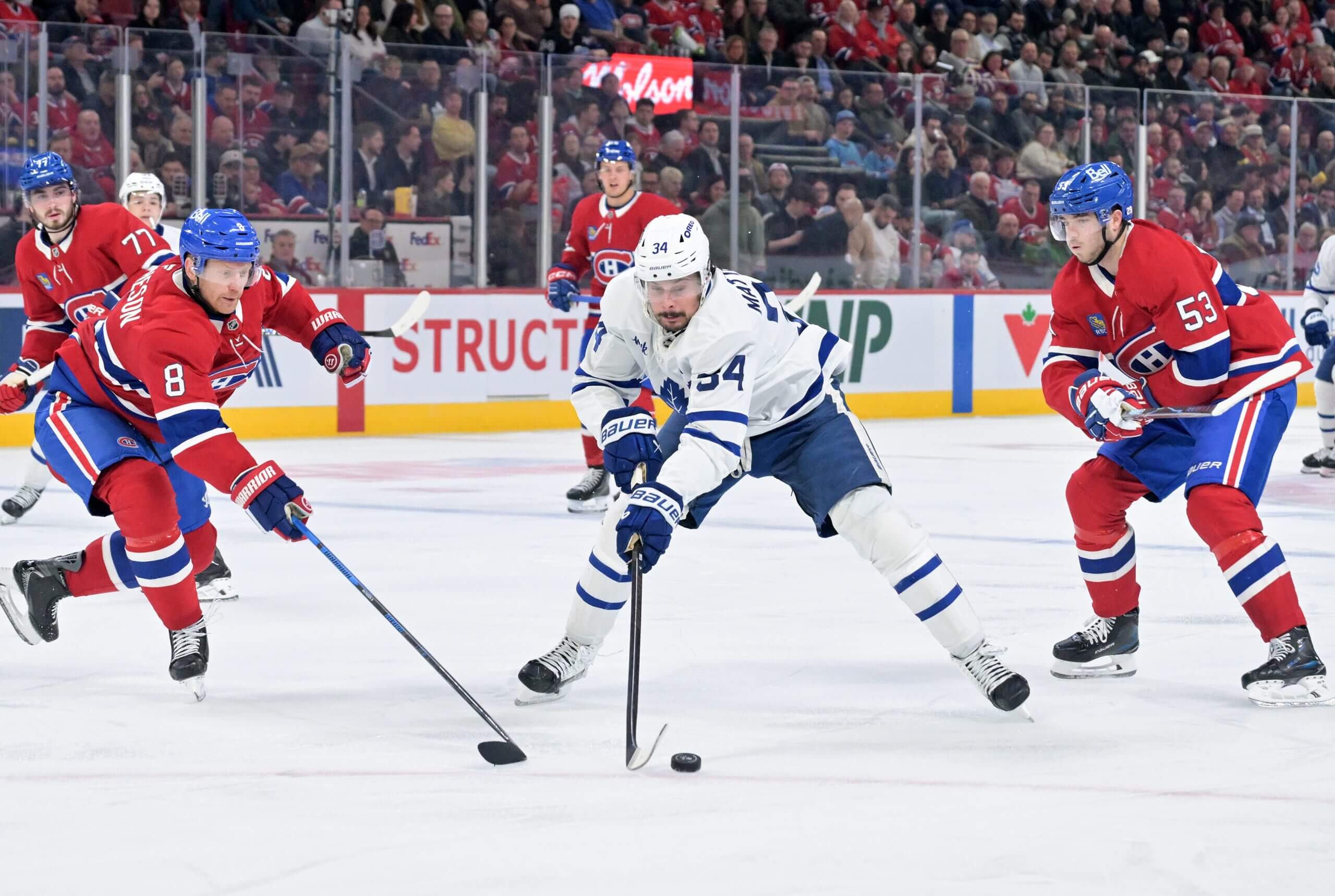
The Leafs will be counting on a huge bounce-back season from Auston Matthews. (Eric Bolte / Imagn Images)
What’s most in question is whether Matthews will rediscover the full lethality of his shot, particularly that once-deadly wrister from the mid range.
Matthews scored a league-best 23 goals alone from the mid range, while shooting 19 percent on wrist shots overall, during that 69-goal season.
Over the last two seasons, he scored 18 goals combined from the mid range, while shooting only 12 percent on wrist shots.
Matthews should be in a better position to succeed next season.
His linemates figure to improve, especially if Gavin McKenna can step in and contribute right away. General manager John Chayka also made it a priority this offseason to acquire centres who can handle a heavy defensive load, which should alleviate some of that burden on Matthews.
And new head coach Jim Hiller sounds intent on boosting Matthews’ profile on the power play; Matthews scored only five power-play goals in 60 games last season, which equaled a career low.
Beyond the return of his shot, the Leafs need Matthews to rediscover his power as a skater — and do so in the aftermath of that surgery. In his peak physical days, Matthews, a big guy at 6-foot-3, was like a freight train coming through the middle of the ice. That, on top of his shot, tremendous defensive instincts (including almost unmatched pickpocketing ability), and top-notch puck control, is what made him such an unusual and incredible force.
Can he be that guy again?
2. Sergei Bobrovsky is the real deal
Unless James Reimer or Cam Talbot sign somewhere before next season — both are free agents as of this writing — Bobrovsky will be the oldest goaltender in the league next season.
Either he’ll be an old goalie who performs like an old goalie, or he’ll be an old goalie who shows he’s still got something left in the tank.
Bobrovsky’s .877 save percentage last season was well below the league average of .896.
Something around average, in the 50-ish games he starts, would probably make next season a modest success for the soon-to-be 38-year-old. Something above and beyond average, on the other hand, would make next season a smashing success.
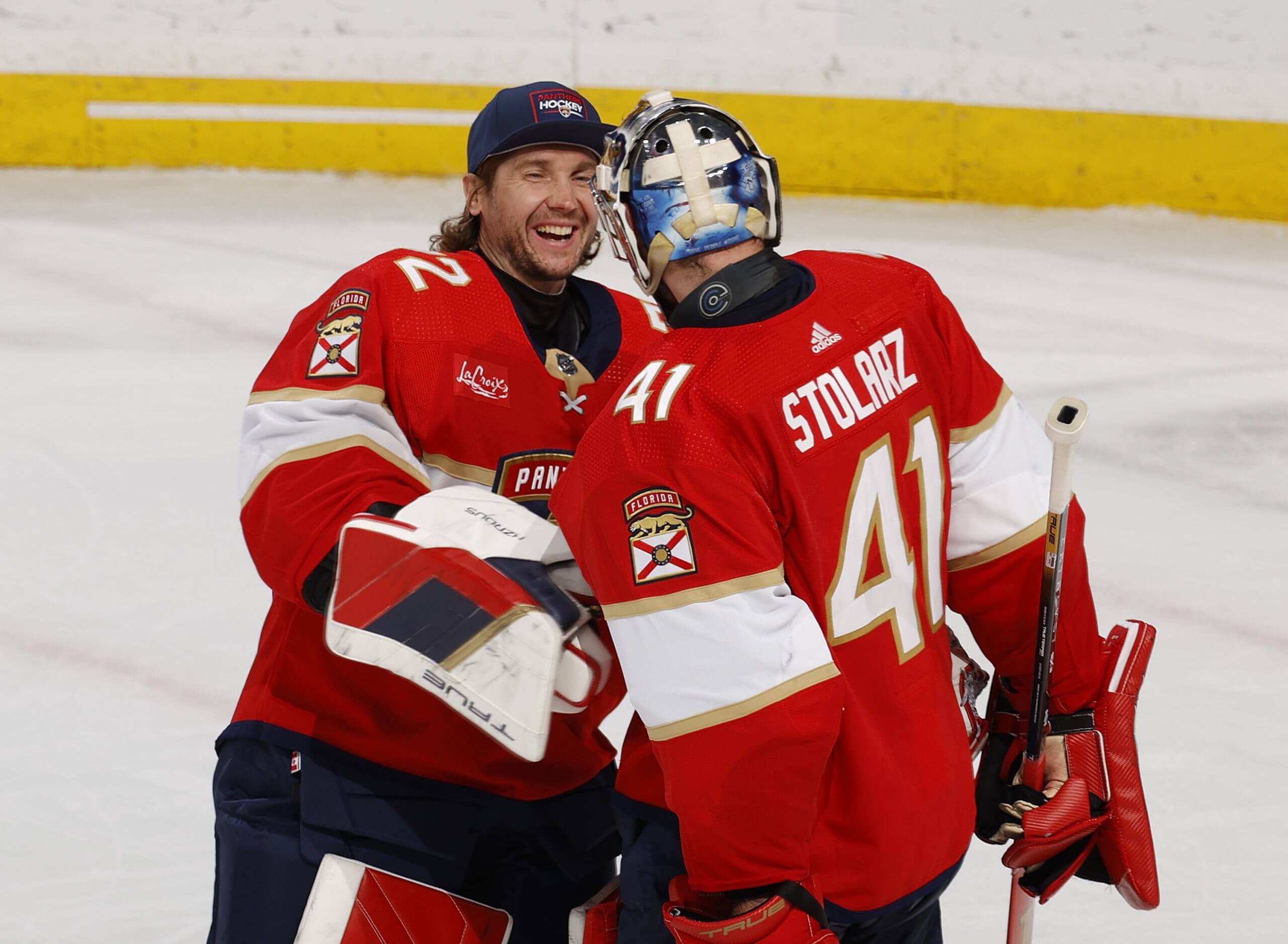
What’s old is new again as Sergei Bobrovsky and Anthony Stolarz reunite in the Leafs crease. (Joel Auerbach / Getty Images)
Three seasons ago, Bobrovsky finished with a sterling .915 save percentage and tied for the league lead with six shutouts for the Panthers. He finished third in Vezina Trophy voting.
That, plus a rockstar postseason if they can get in, would be the dream scenario for the Leafs.
3. The young guys pop
These are the 10 best rookie seasons by a Leaf in terms of point production since the start of the 2005-06 season:
Top 10 rookie performances since ’05-06
McKenna should wedge his way into that bunch, but how high?
He is going to be put in a great position to succeed. McKenna will get a shot to play with Matthews at some point, and if that doesn’t work, he figures to line up alongside John Tavares and maybe William Nylander.
He should play a pivotal playmaking role on what should be a stacked No. 1 power-play unit.
But he’s also 18 (turning 19 in December) and tangling with fully grown men, who are the best at what they do, for the first time. That will be an adjustment for him, perhaps a major adjustment. The 82-game season is long and taxing too amid all that. Even Matthew Knies, about as ready to play physically as one can be walking into the league, showed real signs of fatigue during his rookie season.
The upside for McKenna is clearly much higher. If he delivers right away, with a Calder Trophy-winning type season, the Leafs’ playoff chances will obviously tick up.
Continued growth from the other two key young guys on an otherwise-old roster will be crucial, too.
A leap from Knies, assuming he isn’t moved, after a career-best season (production-wise) would be significant.
What does that look like? More pronounced power-forward elements. More goals, for one, particularly at five-on-five. Knies scored only 10 times in those spots last season, after managing 37 in the two previous seasons when he had Mitch Marner frequently setting him up.
Maybe McKenna plays that maestro role for Knies next season.
The Leafs need more physicality from Knies too, coupled with speed that seemed to drop off last season amid injuries. Knies was noticeably less impactful as a forechecking force last season.
It will be interesting to see if the 23-year-old comes in lighter next fall; he was among the heaviest forwards in the league last season at 232 pounds.
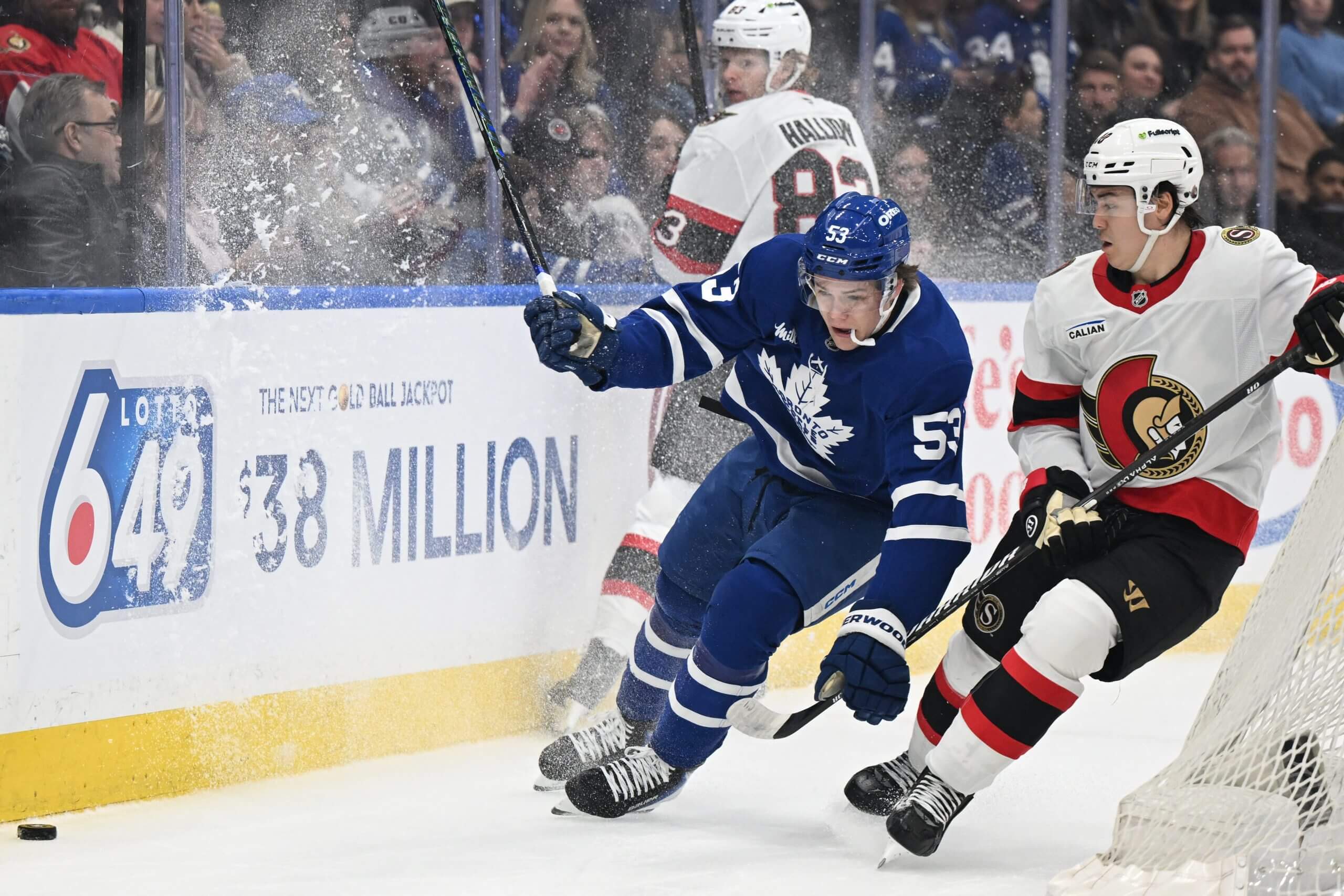
Easton Cowan could become a very important player for the Leafs in his second season. (Dan Hamilton / Imagn Images)
Don’t forget about Easton Cowan either. He feels like a real wild card for the Leafs, with potential that’s undefined as of yet.
The Leafs likely need Cowan or McKenna, and ideally, both, to pop for the top six (as currently constructed) to be formidable.
4. Jim Hiller can coach
The Leafs had to move on from Craig Berube after last season. Time will tell if they got it right in choosing Jim Hiller — especially with the far more credentialed Bruce Cassidy available and interested.
There isn’t a lot to go on with Hiller, given that he coached only one full season with the Kings (along with a lengthy run as an assistant).
The hope is that what his teams in L.A. did defensively can be translated, in one way or another, to Toronto.
It’s hard to be a playoff team, let alone a Stanley Cup contender, without being at least average defensively.
The good news for Hiller is the forward group, in particular, is stuffed with better defenders than what Berube had to work with last season. There is sturdiness and veteran potential in goal and on defence.
Related to those efforts for Hiller and a revamped coaching staff will be getting this group to control the puck far more often than they did last season — and spend more time in the good place as a result. No team spent less time at even strength in the offensive zone than the 2025-26 Leafs.
Hiller’s fate won’t be determined by tactics alone.
Being the head coach of the Leafs is unlike any other head coaching position in the NHL. The scrutiny is so much higher. Every little thing he does, or doesn’t do, will be picked apart and critiqued. Things are always simmering in this market, and oftentimes, boiling over. It can be a lot. And while Hiller witnessed it up close as Mike Babcock’s assistant, being the guy in the spotlight is something else entirely.
Some coaches who thrive as assistants can’t cut it as head coaches.
For the Leafs to succeed next season, Hiller will have to show he’s not one of them.
5. An old team holds up
Even with a teenager, the Leafs will end up being one of the oldest teams in the league next season.
It’s easier to list those under 30 than those 30 or older: McKenna, Cowan, Knies, Matthews, Jack Roslovic, Brandon Duhaime and Emil Andrae.
Everyone else is 30 or older, including both goalies, and six of the projected seven (for now) on the back end. Adding one more sure thing, without the old-guy risk, whether it’s up front or on defence, would really help and should remain a priority for Chayka.
Older teams can be successful, but they are much more vulnerable to age-related decline and injury.
The three oldest players in the bunch also feel like the most critical: Bobrovsky, who we’ve covered; Tavares, who will be 36 in September; and Chris Tanev, who turns 37 in December.
What does Tavares’ 18th NHL season look like, especially if he’s playing centre again? His production has remained strong in recent years — 34 goals and 73 points per 82 games in the last three seasons — even as his ability to drive play has dipped.
As with Matthews, the Leafs might be able to ask less of him next season — fewer minutes, lighter competition — and that could go a long way to keeping him spry and productive again next season.
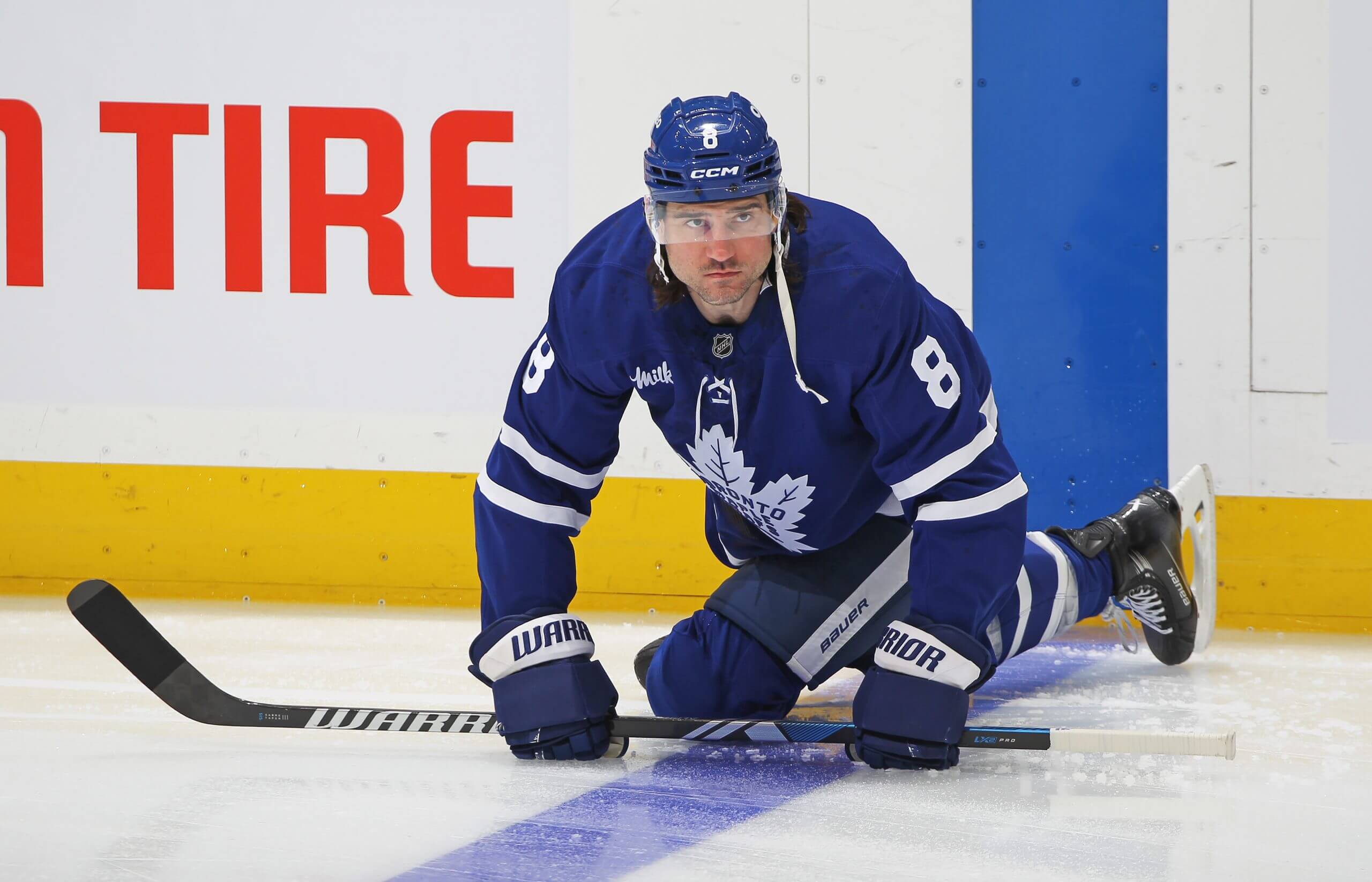
Chris Tanev might be the most critical piece on the Leafs back end. (Claus Andersen / Getty Images)
Even with all the uncertainty about Darren Raddysh, and what he’s able to deliver outside of Tampa after a monster year, the biggest swing piece on the defence might still be Tanev. If he isn’t right, the whole thing might come apart.
It’s not just health either that the Leafs need from Tanev after a season that saw him play only 11 games. It’s the return of Tanev as an elite defender.
Even before the injuries last fall, Tanev didn’t look like the same defensive force. He was getting beat regularly in ways he rarely did during a dominant first season at home in Toronto.
The Leafs have to hope, too, that Jake McCabe and Oliver Ekman-Larsson stave off any meaningful decline at age 33 and 35, respectively, and that if he returns, a 32-year-old Morgan Rielly bounces back with lesser responsibilities under a coach who is more than enthused with his skill set.
In addition to Tavares, the Leafs are going to need 31-year-old Nick Paul to prove that last season wasn’t the start of decline but simply an off year. He might be the swing piece up front who can bring the whole puzzle together.
— Stats and research courtesy of Natural Stat Trick, Hockey Reference, Stat Head, NHL EDGE, PuckPedia and Evolving Hockey