
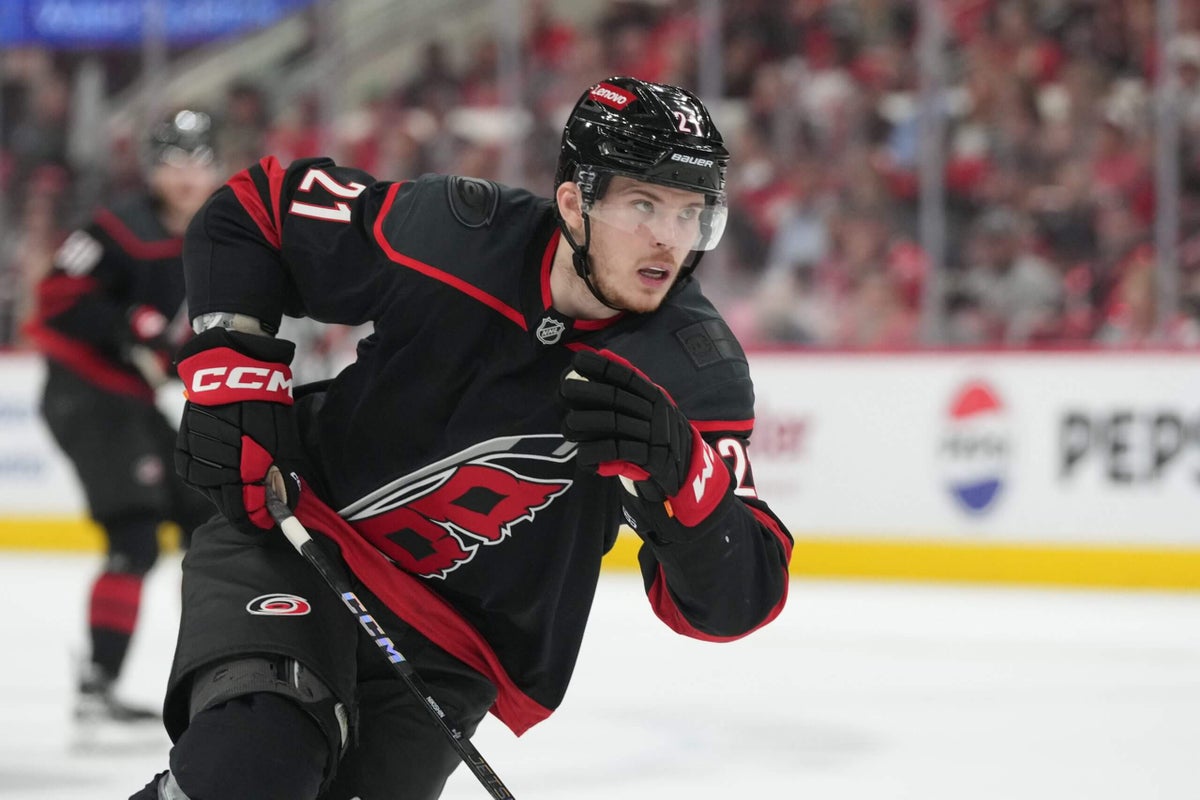
If Alexander Nikishin is actually available as a trade candidate this summer, a handful of teams should be kicking the tires.
The 24-year-old is still pretty unproven, with just 81 regular-season games and 21 playoff games under his belt. But he is a toolsy defenseman who brings size to a lineup and a Stanley Cup ring earned as a rookie, and that’s worth a lot to some teams.
It may even be worth more to other teams than to the Carolina Hurricanes at this point.
But the big question every interested general manager has to ask is why the Hurricanes would be willing to move a once highly touted prospect so early in his NHL career. Considering some of the work general manager Eric Tulsky has done over the last couple of seasons, the follow-up should be whether there’s a way to outsmart Carolina in this type of trade. Nikishin’s RFA status and the price of his next contract add another layer to the conversation.
NHL offer sheets are just business
Sean Gentille and Sean McIndoe
Nikishin checks a lot of the boxes general managers look for in defensemen. He’s big, at 6-foot-3, and knows how to use his size effectively. He can absorb a lot of contact and make life difficult for his opponents with his own hitting. Nikishin’s reach helps him break up plays, too. Pair those two traits together, plus his overall gap control, and it can make for some aggressive defending at the blue line. Nikishin’s zone entry defense helped limit scoring chances in transition, especially in the playoffs.
That playoff seasoning is obviously a part of the package. So many general managers actively look for players with a proven track record in that kind of environment. While Nikishin didn’t play much in the 2025 postseason, he had a mainstay role in the Canes’ run to the Stanley Cup this spring. He wasn’t a game-breaker, but he was a pretty consistent part of the machine in a third-pair role, where he earned a 58 percent xG rate at five-on-five and broke even in scoring.
Add in his overall mobility, which is extremely important in a league that is only getting younger and faster, and a hard shot that he’s more than willing to rip from the point, and there’s some offensive potential. His draft pedigree and transition strength from the KHL may point toward some untapped potential, too.
The context of Nikishin’s usage is important to get a more complete picture of his game and what comes next.
Carolina insulated Nikishin from playing against the opponents’ best — even in the early goings of the season when the Canes were short-handed with Jaccob Slavin sidelined. And that carried throughout the rest of the regular season and into the playoffs. Nikishin and Shayne Gostisbehere put up pretty sparkling postseason numbers, but were so sheltered thanks to Slavin and Jalen Chatfield doing a lot of the heavy lifting, and the second pair of K’Andre Miller and Sean Walker helping shoulder that burden.
And there are a few reasons for that usage. The first is the experience factor because Nikishin was a rookie. While he got a taste of NHL action last spring, he still had to adjust and adapt to this level of competition. His decision-making in his minutes also helps explain things. Sometimes Nikishin doesn’t read situations perfectly and gets too narrowly focused on just one element of a developing play. Sometimes, he opts for the more aggressive play that pulls him out of position and leaves the scoring areas more exposed. The risk-reward of that style can open the Hurricanes up to more dangerous chances against, so he still has to prove he can take on more responsibility.
It’s all pretty understandable for a rookie. But that has to be balanced against his age, because aging curves generally point to a defender’s peak years coming between 25 and 27. Nikishin may be a little more raw at this point and behind the general curve because he made the leap to the NHL a bit later than some prospects. That probably wouldn’t be much of a concern here because there can always be later bloomers if it weren’t for his contract situation.
And that’s why Chris Johnston has him in the top-10 of the latest trade board — Nikishin is reportedly looking for a contract in the $8 million range. That’s a huge leap for a player coming off their entry-level contract who hasn’t proven to be worth it yet.
It makes sense in a rising-cap world, where the middle class has benefited a ton over the last couple of years. Just look at some of the signings from this summer alone. Jacob Trouba got $8.3 million a year, on average, when he is a No. 4 at best, and that likely ticks down over the life of his contract with his age in mind. Rasmus Andersson’s seven-year deal with an $8.5 million cap may not age well, either.
It hasn’t just been UFAs cashing in. Šimon Nemec hasn’t proven a ton at this level yet, but he signed a five-year deal with a $7.3 million AAV. Pavel Mintyukov leveraged himself into a $7.2 million cap hit, too. So there’s room for Nikishin to use those market trends in his favor. AFP Analytics originally projected a six-year contract carrying a $6.4 million hit. He projects to be worth closer to $7.9 million a year, on average, over that time.

Usually, there would be some room to meet in the middle because so many RFAs sign for below their market values. But some of this year’s extensions have bucked that trend. It doesn’t necessarily mean the Hurricanes will, though, with past tendencies in mind.
The Hurricanes have done two things really well over the years: Proactively sign cost-effective contracts that will age well, and rotate supporting players into the system to keep costs in check. There can be exceptions to that — Miller, for example, had all the tools to become a special player, but didn’t look like a $7.5 million defenseman when Carolina signed him last summer.
Maybe Nikishin’s contract mirrors that, considering his skill set and potential.
But there’s reason to have some pause on over-extending him too early. With any player, there is a range of outcomes for their trajectory moving forward. Based on the last year, the best-case scenario has Nikishin following in the footsteps of Noah Hanifin, Alec Martinez, Erik Johnson or even Brent Burns. But there is also some Patrick Wiercioch, Cody Franson and Braydon Coburn in his game. And if that’s the path moving forward, it won’t be a $7-8 million caliber, even in a growing cap world.

So the best-case scenario for the Hurricanes may be a shorter-term bridge deal for Nikishin. That could give the player a chance to prove himself and maximize his earnings on his next contract. And it’s a chance for Carolina’s front office to assess just how well (or not) he fits within this system and start projecting if he can grow into a more meaningful role. The latter is important, considering how many defensemen are on the wrong side of 30: Slavin is 32, Walker is 31, Gostisbehere is 33, and Chatfield is 30. Gostisbehere and Chatfield are both UFAs next summer, too, so there’s a path to Nikishin playing a bigger role in the future, whether it’s more of a shutdown capacity, the next power-play quarterback or some combination of roles.
AFP Analytics’ short-term projection comes in at two years, at $3.7 million a season. But Nikishin should be worth closer to $7 million over the next two years, so maybe the sweet spot is something in the $6 million range to give Carolina its best chance of getting surplus value.
And if Nikishin doesn’t work out with the Hurricanes, there’s a lot of leeway to flip a contract like that. Think of this as a similar situation to the Martin Necas one; there was a lot of buzz around a potential trade when he was an RFA. Carolina extended him to a bridge deal, let him come into the season hot, and traded him at maximum value. Maybe that’s the play here if the Canes don’t envision a long-term future with him in it. Whether the team trades him now or early in the year, it should be able to get a haul back. Nemec may be a couple years younger, but he brought back a great return of draft capital to New Jersey despite being unproven and unsigned.
But one thing for every general manager to consider is the chance of winning a trade against the Hurricanes. No team is infallible, including the Hurricanes, no matter how savvy they have been over the past couple of seasons. But this front office and Rod Brind’Amour’s coaching staff have developed such a strong knack for evaluating defenders and maximizing them within the team’s high-pressure system.
A decision around Nikishin may revolve more around his ability to fit within that versus his actual talent level. Not everyone is built to play the Canes’ style, and some go on to excel elsewhere; Necas and Mikko Rantanen were good within it, but much better in different surroundings.
Maybe Nikishin could join that list. Maybe he’d make more sense on a team outside the player contender tier, with less riding on the next few years — teams such as the Maple Leafs, Jets, or Rangers, among others. The Penguins, Mammoth and Bruins could make sense as teams that need a little more help on the left. If the Kings can move out some contracts, Nikishin would help them get younger, too.
But maybe that doesn’t happen, and it takes a pricey return and contract to figure it out. It wouldn’t be the first time an up-and-coming defenseman was more valuable to the Hurricanes as a trade asset than an actual part of the team — think back to the Scott Morrow trade last summer.
Sometimes, the idea of a player’s special skill set outpaces their actual level of play. The championship pedigree only clouds that even more. That’s what any interested team has to sift through with Nikishin. The potential is there. It will just take a hefty price tag to figure it out — if the Hurricanes decide to move on from him.
— Data via Natural Stat Trick, Evolving-Hockey, HockeyViz, HockeyStatCards, All Three Zones, HockeyStats, Dom Luszczyszyn, CapWages and AFP Analytics. This story relies on shot-based metrics; here is a primer on these numbers.